It requires no great zeal in us, no great charity, to come to you at no risk, and entreat you to turn from the path of death, and be saved. It requires nothing great, nothing heroic, nothing saint-like; it does but require conviction, and that we have, that the Catholic Religion is given from God for the salvation of mankind.
 Such is the history of a man in a state of nature, or in a state of defection, to whom the Gospel has never been a reality, in whom the good seed has never taken root, on whom God’s grace has been shed in vain, with whom it has never prevailed so far as to make him seek His face and to ask for those higher gifts which lead to heaven. Such is his dark record. But I have spoken of only one man: alas, my dear brethren, it is the record of thousands; it is, in one shape or other, the record of all the children of the world. “As soon as they are born,” the wise man says, “they forthwith have ceased to be, and they are powerless to show any sign of virtue, and are wasted away in their wickedness.” They may be rich or poor, learned or ignorant, polished or rude, decent outwardly and self-disciplined, or scandalous in their lives—but at bottom they are all one and the same; they have not faith, they have not love; they are impure, they are proud; they all agree together very well, both in opinions and in conduct; they see that they agree; and this agreement they take as a proof that their conduct is right and their opinions true. Such as is the tree, such is the fruit; no wonder the fruit is the same in all when it comes of the same root of unregenerate, unrenewed nature; but they consider it good and wholesome, because it is matured in so many; and they chase away, as odious, unbearable, and horrible, the pure and heavenly doctrine of Revelation, because it is so severe upon themselves. No one likes bad news, no one welcomes what condemns him; the world slanders the Truth in self-defence, because the Truth denounces the world.
My brethren, if these things be so, or rather (for this is the point here), if we, Catholics, firmly believe them to be so, so firmly believe them, that we feel it would be happy for us to die rather than doubt them, is it wonderful, does it require any abstruse explanation, that men minded as we are should come into the midst of a population such as this, and into a neighbourhood where religious error has sway, and where corruption of life prevails both as its cause and as its consequence—a population, not worse indeed than the rest of the world, but not better; not better, because it has not with it the gift of Catholic truth; not purer, because it has not within it that gift of grace which alone can destroy impurity; a population, sinful, I am certain, given to unlawful indulgences, laden with guilt and exposed to eternal ruin, because it is not blessed with that Presence of the Word Incarnate, which diffuses sweetness, and tranquillity, and chastity over the heart—is it a thing to be marvelled at, that we begin to preach to such a population as this, for which Christ died, and try to convert it to Him and to His Church? Is it necessary to ask for reasons? Is it necessary to assign motives of this world, for a proceeding which is so natural in those who believe in the announcements and requirements of the other? My dear brethren, if we are sure that the Most Holy Redeemer has shed His blood for all men, is it not a very plain and simple consequence that we, His servants, His brethren, His priests, should be unwilling to see that blood shed in vain—wasted, I may say, as regards you, and should wish to make you partakers of those benefits which have been vouchsafed to ourselves? Is it necessary for any bystander to call us vain-glorious, or ambitious, or restless, greedy of authority, fond of power, resentful, party-spirited, or the like, when here is so much more powerful, more present, more influential a motive to which our eagerness and zeal may be ascribed? What is so powerful an incentive to preaching as the sure belief that it is the preaching of the truth? What so constrains to the conversion of souls, as the consciousness that they are at present in guilt and in peril? What so great a persuasive to bring men into the Church, as the conviction that it is the special means by which God effects the salvation of those whom the world trains in sin and unbelief? Only admit us to believe what we profess, and surely that is not asking a great deal (for what have we done that we should be distrusted?)—only admit us to believe what we profess, and you will understand without difficulty what we are doing. We come among you, because we believe there is but one way of salvation, marked out from the beginning, and that you are not walking along it; we come among you as ministers of that extraordinary grace of God, which you need; we come among you because we have received a great gift from God ourselves, and wish you to be partakers of our joy; because it is written, “Freely ye have received, freely give”; because we dare not hide in a napkin those mercies, and that grace of God, which have been given us, not for our own sake only, but for the benefit of others.
Such a zeal, poor and feeble though it be in us, has been the very life of the Church, and the breath of her preachers and missionaries in all ages. It was a fire such as this which brought our Lord from heaven, and which He desired, which He travailed, to communicate to all around Him. “I am come to send fire on the earth,” He says, “and what will I, but that it be kindled?” Such, too, was the feeling of the great Apostle to whom his Lord appeared in order to impart to him this fire. “I send thee to the Gentiles,” He had said to him on his conversion, “to open their eyes, that they may be converted from darkness to light, and from the power of Satan unto God.” And, accordingly, he at once began to preach to them, that they should do penance, and turn to God with worthy fruits of penance, “for,” as he says, “the charity of Christ constrained him,” and he was “made all things to all that he might save all,” and he “bore all for the elect’s sake, that they might obtain the salvation which is in Christ Jesus, with heavenly glory.” Such, too, was the fire of zeal which burned within those preachers, to whom we English owe our Christianity. What brought them from Rome to this distant isle and to a barbarous people, amid many fears, and with much suffering, but the sovereign uncontrollable desire to save the perishing, and to knit the members and slaves of Satan into the body of Christ? This has been the secret of the propagation of the Church from the very first, and will be to the end; this is why the Church, under the grace of God, to the surprise of the world, converts the nations, and why no sect can do the like; this is why Catholic missionaries throw themselves so generously among the fiercest savages, and risk the most cruel torments, as knowing the worth of the soul, as realising the world to come, as loving their brethren dearly, though they never saw them, as shuddering at the thought of the eternal woe, and as desiring to increase the fruit of their Lord’s passion, and the triumphs of His grace.
We, my brethren, are not worthy to be named in connexion with Evangelists, Saints, and Martyrs; we come to you in a peaceable time and in a well-ordered state of society, and recommended by that secret awe and reverence, which, say what they will, Englishmen for the most part, or in good part, feel for that Religion of their fathers, which has left in the land so many memorials of its former sway. It requires no great zeal in us, no great charity, to come to you at no risk, and entreat you to turn from the path of death, and be saved. It requires nothing great, nothing heroic, nothing saint-like; it does but require conviction, and that we have, that the Catholic Religion is given from God for the salvation of mankind, and that all other religions are but mockeries; it requires nothing more than faith, a single purpose, an honest heart, and a distinct utterance. We come to you in the name of God; we ask no more of you than that you would listen to us; we ask no more than that you would judge for yourselves whether or not we speak God’s words; it shall rest with you whether we be God’s priests and prophets or no. This is not much to ask, but it is more than most men will grant; they do not dare listen to us, they are impatient through prejudice, or they dread conviction. Yes! Many a one there is, who has even good reason to listen to us, nay, on whom we have a claim to be heard, who ought to have a certain trust in us, who yet shuts his ears, and turns away, and chooses to hazard eternity without weighing what we have to say. How frightful is this! But you are not, you cannot be such; we ask not your confidence, my brethren, for you have never known us: we are not asking you to take for granted what we say, for we are strangers to you; we do but simply bid you first to consider that you have souls to be saved, and next to judge for yourselves, whether, if God has revealed a religion of His own whereby to save those souls, that religion can be any other than the faith which we preach.
_________
This essay is a chapter from Selected Sermons. Republished with gracious permission from Cluny Media.
Imaginative Conservative readers may use the code IMCON15 to receive 15% off any order of not-already discounted books from Cluny Media.
The Imaginative Conservative applies the principle of appreciation to the discussion of culture and politics—we approach dialogue with magnanimity rather than with mere civility. Will you help us remain a refreshing oasis in the increasingly contentious arena of modern discourse? Please consider donating now.
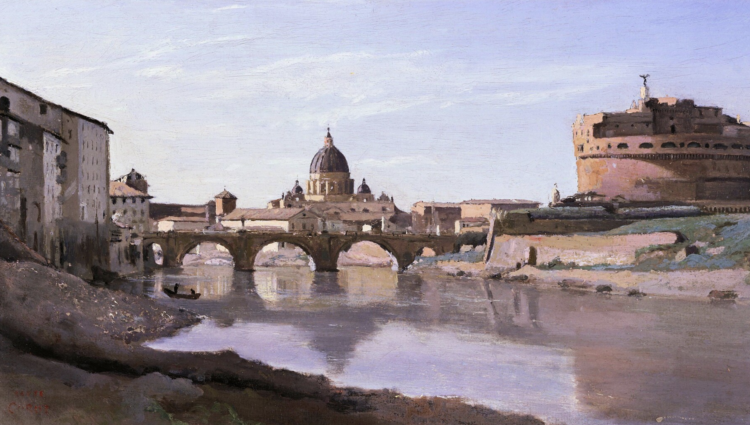
The featured image is “View of Rome – The Bridge and Castel Sant’Angelo with the Cupola of St. Peter’s” (from 1826 until 1827), by Jean-Baptiste Camille Corot and is in the public domain, courtesy of Wikimedia Commons.