Philip Kennicott, according to his bio, is “the Pulitzer Prize-winning culture critic of The Washington Post.” He joined the Post in 1999 as a music critic and later became the art and architecture critic. He eventually graduated to the title of culture critic, which I guess means he gets to offer his opinion on anything loosely connected to art.
But lately the only subject that seems to interest him is, you guessed it, President Trump. I think the easiest (and fairest) way to summarize what he does at the Post is just to present you with the headline for every single column he has written this year, starting in January.
- In ‘Spectrum of Desire,’ the Met takes a nuanced look at gender fluidity
- The abhorrent power of the photograph of a 5-year-old held by ICE
- The grave risk of Trump’s Kennedy Center shutdown
- An award-winning portrait asks Americans, ‘Who is human?’
- At a broken Kennedy Center, the National Symphony begins a new journey
- Chaos in Washington, layoffs in New York, and music everywhere
- On a new banner, Trump evokes the shadow world of authoritarian icons
- The message on Trump’s coin is clear. And it’s chilling.
- Trump is the biggest threat to D.C.’s architectural splendor since War of 1812
- The Met gave a dark opera a happy ending. What’s that say about America?
- The Trump presidential library would be a giant tower of grift
- Trump’s dark rhetoric eclipses the new wonders of the Space Age
- America fought to defeat fascism. This ‘triumphal arch’ reeks of it.
- Trump’s Christlike image is filled with sloppy symbolism
- Raphael, a master of serenity, is the artist we need right now
- Guerrilla art is flourishing in Trump’s Washington
If you lost count, that’s 16 articles and half of them mention Trump by name. Most of the other half also mention Trump in the text of the column. In fact, only two articles seem to avoid him, though the one about Raphael seems to imply Trump as the reason we need serenity now. The one about the Met’s “dark opera” avoids mentioning Trump but briefly mentions the politics of resistance.
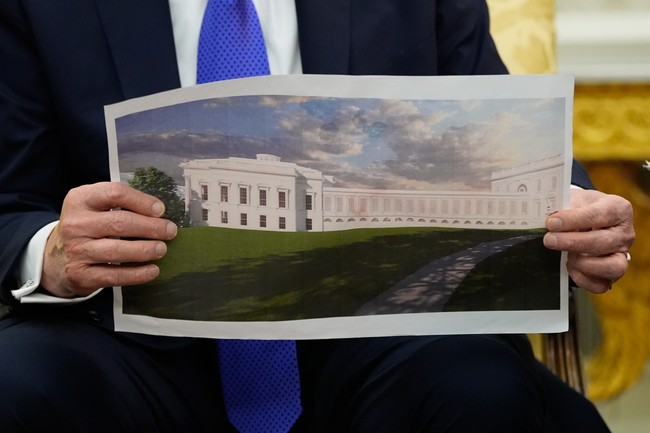
In any case, you get the idea. Kennicott seems more obsessed with Trump than with art and culture. That latter is just his particular club to beat the former with. And that brings us to his latest column about Trump’s planned ballroom which is chock-full of nonsense. Here’s how it opens.
Within the first few minutes of an impromptu news conference after Saturday’s attempted attack on the White House Correspondents’ Association dinner, President Donald Trump glided on wings of non sequitur from details of the averted disaster to his all-consuming favorite project, the giant ballroom he wants to build on the ruins of the White House East Wing.
“We need the ballroom,” he said, still dressed in his tuxedo. “That’s why Secret Service, that’s why the military are demanding it.”
How did Kennicott arrive at this topic for a column? I can tell you. In the hours after the attempted assassination, many on the left began claiming the whole thing was staged. One of the reasons they claimed this was because Trump had mentioned the need for the ballroom in his press conference. This led to progressive outrage.
Kennicott doesn’t embrace the conspiracy theory of his fellow leftists about the attack being staged, but he comes up with another one to take its place: Trump is making himself a king, one cut off from the commoners.
He has previously been unable to convince the American public that the White House needs an ornate entertainment venue that would dwarf the historic mansion. Now, he seeks to convince them that he can’t be safe without one.
This suggests that he plans to leave behind not just a radically transformed White House complex but a different conception of the presidency. The regal trappings Trump favors in design and architecture will now be mirrored by an essentially regal protocol for seeing the president. If the president can safely mingle with others only within a fortresslike ballroom on the White House grounds, then he will no longer be out among the people, no longer in touch with ordinary life. The presidential bubble will be bulletproof — and bombproof and droneproof — but it will also impede the free flow of information from the grass roots to the executive.
How often does Kennicott think the president is out “among the people?” And how exactly is the ballroom going to prevent the flow of information from the grass roots? What flow of information exists now that will be cut off by its construction? He doesn’t actually say.
Here’s a thought which doesn’t seem to occur to Kennicott. Presidents have been driving around in armored cars since 1942. Armored cars became standard for every president after the assassination of JFK. Has the armored car impeded the free flow of information from the grass roots to the executive? If so, what is the alternative. Should we ask the president to drive around in a stock Chevy Blazer to restore that information flow?
What about Air Force One? That impulse also goes back to FDR who had a specially built plane called the “Sacred Cow.” Should we ask Trump to fly coach to make sure he gets all the needed information from the grass roots?
Of course these are dumb ideas and most adults recognize that presidential security is a real concern, one that didn’t start with President Trump. The idea, which Kennicott seems to be pushing, that the ballroom will sever the final thread between the president and the common man is absurd, as is the idea that the Democratic presidents Kennicott voted for didn’t live in a “presidential bubble.” But he keeps going with this nonsense.
State dinners are meant to establish an intimacy and communion with foreign leaders that aren’t possible in larger, more ceremonial encounters. Their purpose is subverted when the guest list grows to convention-center proportions.
Does Kennicott know that communion with foreign leaders isn’t possible in a larger ballroom? No, of course not. Trump will always be seated with foreign leaders and will have plenty of time to socialize with them at the table. Nothing is subverted if another 300 people are allowed into the room for the proceedings. On the contrary, it puts Trump in contact with many more people who are not the very top echelon of the White House and some foreign country. It expands the number of people who can participate in these dinners to include many people who don’t have contact with the president on a regular basis already.
But, of course, the real function of this ballroom isn’t about governance or diplomacy. It’s about fundraising, about endless rubber-chicken dinners for cadres of donors seeking influence and business leaders hungry for government contracts. Both political parties are guilty of selling access to the president through legal and quasi-legal forms of pay-to-play. But it sets a terrible precedent to institutionalize this industrial-scale deformation of democracy through architecture, which ensures its perpetual presence in civic life.
What is obviously a fundraising space will become America’s version of the infamous Salon de l’Oeil-de-Boeuf, the antechamber to royal access at Versailles, where courtiers, sycophants and supplicants came to wait upon the kings of France.
Do you see what has happened here? Kennicott has been whining that Trump will be cut off from the grass roots and now he’s flipped and is whining that Trump will surround himself with tacky, unwashed business people. Is his concern about too few regular people near the president or too many? He can’t seem to make up his mind. The only constant is that anything Trump might do is bad. He even worked in a “No Kings” reference for his left-wing readers who might have attended a similarly named rally at some point.
Trump has suggested it also will be the site of future inaugurations. And thus inaugurations will evolve from an oath-taking at the People’s House on Capitol Hill — a ceremony enacted in front of the American public and witnessed by the world — to a spectacle tightly controlled and entirely choreographed by the executive branch, something more like a coronation.
It seems to have escaped Kennicott’s awareness that Trump’s 2025 inauguration was moved inside because of extremely cold weather.
President-elect Donald Trump’s inaugural address will be moved indoors due to expected freezing temperatures on Monday, he announced on social media.
The inauguration, which would typically take place on the West Front of the U.S. Capitol facing the National Mall, will instead be moved inside to the Capitol Rotunda. Monday’s events could be the coldest inauguration since 1985, when Ronald Reagan’s second inaugural was also moved indoors.
Since inaugurations always happen in January in Washington, DC, (for the past 100 years) cold weather is the norm and dangerously cold weather is always a possibility.
We also live in an era of live camera feeds which means that even indoor events can be seen by everyone with a TV or a phone, which is nearly everyone. Moving the event inside won’t turn it into a coronation any more than the State of the Union is a royal event. If you watched the last SOTU you already know there were plenty of surprises which were not choreographed in advance.
Kennicott is doing his best to sane-wash leftist talking points and feed them back to his left-wing readers. He leaves out anything that might undercut his anti-Trump message. Presumably the Post’s readership loves his brand of resistance journalism, but for anyone outside the left-wing bubble his act is wearing thin.
Editor’s Note: Do you enjoy HotAir’s conservative reporting that takes on the radical left and woke media? Support our work so that we can continue to bring you the truth.
Join HotAir VIP and use promo code FIGHT to receive 60% off your membership.