The Supreme Court struck down a provision of the Voting Rights Act requiring majority-minority House districts.
Image Credit: Sen. Marsha Blackburn / X
***Note from The Tennessee Conservative – this article posted here for informational purposes only. Per The Tennessee Lookout’s Republishing Guidelines, this article has been edited for writing style & length.***
By Adam Friedman [Tennessee Lookout -CC BY-NC-ND 4.0] –
The U.S. Supreme Court struck down a provision of the Voting Rights Act Wednesday, triggering a call from Tennessee’s senior U.S. Senator for the state to redraw its U.S. House map and eliminate its only Democrat-held district.
The Supreme Court ruled that states are no longer required to draw majority-minority districts, stating in a 6-3 decision by the conservative majority that using race to create these maps amounted to its own form of discrimination.
Tennessee, with a Black population of around 16%, was previously required by the Voting Rights Act to draw at least one of its nine congressional districts as majority-minority, effectively helping Democrats hold on to a Memphis-based seat.
“I don’t think anybody is shocked by the ruling,” said Tequila Johnson, the head of the Tennessee Equity Alliance, a Nashville-based organization promoting civic engagement among Black Tennesseans. “They are deliberately trying to dilute Black voting power.”
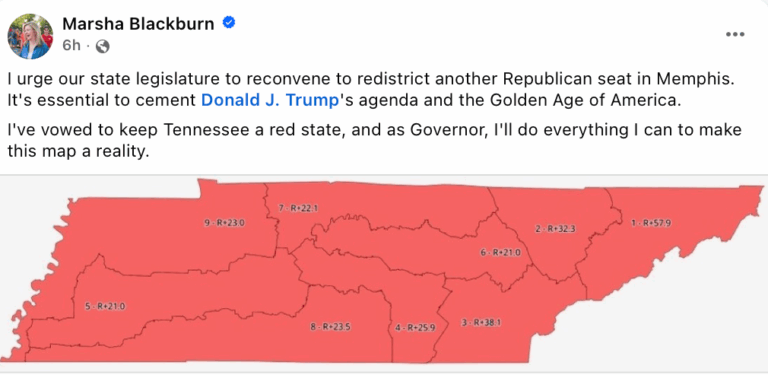
Tennessee Republican U.S Sen. Marsha Blackburn, who’s also running for governor in 2026, called on state lawmakers to hold a special session to draw new maps ahead of the 2026 midterm election.
She shared a photo on social media of a congressional map showing nine Republican districts, adding that she would do “everything I can to make this map a reality,” adding it was “essential” to cement President Donald Trump’s agenda and “the Golden Age of America.”
The Lookout reached out to Gov. Bill Lee, Lt. Gov. Randy McNally and state House Speaker Cameron Sexton to see if they favored a special session to redraw the maps.
Sexton said by email his office was “reviewing the recent opinion” and having “conversations with the White House and other individuals.”
McNally said the current maps are “strong, fair and legal,” and have already withstood court scrutiny.
“I will be talking with leadership in both the House and the Senate to discuss the feasibility of the question over the coming days,” McNally said by email.
Lee did not respond by the time of publication.
Tennessee has a long history of gerrymandering for party advantage by both Democrats and Republicans. But since the passage of the Voting Rights Act of 1965, courts over the years have required the state in its congressional and state legislature maps to maintain a certain number of majority-minority districts.
Another consequence of the Supreme Court ruling is that Republicans are likely no longer required to draw a court-mandated majority-minority state House district in rural West Tennessee. The seat currently held by retiring Democrat lawmaker Johnny Shaw has already been shifting toward Republicans and is considered in play for the GOP this year, according to a Lookout analysis.
State Sen. Raumesh Akbari, a Memphis Democrat, said in a statement the ruling made “it harder to challenge unfair maps and practices designed to dilute the voices of communities like ours.”
“It hands Republicans across the South the legal cover to redraw districts in ways that will cost Black and Latino Americans seats in Congress, seats in state legislatures and seats at every table where decisions about their lives are made,” she said.

Tennessee Republicans in 2022 were legally able to eliminate a Democrat-held seat in Nashville by splitting it across three congressional districts. This led Democrats to lose the 5th district seat, which the party had held since the end of the 1870s Reconstruction era. The seat is now held by Columbia Republican U.S. Rep. Andy Ogles.
Republicans currently hold an 8-1 advantage in congressional seats over Democrats. Tennessee is a Republican stronghold that Trump won with around 64% of the vote in 2024. But if party representation were equally distributed without gerrymandering, Democrats would likely hold two or three of the state’s U.S. House seats.
The Republican advantage is even stronger in the state legislature. Republicans control 75% of the state House seats and 81% of the state Senate.
State Sen. Charlane Oliver, a Nashville Democrat, said the Supreme Court ruling would be “devastating” if it led to a redrawing of the Memphis congressional seat.
“When we saw this happen in Nashville, it led to constituents having less access to their congressional representative,” Oliver said. “None of Nashville’s three Republican representatives has an office in Nashville.”
How fast could these maps change?
Lawmakers would need to move fast to change the maps before the 2026 midterm elections, as Tennessee’s Congressional primaries will be held in under four months on Aug. 6. The qualifying deadline to run in those elections has already passed, and campaigns are already in full swing, a concern expressed by McNally.
“With the filing deadline passed and qualified candidates already running for election, redistricting congressional seats at this time would present several logistical challenges,” McNally said.
U.S. Rep. Steve Cohen, the current Democrat representative for District 9 in Memphis, faces a primary challenge from Memphis state Rep. Justin Pearson. Cohen has held the district for almost 20 years. But Pearson, who rose to national prominence after being temporarily expelled from the state House in 2023 over a protest for gun control, is Cohen’s toughest challenger in recent memory.
Democrats are also hoping to challenge Ogles in his District 5 seat. The nonpartisan Cook Political Report rates Tennessee District 5 as a likely Republican, favoring the party by eight percentage points.
Republicans are also holding a competitive primary in Tennessee District 6, where state Rep. Johnny Garrett and former U.S. Rep. Van Hilleary are vying to replace U.S. Rep. John Rose, who’s running for governor.
Across the country, Republicans and Democrats have been locked in a mid-cycle redistricting back-and-forth. Traditional redistricting has occurred every 10 years after the U.S. Census, but Texas redrew its map in 2025, hoping to help Republicans win five additional House seats.
This has prompted Democrat-run states like California and Virginia to redraw maps to potentially net the party more House seats.