IN A 1982 letter to Michael Foot, Tony Blair wrote: ‘Reading Marx irreversibly altered my perception of society.’
Karl Marx has enjoyed a glorious reputation among many of the world’s most powerful and influential statesmen of modern times.
Jawaharlal Nehru, first Prime Minister of India, was lavish in his praise: ‘Marx was a great scientist and thinker . . . one of the most remarkable figures of the 19th century.’
Harold Wilson enthused: ‘Marx’s writings remain a powerful influence on the thinking of our time.’
The sainted rabble-rouser Nelson Mandela enthused: ‘Marx’s great insight was to see the link between political and economic freedom.’
Tony Benn (of course): ‘Marx was right about the power of capital and the struggle for democracy.’
The even more sainted and rabble-rousing Martin Luther King: ‘Marx had a passion for justice and a concern for the poor that was unmatched.’
Xi Jinping President of China, regularly phoned by Peter Mandelson: ‘Marx is the greatest thinker of modern times.’
Fidel Castro, dictator and impoverisher-in-chief of Cuba: ‘Marx showed us the path to liberation.’
Max Horkheimer, darling of today’s woke critical theorists and the chattering classes: ‘The revolution won’t happen with guns. We will gradually infiltrate their educational institutions and their political offices.’
(Job done, Max, eh!)
Chairman Mao Zedong: ‘Karl Marx, the greatest man who ever lived.’
Vladimir Lenin: ‘No Marxist can deny that the interests of Socialism are higher than the interests of the right of nations to self‑determination.’
I suppose it’s only to be expected that Marxist politicos will be Marxist politicos. The wonder is that there were and are so many of them. But the Marxist disease is more widespread and dominates the lives of those who take little formal interest in politics. Popular ‘culture’ is infested by it. Grind – representative of a ‘music’ genre featuring hip‑hop – is all about what in its skewed view it sees as class oppression, labour exploitation, systemic violence, police brutality, economic despair and nihilism. Such noisy trash is described as ‘combative and rooted in the lived experience of a society spinning out of control’. Then there are the blatantly ideological songs such as ‘Embrace capitalism until it strangles you’ by Abraxas which hideously parodies capitalism and calls for the revolution.
Contemporary visual art – massively and exclusively financed by the Arts Council – hates the traditional way of life of the country from which it derives its entire subsidy. Talk about biting the hand that feeds you! Actually, the millionaire pop stars, luvvies and ‘influencers’ despise ordinary working-class people and instead take refuge in Marxist jargon and constantly harp on about ‘the commodification of human life, exploitation of the workers, wealth inequality and corporate power’.
They eulogise – forgive me, I’m running out of my allotment of inverted commas – but I should mention also ‘the aesthetics of resistance, deconstruction of consumer imagery, repurposed industrial materials, documentary‑style depictions of working‑class life and anti‑spectacle approaches that reject capitalist polish’.
Ah, that’s better – I’ve just found another box of speech marks I didn’t know I had! These parasitical pop-millionaires claim to ‘speak truth to power, expose the violence of class hierarchy, reveal the hidden forced labour behind commodities and challenge the ideology of consumer culture’. And that’s all before they get round to smoking another joint and slagging off the memory of Margaret Thatcher.
The Western world has been in thrall to Marxism for more than a century. This does not mean that everyone is a Marxist or even interested in politics at all. The best comparison is with the Christian faith which dominated Western society for the best part of 2,000 years. Not everyone was a paid-up, active, confessing Christian but the general atmosphere, the climate, the outlook – Germans call it the Blik – the underlying, unspoken, taken-for grated assumption was institutional Christianity. In a word, Christendom. Similarly, since the Bolshevik revolution of 1917, the West has been dominated by the dogma of materialism, specifically the dialectical materialism of Karl Marx.
Our whole society is formed by and founded upon Marxist assumptions – to the extent that this fact goes completely without our being aware of it. It is nonsensical of course: to take just one example, the word ‘privilege’. The beloved proletariat are described as ‘under-privileged’. The despised middle classes are ‘over-privileged’. As if there were just the right amount of privilege. This makes the word meaningless.
The mass media generally – and the BBC endemically – is saturated in Marxist assumptions. There is the smarmy piece of self-promotion – you must have heard it? – in which people with faux regional working-class voices come on the wireless and drool sickeningly over ‘our BBC’.
We are governed – tyrannised – by the Marxist philosophy and our subservience to it is all the more deadly because it goes unnoticed. So it’s way beyond the time when we ought to have a close look at Karl Marx and refresh our memories about just what manner of monster he was.
Marx, breathing class envy, said: ‘Capitalists are parasites on the working class. All property is theft.’
But this self-styled class warrior discovered that, in order to be a seriously successful Communist, one needs a good start in life, and in this he was most fortunate. His father owned many fine vineyards in the Moselle and his mother came from a wealthy family of factory-owners who would eventually found the Philips Electronics Company. So he was paid to attend Bonn and Berlin universities and turn his mind to planning the Communist Revolution. It was unkind of the authorities to disapprove of his political programme, and he was obliged to flee to London, where he penned, after much beseeching from his sycophants, an autobiographical outline.
Here he noted that a true prophet of Communism such as he was requires not merely a sound financial foundation on which to build his programme, but further considerable provision to sustain his aims to abolish all privilege and create the conditions for the flourishing of the working class and the eventual dictatorship of the proletariat. So once again he thanked God (except there is no God) for his uncle Ben Philips, the wealthy capitalist, who bankrolled him while he was dedicating himself to revolutionary Socialism in Soho.
He knew too that it was important for him, as the aspiring leader of the workers of the world, to marry into the aristocracy. Again, he was well looked after, for he became engaged to Baroness Jenny von Westphalen who subsequently became his wife. They had children, two daughters nicknamed Qui-Qui, Emperor of China and Kakadou the Hottentot. And he instructed his children to address him as Old Nick. But then, you see, one begins to worry about what will become of one’s children when one is gone. How reassuring then when Friedrich Engels, his lifelong friend and co-author of The Communist Manifesto, promised to leave them a substantial portion of his £4.8million estate – worth more than a billion pounds today. As Marx always said, you can’t beat class solidarity! Friedrich lived in Manchester and Liverpool for some years and wrote his Conditions of the Working Class in England in 1844. He repeated Karl’s slogan: Property is Theft.
Marx prophesied that Russia’s rural commune – all its pernicious influences soon to be eliminated – would form the basis of his Communist utopia. And, because he was a true visionary, he could even see that in the 20th century a man would arise in Russia who would exceed anyone in history in the elimination of . . . well, the elimination of nearly everybody, actually. For Marx in his utopian vision did not foresee the reign of the dictator Stalin who instituted torture, a police state, the gulag and slaughtered up to thirty million of his own people.
As his bestowing those nicknames on his girls demonstrates, Marx was no humourless academic philosopher. And when old he recalled with affection his trip to Bonn with his friend Bauer and how they were pissed for days on end, got thrown out of a church for laughing at the Lutheran pastor and ended up charging through the narrow streets on donkeys.
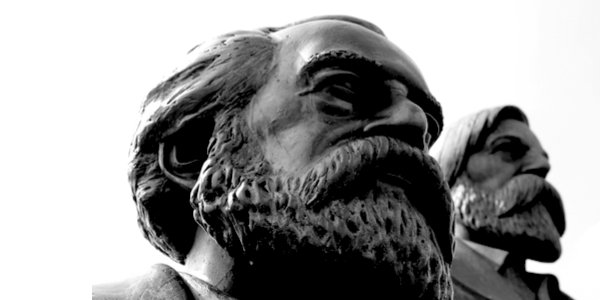
It remained only for him to ensure himself the biggest memorial in Highgate cemetery: a fitting monument to modernity’s most calamitous hypocrite.