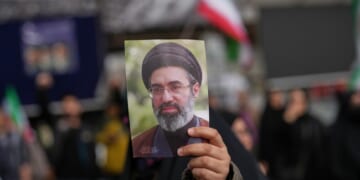
IN late 1978, I remember sitting on the immigration desk at Dover and marvelling at the thousands of Iranians going to France for weekends and returning with fervour in their eyes and looking as if they had glimpsed the Promised Land. I eventually learned that the reason was to be close to their spiritual leader, Ayatollah Khomeini, who had been given refuge by the French in 1978 after Saddam Hussein had had enough of him. Few saw Khomeini, but they would listen to tape recordings of him berating the Shah.
In those pre-E-Gate days, every passport and face was scrutinised by an immigration officer. To the trained and experienced eye, the face became an open book. The fervour and passion of the people I saw returning from something akin to a pilgrimage was written plainly there.
I don’t recall women with covered faces at the time; but then again, we insisted on seeing a passenger’s face, to check against the passport photograph. In fact, most of those travelling – men and women – were in Western attire.
Tim Sigsworth’s report in the Daily Telegraph about up to 100,000 Ayatollah Khomeini type devotees descending on the tiny Barham, Suffolk, community of little more than 1,500 for an event organised by an ‘ultra conservative’ Dewsbury mosque in July, immediately brought back memories of 1978 – the fervent eyes and excited faces. If I were one of the residents of Barham, I too would be alarmed and against the ijtema, as it is known, taking place.
On the other hand, are such events not inevitable, as the size of nationalities and ethnic groups, often with a common religion, grow? The ethnic minority proportion of the population, including the Muslims, has been growing rapidly for over 20 years. The scale and speed of immigration have been unprecedented, with hundreds of thousands added to our population each year. In the year to mid-2024, our population grew by 755,000, 98 per cent of which was due to immigration, and every local authority in England except one saw an increase. It is simply impossible to integrate such massive numbers of people.
Meanwhile our towns and cities are in general becoming more diverse, with more people of different origins living near each other, though some communities, especially Pakistani, have become very uniform. For example, in Bradford, Toller Ward is 75 per cent Pakistani, Bradford Moor 66 per cent and Manningham 63 per cent; very few residents are native British (13 per cent), down from 25 per cent in 2001. These are little more than parallel societies.
In some towns and cities, the proportion of residents who are what the ONS describes as ‘White British’ – that is English, Scottish, Welsh, and Irish – has declined markedly. When striving to integrate new arrivals into Britain, into what, exactly, are we seeking to integrate them?
In London, the overall ethnic minority population is approaching 50 per cent; indeed, in many boroughs it is already between two-thirds and three-quarters. This is a pattern across many of our other cities: Birmingham and Manchester are firmly minority white British cities. Overall, as Professor David Coleman noted in 2010, and Matt Goodwin has written more recently, the majority population will become the minority by the mid-2060s.
Britain’s Muslim population more than doubled in two decades. According to the 2001 census for England and Wales it was 1,600,000; by 2021, it was 3,900,000. It is now more than 4,000,000. And the growth is often highly concentrated. Tower Hamlets is 40 per cent Muslim; Blackburn with Darwen 35 per cent; Birmingham 30 per cent; Bradford approaching a third. In these areas, parallel societies have taken root, with an estimated 85 sharia councils operating across England and Wales.
Reasserting control over migration is not merely about numbers; it is about factoring in the cultural differences between the native population and the minority communities that migration is growing. And, as population growth is nearly entirely due to migration, we need to be asking questions about whether the native culture will be able to persist with such high levels of migration. More than anything, we must stop sowing the seeds of tension and division.
This article first appeared in GB News on April 29, 2026, and is republished by kind permission of the author.