To paraphrase one of the wisest axioms of all time: ‘Tis better to keep one’s pen capped and be thought a fool, than to apply it to paper and remove all doubt.
Clearly, Ketanji Brown Jackson has never learned that lesson. And it seems very doubtful that she has lacked the opportunities to do so from experience.
Yesterday, the Supreme Court accelerated the process of finalizing its decision in Louisiana v Callais, the 6-3 ruling that all but negates the use of the Voting Rights Act to create minority-set-aside congressional districts. The court approved a request from Louisiana to allow immediate effect for the ruling, giving more time to replace the map the court ruled unconstitutional so that elections can be held with a proper redistricting map. “Time … is of the essence,” the plaintiffs wrote, especially due to the need to return to the district court to establish the new map.
Eight of the justices agreed with the request, tacitly at least. Only one justice objected to waiving the normal procedural time to allow Louisiana to hold an election. Guess who?
On Monday, the high court granted that request, writing that the court’s typical 32-day wait period is “subject to adjustment” by the justices.
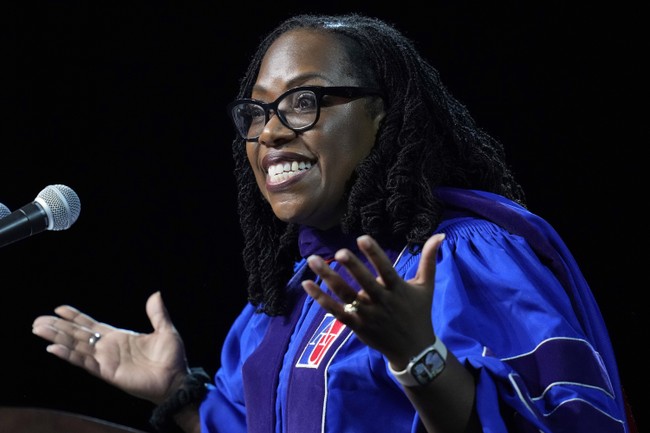
Justice Ketanji Brown Jackson, one of the court’s three liberals, assailed Monday’s decision, calling it “unwarranted and unwise” and suggesting the court had effectively greenlit Louisiana’s attempts to call off its primaries and push through a new map. She pointed to still-ongoing legal battles over the suspended primaries, part of the “chaos” wrought by the Callais ruling.
Jackson said the court should “stay on the sidelines” to “avoid the appearance of partiality,” citing the court’s traditional reluctance to make changes right before an election.
“And just like that, those principles give way to power,” she wrote.
And just like that … the SCOTUS justices went to war. Before we get to the response, however, one has to take note that Jackson’s dissent was included solo. Neither Elena Kagan nor Sonia Sotomayor joined her attack despite the three liberal justices’ joint dissent on Callais. The order itself waiving the 32-day administrative period would have been per curiam had Jackson not written a dissent, and the silence of Kagan and Sotomayor in this process speaks volumes about KBJ’s extreme and uninformed views on the matter.
Justice Samuel Alito’s response has more company. Justices Clarence Thomas and Neil Gorsuch joined Alito in taking Jackson to the woodshed for her grandstanding, and strongly hinted that Jackson was the reason that the waiver was necessary at all. That bomb gets dropped in a footnote:
The dissent in this suit levels charges that cannot go unanswered. The dissent would require that the 2026 congressional elections in Louisiana be held under a map that has been held to be unconstitutional.*
*That constitutional question was argued and conferenced nearly seven months ago.
In other words, someone stalled the dissent process for months in the hope that the ruling would not impact the midterm cycle. It might be more than one someones, of course, but the context of this ferocious response stronly implies that Jackson was primarily responsible for the delay. That makes Jackson’s accusation that principles gave way to power look like a fatal case of projection.
Nor were the three justices done. They pointed out that Jackson never argued in the dissent that Louisiana could hold an election using an unconstitutional map or that it was too late to create a proper map for this election cycle. Jackson offered two points in her dissent, one of which Alito called “trivial at best,” and the other “baseless and insulting.”
Alito then demolished both in three paragraphs, with a fourth for a rhetorical coup de grace:
The first is compliance with the 32-day default rule set out in this Court’s Rule 45.3, but as the Court’s order explains, there is good reason to depart from the default rule here. The principal reason for the 32-day default rule is to give a losing party time to prepare a petition for rehearing. But here, the Robinson appellees have not expressed an intent to file such a petition, much less set out any ground on which a petition might be based. And the need for prompt action by this Court is clear. The date scheduled for the beginning of early voting in the primary election has already passed. The congressional districting map enacted by the legislature has been held to be unconstitutional, and the general election will be held in just six months.
The second reason offered by the dissent is that we should allow the 32-day period to run out in order to “avoid the appearance of partiality.” Post, at 3 (opinion of JACKSON, J.). But the dissent does not explain why its insistence on unthinking compliance with Rule 45.3’s default rule does not create the appearance of partiality (by running out the clock) on behalf of those who may find it politically advantageous to have the election occur under the unconstitutional map.
The dissent goes on to claim that our decision represents an unprincipled use of power. See post, at 4 (“And just like that, those principles give way to power”). That is a groundless and utterly irresponsible charge. What principle has the Court violated? The principle that Rule 45.3’s 32-day default period should never be shortened even when there is good reason to do so? The principle that we should never take any action that might unjustifiably be criticized as partisan?
The dissent accuses the Court of “unshackl[ing]” itself from “constraints.” Post, at 4. It is the dissent’s rhetoric that lacks restraint.
So … Jackson’s “principle” is that the people of Louisiana should be denied a valid congressional election because a 32-day bureaucratic process at the Supreme Court takes precedence over their representation in Congress? Is that the “principle” under which Jackson operates?
One thing’s for sure: KBJ’s attempt to politicize a bureaucratic waiver to allow for a clean election was so embarrassing that even her nominal allies on the court refused to side with her. And not for the first time, either. Kagan and Sotomayor stood by while Alito, Thomas, and Gorsuch stripped whatever façade of intellectual heft Jackson still had completely away, exposing her as a political activist in judicial robes rather than a serious jurist.
Jackson’s tenure on the court is shaping up to be a mighty lonely one. Maybe she should consider the wisdom of keeping her mouth shut rather than opening it and exposing her shortcomings, at least for a while.
Editor’s Note: Unelected federal judges are hijacking President Trump’s agenda and insulting the will of the people.
Help us expose out-of-control judges dead set on halting President Trump’s mandate for change. Join HotAir VIP and use promo code FIGHT to receive 60% off your membership.