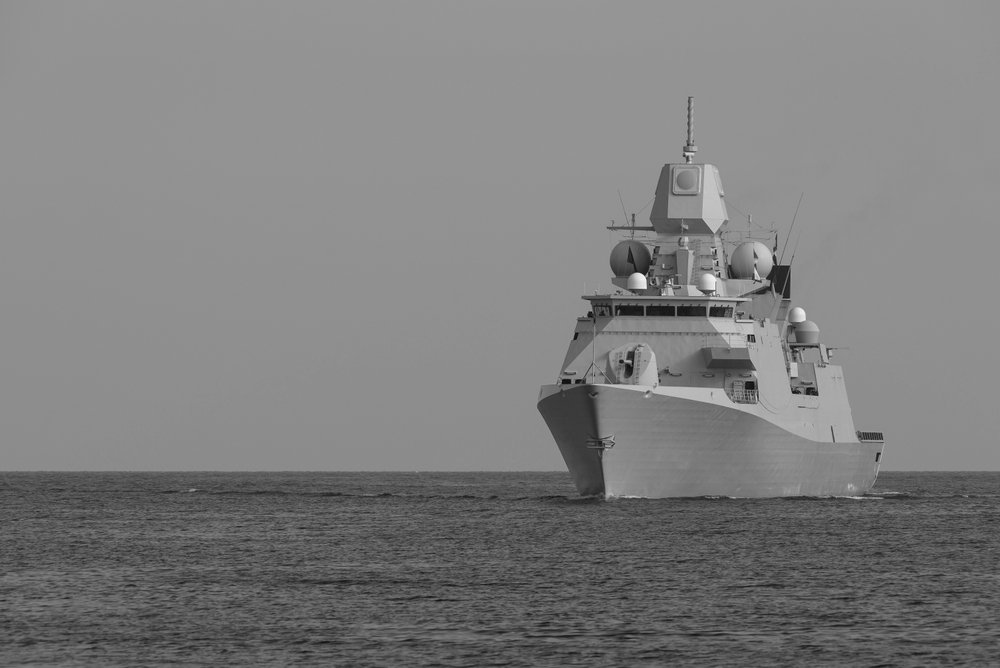
THE Potemkin village of our armed forces is collapsing. The latest manifestation is the decommissioning of HMS Iron Duke less than three years after a £103million five-year refit, reported by the reliable and well-informed Navy Lookout, which leaves the UK with just five operational frigates. The first of the class, HMS Norfolk, was commissioned (i.e. came into service) in 1989, and there were 13 in the class. Now just five warships are left to cover a role that originally needed 13. Extended well beyond their design life, these are the ships that conduct undersea warfare. Protecting the nuclear deterrent and our cable infrastructure requires two frigates, as does protecting the carrier battlegroup. With HMS Kent in docks for refit, even without breakdowns (and old warships break frequently), there is nothing to spare for tasks in the Mediterranean or Gulf.
Of the six Type 45 destroyers, two are undergoing an upgrade, two are in maintenance, HMS Dragon is defending Cyprus (when not repairing her freshwater systems) and the other, HMS Duncan, is in work-up following maintenance. That’s all we have; the Prime Minister may want to put together a European operation to assist the United States in clearing the Strait of Hormuz, but he hasn’t got the warships. All our mine hunters are in the UK at the moment as the Navy transitions to integrated ship and drone mine hunting. Starmer might not be prime minister for much longer, but that won’t solve the lack of warships.
Achieving this level of rundown without a public outcry is an astonishing PR achievement. No doubt some PR type or behavioural economist will research quite how the Navy withstood parliamentary and public scrutiny. For what it’s worth, my theory is that no one wants bad news – especially if it’s expensive – so everyone wanted to be lied to. (See also pension Ponzi schemes, the deficit and Net Zero).
The root of the Navy’s problem was the abject failure of any government to order replacement frigates in time; not one was commissioned between 1996 and 2017 – a dereliction of duty by multiple First Sea Lords and Ministers of Defence (of all political flavours). Frigates are now on order; indeed, the first two (of eight) Type 26 (HMS Glasgow and HMS Cardiff) have been launched and are fitting out, a process that takes years. Three more are in construction and two more on order. Two Type 31 Frigates (HMS Venturer and HMS Active) are also in the water fitting out, with two more under construction. That will give the Royal Navy a total of 13 frigates by the end of the 2030s. It probably needs more and it definitely needs them more quickly.
That’s a challenge, as dockyard space is at a premium. Expanding dockyard capacity is expensive and risky but is probably necessary if the nation is to rearm. Of course, there is no money. Rachel Reeves wasn’t planning on rearmament, so the Defence Investment Plan is parked in the Treasury pending some fundraising miracle, balancing of the budget or decision on what to cut – which was never going to happen before the May elections.
In the interim, various parts of the MoD are lobbying for more money and blithely continuing as before, which (helpfully for senior officers and top civil servants) glosses over the reality that they are part of the problem. Thus we saw the stealthy emergence of Ajax 2 as the alleged solution to all the Ajax problems. (It isn’t, but few in the MoD care, as I wrote here.) Note that the £6billion cost of the failing Ajax programme would cover the cost of a dozen Type 31 frigates or six Type 26s. (The Type 31 doesn’t have the super-expensive anti-submarine warfare capability of the Type 26).
On top of that, some people and organisations are creating problems that don’t exist, presumably in the hopes of lucrative contracts. One of the most egregious is the concern that the United Kingdom lacks an anti-ballistic missile (ABM) system. We’ve never had one. We’ve never needed one. ABM systems are hugely expensive. Why would we buy or develop one?
Ballistic missiles move very quickly, and the more sophisticated designs manoeuvre as well. Shooting them down is difficult; very difficult. Israel is one of the few nations that does have an operational ABM, David’s Sling, developed with America. It’s designed to destroy incoming missiles from Iran and the Houthis in Yemen, which it does. However, the missiles being fired at Israel are relatively crude inasmuch as they are slow (if you can call travelling at more than five times the speed of sound slow), lack multiple warheads and don’t manoeuvre. That gives David’s Sling time to compute the missile trajectory and dispatch an Arrow missile (or two) to intercept it.
The Arrow missiles kill incoming warheads and missiles by hitting them, and they can do that even when the missiles are outside of the earth’s atmosphere. David’s Sling and the Arrow missile have protected Israel from ballistic missiles hitting its population centres. (It may let missiles that are off track through, saving expensive Arrow missiles for the incoming warheads that are on target.)
Clearly David’s Sling is brilliant. Finland has bought it and other countries are interested. Germany has purchased the Arrow 3 missile from the system, now installed, and is pressing to put that at the centre of the European Sky Shield Initiative, of which 15 countries (including the United Kingdom but not France) are part. The ESSI continues the Obama-era Nato missile defence system, which petered out.
Then there is the existing American THAAD (Terminal High Altitude Area Defense) system, which has been in action in the current Iran confrontation. THAAD is deployed by Saudi Arabia and the UAE. THAAD is mobile, so there may well be additional American THAAD batteries in the Gulf area and Israel at the moment. Like David’s Sling, THAAD is designed to defeat intermediate-range ballistic missiles (IRBM), not intercontinental ones (ICBM), as ICBMs are significantly harder to intercept. They’re faster and most now have multiple warheads capable of manoeuvring independently, so one missile becomes (say) ten targets, some of which might be dummies.
Fortunately for us, interception is not necessary in the world of Mutually Assured Destruction (MAD) and the nuclear deterrent. The UK has a significant nuclear arsenal and maintains it at sea 24 hours a day every day of the year (as it has done for decades). We have the capacity to deliver complete destruction to any power foolish enough to strike us with any nuclear weapon, including those launched by ICBM. As no rational actor would take such a step, we don’t need ABMs.
There are flaws in that theory. A rational actor might not believe that the UK’s Prime Minister would order a retaliatory strike. Today they might have a point; Starmer’s record of decision avoidance is lamentable. However, he’s also ruthlessly vindictive – ask Olly Robbins – so nuclear retaliation is not unthinkable in the way that it would have been had Michael Foot ever become prime minister.
Secondly, the possessor of nuclear-tipped ICBMs might not be rational. The threat of Iran’s mullahs possessing ICBMs (which they are developing and their ally, North Korea, already has) plus nuclear warheads (which they are – or were – also developing) suddenly threatens the entire MAD-based deterrence posture. Do they hate us that much? Do they think we won’t retaliate? Do they care if we do?
In such circumstances an anti-ICBM capability might be justifiable. Some already exist. The Russians have the Gazelle, which protects only Moscow. The United States has the snappily named Ground Based Mid-Course Defence, which protects against North Korea. The American RIM-161 Standard Missile 3 (carried on the US Navy’s Arleigh Burke destroyers) has destroyed ICBM targets, although it needs radar support from other systems. The UK’s Sea Viper (on Type 45 destroyers) might get close. The Chinese probably have something; the Indians are rumoured to be developing one too.
But what is the threat? Iran’s nuclear missile aspirations have taken a pummelling and the North Koreans seem rational. Fat Boy Kim is probably also constrained by neighbouring China, as the fallout from a retaliatory strike on Pyongyang might drift their way. The United States, Russia, China, India, Pakistan and Israel are unlikely to launch at us. Nor is France. MAD continues to work; throwing vast sums (that we do not have) at hugely complex and expensive anti-ballistic missile systems makes no sense, even if they can be made to work perfectly.
The list of British military deficiencies is long, depressing and expensive. Even if money were available, there is no quick fix. If the perceived threat is Russia, a country well versed in the logic of MAD, our nuclear deterrent is enough. Spending money on conventional weaponry has a greater deterrent effect, as the Cold War showed. (If a state can’t win a conventional war, its choice is Armageddon or peace).
This is where Starmer is so wrong when he courts electoral gain and proclaims the Iran war is ‘not our war’. Beyond the Iranian attacks on British sovereign territory, Israel and the United States are shedding blood and expending treasure to eliminate the emerging long-range nuclear threat from Iran. If the mullahs are not rational or have a different logic, that emerging and now (hopefully) snuffed-out threat was a threat to the UK. Our depleted armed forces couldn’t have done much to help, but Starmer’s grandstanding offended key allies whose expertise we may need as we rearm.
Rebuilding our armed forces will take time, huge sums and, above all, a focus on spending wisely, which, as the Ajax programme continues to show, is a rarity. Like France, we have a nuclear deterrent. Like France, we don’t need ESSI. We don’t need ABMs.
We desperately need frigates.
This article appeared in Views From My Cab on May 6, 2026, and is republished by kind permission.