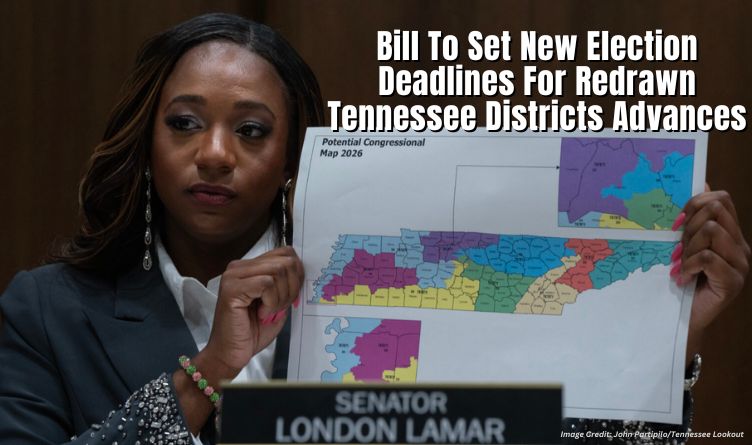
Image: Sen. London Lamar, a Memphis Democrat, discussing new GOP-drawn congressional maps that split the current Memphis district into three new ones during Wednesdays Senate Judiciary Committee. Image Credit: John Partipilo/Tennessee Lookout
***Note from The Tennessee Conservative – this article posted here for informational purposes only. Per The Tennessee Lookout’s Republishing Guidelines, this article has been edited for writing style & length.***
By: Cassandra Stephenson [Tennessee Lookout-CC BY-NC-ND 4.0] –
A bill to restructure rules for Tennessee’s 2026 U.S. congressional house elections advanced in key committees Wednesday, amidst Democrat cries of endangered election integrity and confusion for voters.
Should the Tennessee General Assembly pass new district maps before Friday, candidates for U.S. congressional house seats would have until May 15 — one week — to qualify for new districts or bow out of the race, according to the bill.
Political parties would have until May 17 to decide whether candidates are qualified to run as a bona fide member of the party, and there would be no process for candidates to appeal that decision.
Candidates who have already qualified under the usual March 10 deadline would not need to re-qualify if they wish to run in the same numbered district, even if that district’s lines have been redrawn.
Gov. Bill Lee called a special legislative session at the urging of President Donald Trump after a recent U.S. Supreme Court decision amended part of the federal Voting Rights Act.
Tennessee’s Republican supermajority now aims to create a map with nine Republican-leaning districts, eliminating a historically Democrat-held U.S. House seat in Memphis.
The proposed map, released Wednesday morning, would split Memphis into three districts. Two of those districts stretch from Memphis, in the state’s southwest corner, to Williamson County, a wealthy Republican stronghold in Middle Tennessee.
The 2026 U.S. House seat primary election falls on Aug. 6, with the general election on Nov. 3.
While typical election rules require district and precinct boundary changes to be published in newspapers and voters to be notified by mail, this bill appears to allow county election commissions to meet notice requirements solely by posting any changes to the commission’s website, if they have one.
The bill would also give counties an avenue to request reimbursement from the state for extra costs caused by the changes.
Sen. Adam Lowe, a Calhoun Republican, said the newly amended bill “is really about the process of qualifying for the office and adjusting the information that’s available to the public prior to August 6.”
It will only go into effect if district lines are redrawn, and will apply solely to the 2026 U.S. House seat election, he said.
Sen. Jeff Yarbro, a Nashville Democrat, pointed to an April 2022 Tennessee Supreme Court decision that blocked the injunction of a Senate redistricting plan ahead of the 2022 U.S. House seat election, concluding that an injunction would “detrimentally” impact election officials by extending the candidate filing deadline, “as well as the public interest in ensuring orderly elections and avoiding voter confusion.”
A lower court had previously agreed with voters who sued to stop the Senate redistricting plan, which they said split Davidson County into three non-consecutively numbered seats in violation of the state constitution. The election ultimately happened under the newly drawn map, but not without consequence: More than 200 voters in the newly split Davidson County were given incorrect ballots during the early voting period that November, spurring a lawsuit.
“It’s not accurate to say that we’re not going into the guts of the election process in a time that the election administrators, the state office, the counties and the (state) Supreme Court have said is dangerous (and) will undermine the election integrity and cause voter confusion,” Yarbro said.
“I appreciate my colleague from Davidson bringing up past situations with the court, all the more reason why this bill is here,” Lowe replied.

Concerns flare over voter confusion
The compressed timeline and reduced public notice requirements incited concern from Natalie Tennant, former West Virginia Secretary of State and current Kanawha County, West Virginia Commissioner.
Voters need and deserve consistency, transparency and accessibility in elections, Tennant testified in the Senate State and Local Government Committee Wednesday.
“I’ve often said that voter confusion is voter suppression,” she said.
Tennessee Elections Coordinator Mark Goins did not attend the meeting.
Goins acknowledged in a letter to county election commissions on May 4 that drawing new districts may require counties to rebuild election templates, reprogram election management systems, update voter registration systems, address new county and precinct splits between districts and retrain poll officials.
If commissions decide to make precinct changes, that could result in voters having different polling places than they’re used to. While precincts may legally contain more than one congressional district, some commissions may choose to adjust precinct boundaries to simplify administration.
“You are scrapping (the March 10 qualification deadline) and saying we’re going to make it May (15), and forget all the work (that must be redone),” Tennant said, adding that this would be a disrespect to election administrators and voters.
The memo “does not identify a significant operational impact” and “is neutral in nature,” Kylie Walker, deputy communications director for the Secretary of State’s Office wrote in an email to the Lookout. The memo was intended to respond to questions from elected officials after Lee called for the special session.
Sekou Franklin, an MTSU political science professor, told a Senate panel Wednesday that major alterations can’t be made at this point in the election cycle because of the potential for “voter confusion” and “chaos” due to the need for changes in absentee ballots for military personnel and other logistical problems.
Another speaker cited Purcell v. Gonzalez, a 2006 case in which the U.S. Supreme Court opined that election rules should not be changed too close to an election to avoid causing confusion.
Tennessee Coalition for Open Government Executive Director Deborah Fisher said as she understands it, this bill negates a requirement to notify voters by mail of changes in their polling place or district, instead allowing changes to be posted solely online. Fisher said she has contacted the Secretary of State’s office for clarity, but has yet to receive a response.
“I think that if you’re going to make a change in the districts midstream, and there is a voter whose polling place changes, that … they need to do more, not less, to let that person know,” Fisher said.
“This bill sticks to those points: resources available, educating voters, educating candidates on the process to accommodate it, should the other (redistricting) bill pass,” Lowe said, noting that Tennessee has dealt with split precincts before, and the bill itself does not require election commissions to split precincts.
The Senate State and Local Government Committee recommended the passage of the amended bill, 7-2, with Yarbro and Sen. Charlane Oliver voting against. The House Congressional Redistricting Committee recommended passage 15-5, after Knoxville Republican Rep. Jason Zachary called the question to cut off debate.
*Sam Stockard contributed reporting.