FOR years, we have been fed a never-ending diet of apocalyptic climate scares – killer heatwaves, biblical floods, deadly droughts, devastating hurricanes, to name just a few.
And it is not just sensationalism from the media that I am talking about. The language may have been slightly less dramatic, but official bodies from the UN down have been equally guilty, including our own Met Office.
All these scare stories have one thing in common – they are based on emissions scenarios which have long been regarded by independent experts as implausibly high. The scenario in question is known as RCP8.5.
RCPs are a set of greenhouse gas concentration trajectories (not emissions scenarios per se) used by the IPCC for climate modelling and projections. They describe different possible future paths for atmospheric greenhouse gas concentrations and the resulting radiative forcing (the change in energy balance in the Earth’s atmosphere, measured in watts per square meter or W/m²) by the year 2100.
RCP8.5 is the highest, being based on continued, strong growth of greenhouse gas (GHG) emissions:
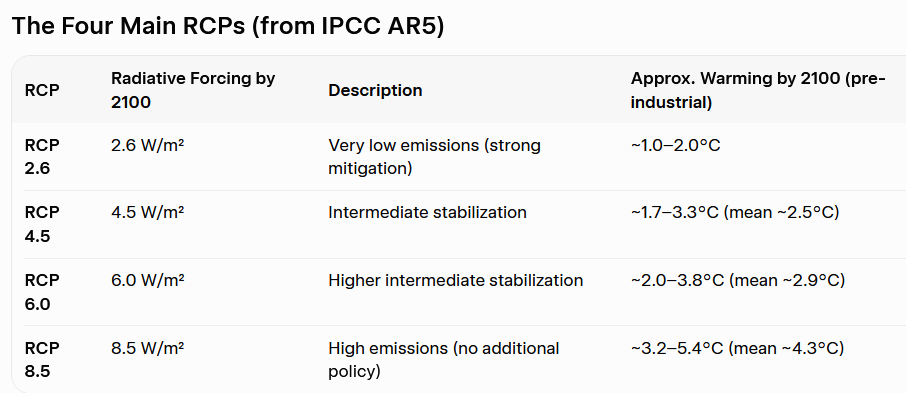
It was described by one of the Intergovernmental Panel on Climate Change’s co-chairs in 2021 as follows: ‘The high-emissions RCP8.5 scenario has long been described as a “business-as-usual” pathway with a continued emphasis on energy from fossil fuels with no climate policies in place. This remains 100 per cent accurate.’
However, energy experts have stated that a continuation of the recent growth rate of fossil fuel use simply is not possible, because there are not enough reserves of coal, gas and oil to supply such demand.
Now it has been formally announced that RCP8.5 and other similarly high scenarios, such as RCP6.0, will be eliminated in future.
All of a sudden, the doomsday projections of 4C of warming have been binned.
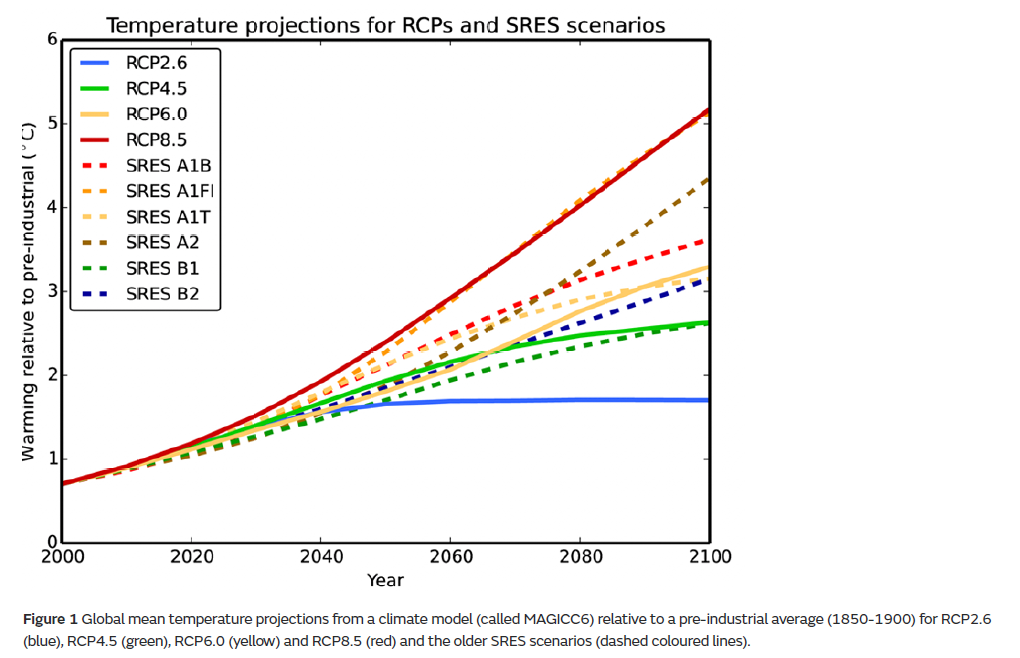
That does not mean, of course, that the lower emission scenarios are any more credible.
But as Professor Roger Pielke Jr puts it: ‘The now-implausible upper-end scenarios –RCP8.5, SSP5-8.5, and SSP3-7.0 – are not just academic constructs used in esoteric research. They are embedded in the policies and regulations of most of the world’s largest economies, found across the world’s most important multilateral institutions, and used in the climate stress tests that govern hundreds of billions of dollars in bank capital.’
In this country, government policy is influenced and even the Bank of England’s stress tests of banks and insurers must take account of these upper-end scenarios.
Let’s look at the Met Office, for instance.
In 2022, they published a report titled UK Climate Projections (UKCP18). Innocent enough, you might say.
But right at the start, they tell us that their report focuses on RCP8.5:

https://www.metoffice.gov.uk/research/approach/collaboration/ukcp
Sure, you can ‘extract results’ for other scenarios, but it is RCP8.5 that is making the headlines and it is projections using RCP8.5 that form the basis of government policy making.
These are some of the plainly far-fetched claims made in UKCP18:
· Summers will be 5.1C hotter by 2070 and winters 3.8C;
· The temperature of the hottest summer days will increase by 6.8C by the 2070s;
· By 2070, summer rainfall could be 45 per cent lower on average and winter rainfall 39 per cent higher;
· There will be an increase in the intensity of summer rainfall;
· Summer storms will extend into autumn, as temperatures increase;
· There will be significant increases in hourly precipitation extremes in the future;
· Droughts in summer will be much worse;
· Snow will be a thing of the past, except for mountainous regions;
· Sea levels in London will be 1.15m higher by 2070.
As the Met Office pointed out, ‘government will make use of UKCP18 to inform its adaptation and mitigation planning and decision-making’.
How much money has the Government wasted adapting to events that will never happen?
All the above fictitious claims, and many others made since by the Met Office, have been discredited by their own data, which has consistently shown none of these things happening in practice. Yet still the projections remain the official source of climate advice for governments:
As the Met Office states: ‘As part of the Met Office Hadley Centre Climate Programme, the UK Climate Projections 2018 (UKCP18) offers a range of tools designed to help decision-makers assess their risk exposure to climate change and adapt. The UKCP18 project uses cutting-edge climate science to provide updated observations and climate change projections until 2100 in the UK and globally. The project builds upon on the success of UK Climate Projections 2009 (UKCP09) to give the most up-to-date assessment of how the climate of the UK may change over the 21st century.’
Now we know that the Met Office has been feeding government with advice based on faulty assumptions. They must now withdraw UKCP18 in its entirety and explain why they used them in the first place, particularly given the long-standing criticisms of RCP8.5.
In turn, the Government must come clean and immediately suspend all programmes, spending and targets, which have been justified on the basis of the Met Office’s climate projections.