While we should rightly praise Thomas Jefferson for his authorship of the Declaration of Independence, we should never ignore the role of John Adams. If Jefferson was the pen, Adams was the voice.
The Declaration of Independence: A Radical Experiment in Liberty (Stone House Press, 2026)
“Who shall write the history of the American revolution? Who can write it? Who will ever be able to write it? The most essential documents, the debates and the deliberations in Congress from 1774-1783 were all in secret, and are now lost forever. Mr. Dickinson printed a speech, which he said he made in Congress against the Declaration of Independence; but it appeared to me very different from that, which you, and I heard. Dr. Witherspoon has published speeches which he wrote beforehand, and delivered Memoriter, as he did his Sermons. But these I believe are the only speeches ever committed to writing. The Orators, while I was in Congress from 1774-1778 appeared to me very universally extemporaneous, and I have never heard of any committed to writing before or after delivery.”[1] –John Adams
“The proud domineering spirit of Great Britain; their vain conceit of their own Omnipotence; their total contempt of us, and the incessant representations of their friends and instruments in America, would drive us to extremities and finally conquer us; transport us to England for trial, there to be hanged, drawn and quartered for Treason, or to the necessity of declaring Independence, however hazardous and uncertain such a desperate measure might be.”[2]—John Adams
Though Congress declared independence from Great Britain on July 2, 1776, it had yet to decide on a way to announce this momentous decision to the world. A month earlier, on June 11, the Second Continental Congress had chosen five of its members to draft a formal Declaration: Thomas Jefferson, John Adams, Ben Franklin, Roger Sherman, and Robert Livingston.[3] Adams fondly remembered how appreciated Jefferson was as soon as he came to the Second Continental Congress.
Mr Jefferson came into Congress in June 1775. and brought with him a reputation for literature, science, and a happy talent at composition. Writings of his were handed about remarkable for the peculiar felicity of expression. Though a silent member in Congress, he was so prompt, frank, explicit and decisive upon Committees, not even Saml Adams was more so, that he soon seized upon my heart, and upon this occasion I gave him my vote and did all in my power to procure the votes of others.[4]
As it turned out, Jefferson earned one more vote than the rest of the committee members and the committee then chose him and Adams as its head. They were to draft the Declaration. Jefferson, however, proved reluctant.
Jefferson proposed to me to make the draught. I said I will not; You shall do it. Oh No! Why will you not? You ought to do it. I will not. Why? Reasons enough. What can be your reasons? Reason 1st. You are a Virginian, and Virginia ought to appear at the head of this business. Reason 2d. I am obnoxious, suspected and unpopular; You are very much otherwise. Reason 3d: You can write ten times better than I can. “Well,” said Jefferson, “if you are decided I will do as well as I can.” Very well, when you have drawn it up we will have a meeting.[5]
Jefferson, as agreed, wrote a version of the Declaration of Independence, giving it first to Adams. Adams was beside himself with glee, at least at the time. “I was delighted with its high tone, and the flights of Oratory with which it abounded, especially that concerning Negro Slavery, which though I knew his Southern Brethren would never suffer to pass in Congress, I certainly never would oppose,” Adams stated in hindsight. Still, there were things about Jefferson’s version that he very much opposed.
There were other expressions, which I would not have inserted if I had drawn it up; particularly that which called the King a Tyrant. I thought this too personal, for I never believed George to be a tyrant in disposition and in nature; I always believed him to be deceived by his Courtiers on both sides the Atlantic, and in his Official capacity only, Cruel. I thought the expression too passionate and too much like scolding for so grave and solemn a document.[6]
Adams, though, left well enough alone, presuming that the other committee members—especially Franklin and Sherman—would criticize Jefferson directly. As it turned out, though, the committee members made no editorial changes, Adams remembered, and Jefferson, in haste, submitted his draft to the Second Continental Congress on June 28, 1776. Jefferson, however, remembered it all slightly differently.
Nor should I, at the age of 80, on the small advantage of that difference only, venture to oppose my memory to his, were it not supported by written notes, taken by myself at the moment and on the spot. he says ‘the Committee (of 5. to wit, Dr Franklin, Sherman, Livingston and ourselves) met, discussed the subject, and then appointed him and myself to make the draught; that we, as a subcommittee, met, & after the urgencies of each on the other, I consented to undertake the task; that the draught being made, we, the subcommittee, met, & conned the paper over, and he does not remember that he made or suggested a single alteration.’ now these details are quite incorrect. the Committee of 5. met, no such thing as a subcommittee was proposed, but they unanimously pressed on myself alone to undertake the draught. I consented; I drew it; but before I reported it to the committee, I communicated it separately to Dr Franklin and mr Adams requesting their corrections; because they were the two members of whose judgments and amendments I wished most to have the benefit before presenting it to the Committee; and you have seen the original paper now in my hands, with the corrections of Doctor Franklin and mr Adams interlined in their own hand writings—their alterations were two or three only, and merely verbal I then wrote a fair copy, reported it to the Committee, and from them, unaltered to Congress. this personal communication and consultation with mr Adams he has misremembered into the actings of a sub-committee.[7]
Importantly, according to Adams, there was little if anything original in the Declaration, Adams remembered.
As you justly observe, there is not an idea in it, but what had been hackney’d in Congress for two years before. The substance of it is contained in the declaration of rights and the violation of those rights, in the Journals of Congress in 1774. Indeed, the essence of it is contained in a pamphlet, voted and printed by the Town of Boston before the first Congress met; composed by James Otis, as I suppose—in one of his lucid intervals, and pruned and polished by Saml: Adams.[8]
Still, Adams worried, Jefferson had done a disservice by being overly dramatic in his misrepresentation of the king. “We whigs attempted somewhat of the kind,” Adams explained in 1811. “The Declaration of Independence I always considered as a theatrical show. Jefferson ran away with all the stage effect of that… [in original] and all the glory of it.”[9]
Jefferson, for his part, impressively remained restrained as an author, not being too possessive of the Declaration itself. Most likely, he saw himself at this point in time and history as a draftsman, rather than an author in the most proper sense of the word. Still, the changes made by Congress to his document, annoyed him. In his personal notes, he admitted:
The pusillanimous idea that we had friends in England worth keeping terms with, still haunted the minds of many. For this reason those passages which conveyed censures on the people of England were struck out, lest they should give them offence. The clause, too, reprobating the enslaving the inhabitants of Africa, was struck out in complaisance to South Carolina and Georgia, who had never attempted to restrain the importation of slaves, and who on the contrary still wished to continue it. Our Northern brethren also I believe felt a little tender under those censures; for tho’ their people have very few slaves themselves yet they had been pretty considerable carriers of them to others.[10]
For the most part, Jefferson took all of this rather Stoically. With Jefferson as a sitting member, observing the whole process, the Second Continental Congress debated and changed Jefferson’s draft on the 2nd, 3rd, and 4th of July, finally ratifying the document on the 4th. Jefferson remembered the editing process with some discomfort.
This however I will say for mr Adams, that he supported the declaration with zeal & ability, fighting fearlessly for every word of it. as to myself, I thought it a duty to be, on that occasion, a passive auditor of the opinions of others. more impartial judges than I could be, of it’s merits or demerits. during the debate I was sitting by Dr Franklin, and he observed that I was writhing a little under the acrimonious criticisms on some of it’s [sic] parts.[11]
While we should rightly praise Jefferson for his authorship, we should never ignore the role of John Adams. If Jefferson was the pen, Adams was the voice. Again, as Jefferson said:
Had mr Adams been so restrained, Congress would have lost the benefit of his bold and impressive advocations of the rights of revolution. for no man’s confident & fervid addresses, more than mr Adams’s, encoraged and supported us thro’ the difficulties surrounding us, which, like the ceaseless action of gravity, weighed on us by night and by day. yet, on the same ground, we may ask what of these elevated thoughts was new, or can be affirmed never before to have entered the conceptions of man?[12]
It was he, almost single-handedly, who guided the Declaration through Congress to its approval. In 1813, Jefferson revealed: “No man better merited this than Mr. John Adams to hold a most conspicuous place I the design. He was the pillar of its support on the floor of Congress, its ablest advocate and defender against the multifarious assaults it encountered for many excellent persons opposed it on doubts, whether we were provided sufficiently with the means of supporting it, whether the minds of our constituents were yet prepared to receive it, etc., who, after it was decided, united zealously in the measures it called for.”[13] Impressed with Adams, all members of the Second Continental Congress except John Dickinson agreed to it, though no one would sign the Declaration formally until August 2, 1776.[14] Though we often think of the Declaration as so important we imagine that the day’s proceedings must have been consumed with it. However, the best evidence suggests that the Declaration had been approved by noon and the afternoon taken up with a myriad of other matters. Still, the import of the moment certainly resonated through Congress. One member of Congress recorded in his diary simply, “Cool. The Independence of the States Voted and declared.”[15] Another member, reported at greater length on the matter: “I arrived in Congress (tho detained by thunder and Rain) time Enough to give my Voice in the matter of Independence. It is determined by the Thirteen United Colonies with out even one disenting Colony.”[16] I will inclose to you a Declaration, in which all America is remarkably united,” John Adams wrote with obvious glee. “It compleats the Revolution, which will make as good a Figure in the History of Mankind, as any that has proceeded it.”[17]
__________
The above is an excerpt from Chapter 5 of Dr. Birzer’s new book, available for purchase here. —Editor
The Imaginative Conservative applies the principle of appreciation to the discussion of culture and politics—we approach dialogue with magnanimity rather than with mere civility. Will you help us remain a refreshing oasis in the increasingly contentious arena of modern discourse? Please consider donating now.
Notes:
[1] John Adams to Thomas Jefferson, July 30, 1815, in Lester J. Cappon, ed., The Adams-Jefferson Letters: The Complete Correspondence Between Thomas Jefferson and Abigail and John Adams (1959; Chapel Hill, NC: The University of North Carolina Press, 1987), 451.
[2] John Adams to Timothy Pickering, August 6, 1822.
[3] June 11, 1776, JCC 5: 431.
[4] John Adams to Timothy Pickering, August 6, 1822.
[5] John Adams to Timothy Pickering, August 6, 1822.
[6] John Adams to Timothy Pickering, August 6, 1822.
[7] Thomas Jefferson to James Madison, August 30, 1823.
[8] John Adams to Timothy Pickering, August 6, 1776.
[9] John Adams to Benjamin Rush, June 21, 1811, in The Spur of Fame: Dialogues of John Adams and Benjamin Rush, 1805-1813, ed. by John A. Schutz and Douglass Adair (1966; Indianapolis, IN: Liberty Fund, 2001), 197.
[10] Thomas Jefferson’s Notes of Proceedings in Congress, July 1-4, in LDC 4: 358ff.
[11] Thomas Jefferson to James Madison, August 30, 1823, in Republic of Letters (New York: W.W. Norton, 1995), 3: 1875-1877.
[12] Thomas Jefferson to James Madison, August 30, 1823.
[13] Thomas Jefferson to W.P. Gardner, February 1813, in The Works of John Adams 3: 57.
[14] “The Debates in 1776, on the Declaration of Independence and On a Few of the Articles of the Confederation, Preserved by Thomas Jefferson,” 18.
[15] Robert Treat Paine’s Diary, July 4, 1776, in LDC 4: 286.
[16] Caesar Rodney to Thomas Rodney, July 4, 1776, in LDC 4: 388.
[17] John Adams to Mary Palmer, July 5, 1776, in LDC 4: 389.
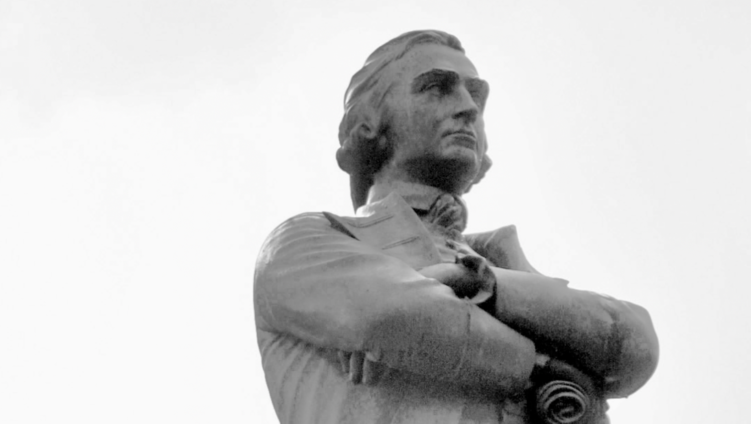
The featured image is a photograph of Samuel Adams, Faneuil Hall, by sculptor Anne Whitney, and is in the public domain, courtesy of Wikimedia Commons.