YOU have to hand it to them: the people who have turned autism into a socially acceptable identity category and an appealing social movement have been remarkably successful.
What used to be diagnosed in shabby rooms at the back end of the psychiatric estate has become a must-have label that is avaiable to all – and it can be yours if you go online, complete the survey and pay a large fee.
What used to be understood as a rare and crippling, life-long, neurodevelopmental disability has become a disorder you can adopt with great pride.
What used to be hidden away in psychiatric hospitals, special schools and residential homes is now out in the open; except that it isn’t.
Only one version of autism has become fashionable: the mild version that doesn’t require institutional restraint, specialist support and full-time care. The version that makes good TV, adds colour to the lives of fading celebrities and fuels the intellectual life of our universities.
This is the acceptable kind of autism, the one that is ‘difference, not disability’. The one that is about ‘neurodiversity’, not neuro-dysfunction.
This happy-clappy autism has almost entirely obscured the less-happy kind.
You wouldn’t know it from the public debate, but growing numbers of children have the kind of autism that requires a special school place. Local authorities have had to expand their own special schools and fund placements at private schools to accommodate this demand.
This week, I decided to look at what has been happening in the place where I live – Cornwall – a beautiful rural county (and some would say an ancient nation) in the far southwest of the UK.
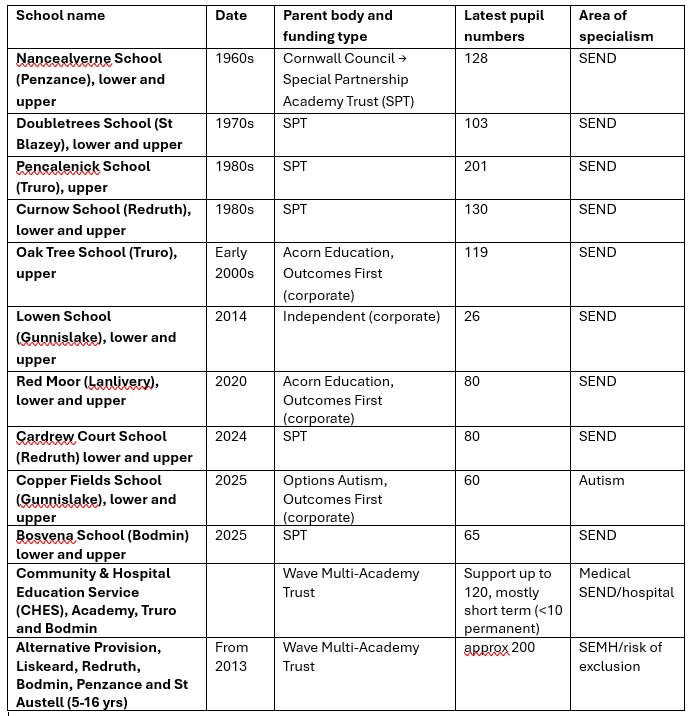
As summarised in the table posted below, since the 1970s, the small estate of council-owned schools has grown into a special academy trust that has just built two new schools, bringing the total number to six.
The council has supported placements at four new private special schools. They also pay for placements in alternative provision at five sites, as well as hospital-based education for a small number of permanent pupils, as well as a larger group who have short-term support in three different sites.
Over recent years, the council has supported the establishment of specialist bases within mainstream schools, and there are more than 20 of these.
A growing number of children are registered as being in Education Otherwise Than At School (EOTAS), some of which is also paid for by the council covering up to 25 contact hours (for a pre-16) and 18 hours for post-16 a week during term time (38 weeks a year). Examples include online schooling, tuition at home, tuition or training at a specialist centre, life skills training, mentoring and therapeutic intervention. The most recent data (published following a FoI request in 2023) indicates that 54 children were supported for EOTAS, but this group is known to be rising in size.
Although we know that small numbers of children – likely those with the highest levels of needs – are sent to specialist residential provision outside Cornwall, there are no published data on the numbers involved.
Each of these children clearly has very high levels of need. Many of them have severe autism.
They represent just over 2 per cent of all the pupils in Cornwall. These children deserve much greater attention and all the talk about neurodiversity does them no favours at all.
While the number of children with special educational needs has risen fast (to one in five), those with greater needs, supported with Education, Health and Care Plans (EHCPs), has now reached one in 20. My research indicates that the number in specialist provision has now reached one in 50.
No one talks about this latter group, whose needs are immense.
I wish that politicians, researchers, clinicians, high-profile influencers and policy makers would visit a special school before they unthinkingly adopt the language of neurodiversity. It is not helping our children and young people to make sense of the world, and it is certainly not helping those most in need of support.
Special schools in Cornwall – a chronological view
This article appeared in the Autism Tribune on May 6, 2026, and is republished by kind permission.