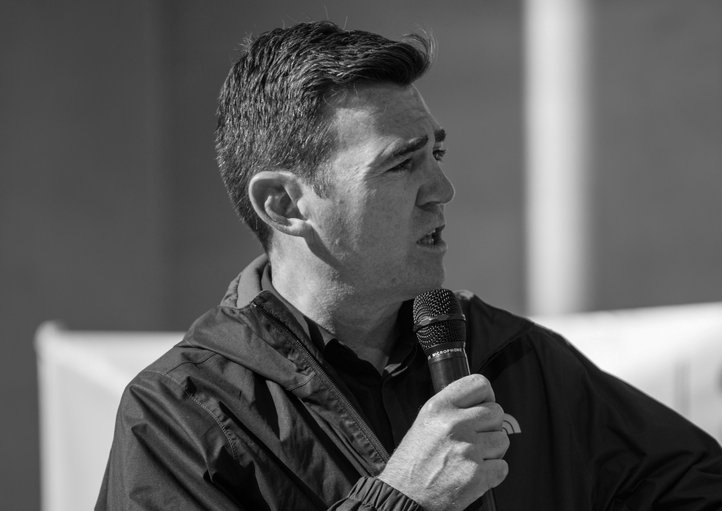
IT IS impossible to argue with one fact: what will deliver victory to Andy Burnham in Makerfield is the splintering of the ‘right’ wing vote.
A couple of months ago Donna Rachel Edmunds wrote an article in TCW called ‘A roadmap for the resurgent right to retake Britain‘, on why the left wing, although it is intellectually and morally bankrupt, still manages to hang on in there. Her analysis was simple and correct. While the left organises, the right infight.
How true this is for the Makerfield by-election. The first thing that hit me a week or so ago was the sheer craziness of Kemi Badenoch’s refusal, in defiance of senior Conservatives’ advice, to offer a deal to Nigel Farage’s Reform UK. Jacob Rees-Mogg thinks his Conservative Party and Reform should work together in the national interest: ‘The voters may recognise the advantages of tactical voting. But wouldn’t it be more sensible for the two leaders, Kemi Badenoch and Nigel Farage, to see there is an opportunity to work together, to show that politicians can come together and can do things that are overwhelmingly to the benefit of the country at large?’
Tory veteran Edward Leigh weighed in, saying that the Tories should stand down in Makerfield in return for Reform standing down in Aberdeen South, where Stephen Flynn’s seat is up for grabs and the Tories are 1,000 votes off the SNP: ‘If doing some kind of deal means we can win Aberdeenshire and save the Union, it’s worth doing. My view is that if at the next general election there are two right-wing parties slugging it off in every single constituency, as night follows day there will be a left-wing government.’
Disregarding for the moment whether the Tories deserve the moniker ‘right-wing’, both Rees-Mogg and Leigh are right. To no avail with ‘out of touch with political reality‘ Kemi, oblivious apparently to the fact that once Burnham gets into Westminster he will go straight to the top.
Survation’s first polling shows Andy Burnham leading Reform’s Robert Kenyon by three points, 43 per cent to 40. Rebecca Shepherd, standing for Rupert Lowe’s Restore Britain in the party’s first parliamentary contest, is on 7 per cent. The Liberal Democrats are on 4, the Green candidate on 3 and the Conservatives on 2.
Restore’s 7 per cent ‘take’, if voters do indeed make this choice, is a killer not just for Reform but for the rest of us; for the country in fact, left burdened with a leader whose far-left policies will condemn us to a soup kitchen, bread queue inflationary hell. Everyone said it couldn’t get worse last time around. It did and it still can.
On Monday Matt Goodwin set out a plausible chain of events that could follow a Burnham win. The key point is that the 3-point gap between Labour and Reform is dwarfed by the 9 points going to two other right-wing parties, namely the Tories and Restore UK led by ex-Reform MP Rupert Lowe.
Under this scenario Goodwin sets out what could happen. He will, I am sure, forgive me for quoting him at length:
***
Andy Burnham narrowly wins the Makerfield by-election and in the aftermath proclaims that he is the only person who can unify the Labour Party and defeat Reform in a pro-Brexit, heavily white British seat in northern England.
He is the only person, he will say, who can save the Labour Party.
In the aftermath of victory, Labour MPs from different factions of the party rally around Andy Burnham and pile enormous pressure on an already deeply unpopular Keir Starmer to immediately resign.
Burnham’s leadership rivals and perhaps Starmer himself are offered top jobs in a Burnham-led administration to ease the rapid transition.
Within weeks, Andy Burnham is appointed leader of the Labour Party and prime minister, much like Gordon Brown was in 2007.
Given there is no democratic support for Prime Minister Andy Burnham, widespread calls for a general election emerge across the country.
But here’s the twist: Andy Burnham also wants an early, snap general election.
Why?
Because he looks at the political landscape.
In his eyes, he’s just defeated Reform in northern England, while Reform has a new problem with Restore which is not a big party but significant enough to cost Reform seats like Makerfield.
The Tories, having lost their deposit at both the Gorton and Denton and now Makerfield by-elections are clearly dying but also remain a problem for Reform in a few pockets of the country.
The Right, in short, is divided. It is visibly, clearly divided.
On the left, Burnham sits down with senior Greens and essentially buys them off with some kind of offer on electoral reform, perhaps proportional representation – an offer sweetened by Labour offering the Greens a clear run in a dozen or so seats.
Then Burnham looks at the economy.
While rising, the Iran-linked surge of inflation is yet to arrive. So too is mass unemployment and recession, which are on the way but still lie over the horizon.
The latest growth figures were not a complete catastrophe and compared with other nations Burnham says ‘we are doing better than others’.
More importantly, he wants his own mandate. He does not want to be locked into the fiscal rules and policies imposed by Starmer and Reeves. He wants to be his own man.
And he certainly doesn’t want to wait for the major economic downturn that is coming – better to deal with that when he’s actually got his own majority and is safely ensconced in Number 10 for years.
Burnham is also influenced by his experience of watching Gordon Brown bottle an early general election when he was appointed prime minister in 2007, just before a major global financial crisis erupted – a mistake that Burnham does not want to replicate in 2026, with a major debt crisis on the horizon.
All this pushes Burnham to do the unthinkable and roll the dice: calling an early, snap general election. He calls one within days of entering Downing Street, setting the stage for a general election roughly 5-7 weeks after taking office.
Labour does not like winter elections so he moves quickly to avoid one.
He hopes to secure his own mandate. Crush any opposition to his rule within the Labour Party. Capitalise on media excitement around a ‘new direction’. And, more than anything, exploit a divided Right.
He enters the general election with a united Labour Party, willing to do whatever it takes to keep the Greens and the Scottish National Party on side, and exploit a divided right, winning enough votes to cobble together a coalition.
For yet another five years, until at least the year 2031, Britain is now in the grip of a hard-left coalition that’s committed to ongoing mass immigration, record taxation, spending and borrowing, that refuses to fix the borders, and continues to reform the electoral and political system so that the right finds it much harder to win power.
***
Now, you can say that Goodwin, as a member of the Reform Party and desperate for everyone to come onside, ‘would say that, wouldn’t he’.
But the unpalatable truth is that there is no other plausible scenario unless Restore gracefully back down. Which they won’t for two reasons: their leader and supporters hate Farage more than they hate Labour; and second, for them this isn’t about the cost of living or even government incompetence or overreach, they exist because the Conservatives betrayed patriotism, Brexit, nationalism and ordinary people. They worry that Reform will betray them too.
Understandable after years of uni-party globalist policies, but indubitably this will hand power to an even worse far left ‘Islamo-globalism’.
Together Restore, Reform and Advance are showing, Daniel Jupp wrote this week, that they are just as ready to hand power over to the left as the Conservatives were. What an irony. Jupp’s analysis agrees with Goodwin’s: The Restore vote will hand victory to Labour. Furthermore, as Jupp points out:
‘Burnham is a lot more popular than Keir Starmer. While this may be a bit like saying that Lucy Letby is more popular than Harold Shipman, Burnham’s measly 4 per cent positive approval rating actually has an impact on projected Labour votes that could be significant in a national election. Pollsters are putting Labour at around 18 per cent with Starmer as leader. Some of them suggest Labour under Burnham polls at 30 per cent. That’s a huge bump that would make a snap election attractive and winnable for Labour (before the gloss wore off as it inevitably would since Burnham is actually even more crazed and uncharismatic than Starmer). Labour or a left coalition would then smash Reform in a general election, securing a reset mid-term with five years more of the left ruling Britain rather than three years.’
Jim Chimirie, an exceptionally acute political observer on X, also sees the Makerfield by-election as the vehicle through which Andy Burnham will return to Westminster and win the Labour leadership. Although Reform took every council seat in the area at the May local elections with 46.2 percent of the vote he says the stakes could not be higher. However strong the antipathy of (modern) ‘Wigan man’ is to Labour, however much he feels that Labour does not represent him any more, ‘that they have taken them for granted and that Labour does not put them first’, Burnham may have less of a struggle than the author of this article suggests. Why? Because Labour plays dirty as Chimirie highlights and the establishment lets them get away with it. Take how the Hope Not Hate charitable trust, whose trustees are overwhelmingly current or former Labour politicians, is funding Hope Not Hate, a private company, to distribute leaflets in a by-election constituency explicitly targeting Reform and backing the Labour candidate. A ‘charity whose trustees read like a Labour Party honours list is spending charitable funds to help deliver the result’. Against all the rules charitable money is being spent to influence a by-election that could determine who leads the country. The regulator that failed to stop this in January has so far not acted. The playing field is not level.
And lest we forget, each year of the five possible years of leftist rule (that a Burnham win will mean) is another million migrants added. And another year to push through crippling taxes, insane legislation, and closer alignment with the EU.
Restore UK cannot win. Splitting the vote is worse than pointless. That’s why Restore and Conservative voters alike in Makerfield really must hold their noses and vote Reform UK.