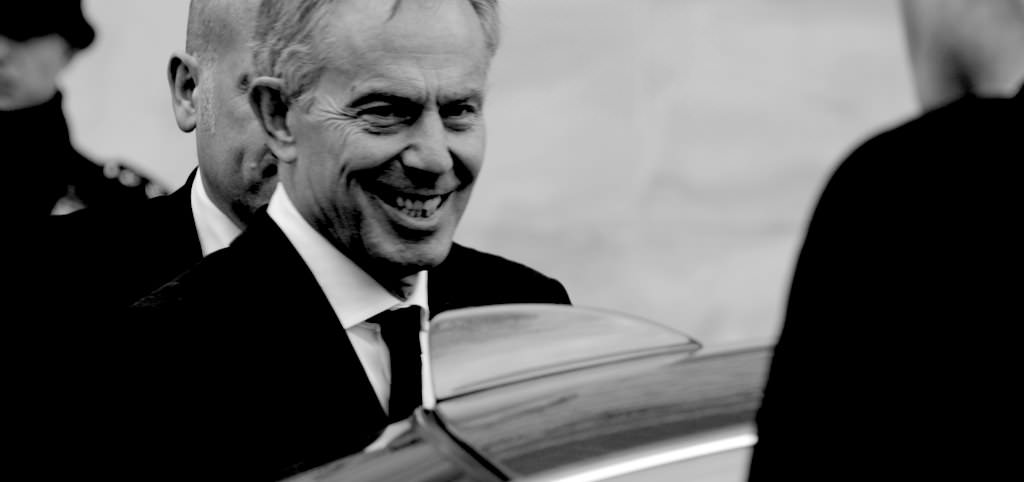
YOU might have noticed that last week the Messiah of the Third Way re-emerged from exile – all 5,000 words of him. The pretext for Sir Tony Blair’s unwelcome incursion into UK politics? Keir Starmer’s government is apparently ‘playing with fire’ over the future of the Labour Party and the country itself (naturally, in that order). Publishing under the auspices of the Tony Blair Institute for Global Change, Blair sets out a ten-point plan for ‘economic prosperity and social justice’ which, stripped of the author’s name and the faint whiff of sanctimony, sounds eminently sensible: energy self-sufficiency in lieu of Net Zero masochism; a solution to illegal immigration ‘whatever it takes’; planning reform; welfare restraint; an overhaul of the NHS; and Blair’s ‘principal challenge’, AI.
Large sections of this, of course, could pass for a Reform UK manifesto on a particularly lucid day. If only the author were not the very man who, more than any other political figure, plotted, designed, and presided over the destruction of Britain in the first place.
I could be wrong, but I suspect that for the working class Blair’s meddling is about as welcome as the reformed smoker lecturing the regulars on the dangers of tobacco, and ‘proving his point’ by setting fire to the pub curtains. For my money, he is truly the traitors’ traitor. Judas at least had the decency to hang himself. Brutus observed the etiquette of stabbing you in the back. And say what you want about Guy Fawkes, his solution to Westminster interference was nothing if not honest. Blair, by contrast, has no such redeeming features. He shows up at the eleventh hour, Armani-suited, convinced that only he can save us from the consequences of his own handiwork.
Politicians such as Blair are fond of saying, ‘Let us be clear’. So let me be clear: Britain’s current woes arrived not by accident or solely on the wings of global forces. They were, to a significant degree, the obvious consequence of the New Labour grand projet of social and demographic engineering.
Sir Tony claims government must stop creating obstacles for business adapting to AI. Yet under his New Labour government, Britain saw the opposite of Thatcher’s deregulation: a new law passed every three and a quarter hours (a 22 per cent increase on the previous decade), piling heavy new costs and bureaucracy on to businesses. He calls the planning system an ‘abomination’ that needs transformative reform. The result of his government was a system more complex and bureaucratic after 12 years of continuous reforms that added layers of policy, regional targets, and guidance. Again it was Thatcher, not Blair, who oversaw the building of more houses.
On energy, it’s easy to scoff at Ed Miliband’s Net Zero zealotry, but it was the Blair government which signed us up to the Kyoto Protocol, pledging an aggressive 60 per cent emissions cut by 2050 which locked in the green constraints we see today.
On education and youth unemployment, Blair wants to strengthen schools/universities and expand training. His infamous 50 per cent university target, however, is still risible. It led to a huge expansion of Mickey Mouse degrees at the expense of practical skills and apprenticeships. The result? A persistent skills mismatch. Too many graduates in non-graduate jobs, and the very training gaps he now criticises.
Freedom from bureaucracy and private-sector partnership to ‘reindustrialise the north’ sounds good, the kind of soundbite Andy Burnham will likely deploy in Makerfield. But was it not the Blair government that centralised power, created 92 quangos (more than any other administration), and added layers of targets and regional bodies?
When Blair talked of reform of welfare, reform of the NHS, and particularly the need to stop illegal immigration, ‘whatever it takes’, I confess I almost had a fit. Was it not Blair who oversaw massive expansion of the welfare state (dependency rising from 45.9 per cent to 53.5 per cent of households under New Labour)? Was it not Blair who aggressively expanded PFI deals, with £13billion of investment which would end up costing the NHS over £80billion? And was it not under Blair that net migration quadrupled? Millions were brought in (‘search parties’ were sent out according to Mandelson) not just to ‘rub the right’s nose in diversity’ as Andrew Neather said, but to ‘render their arguments out of date’. In other words, not just gerrymandering but the mass import of voters.
The part which concerns me the most is the embrace of AI. No doubt Blair is right – the world is moving only one way, and Britain must move with it or face being left behind. I cannot help thinking, however, that this merely facilitates his dream of digital ID and total control over the population.
You have to hand it to Blair, he doesn’t shy from giving the hit-piece writer almost unlimited material. Were he more of a technical bent himself, he would no doubt be the man simultaneously writing the computer viruses andthe software, charging the public premium rates for both. It’s too bad he didn’t come up with covid. He could have sold us the jab, the app, the digital ID passport and a nice public-private partnership to monitor our compliance.
Let us grant the obvious: many of Blair’s ten points have merit. Britain does need planning reform, energy realism, welfare discipline and a grown-up conversation about immigration and integration. Productivity has flatlined. The NHS is a national treasure that increasingly resembles a national tragedy. Housing is a disaster. These are not right-wing talking points: they are observable reality. Sensible voices from across the spectrum should not only be able to say so, they should also be willing.
The problem is the author. Blair is a chameleon. He will say whatever is necessary to regain credibility and influence. Strip away the polished delivery and you find the same megalomaniac who once believed he could remake Britain, Iraq, and the world order in his own image. Good faith (like good immigration) has its limits, and the lecture would land with greater precision, if the lecturer first acknowledged his leading role in Britain’s downfall.
Believing Blair is the solution to Britain’s problems is like treating arsenic poisoning with another generous spoonful of it. So thanks, Tony, but no thanks.
This article appeared in The Frank Report on May 31, 2026, and is republished by kind permission.