THESE days, autism is rarely out of the news. A once-rare debilitating childhood neurodevelopmental disorder is now located firmly at the centre of public debate.
In the three weeks since my last post, the news has only been bad.
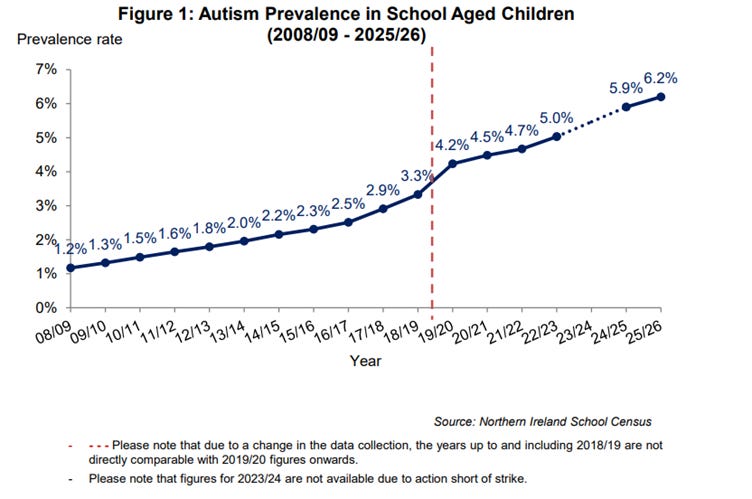
First, we had the latest instalment in the long-running dataset collected from registers of school-aged children in Northern Ireland that showed yet another rise in the rate of those diagnosed with Autistic Spectrum Disorder (ASD). The rate is now one in every 16 children (or 6 per cent) of those aged between four and 15, and the vast majority of these were reported to have special educational needs and/or disabilities (SEND).
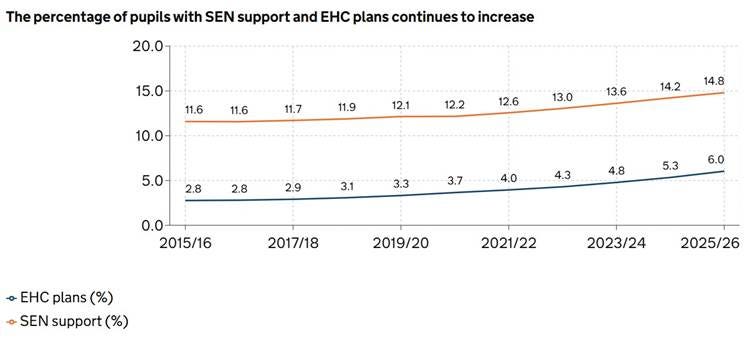
Second, the latest data on the number of children with EHCPs were also released. Numbers increased to more than half a million (538,500) pupils (6 per cent or one in 16) in England in January 2026. This was a rise of 11 per cent on the previous year and represents a doubling in less than a decade. At least a third of these were awarded to children with autism.
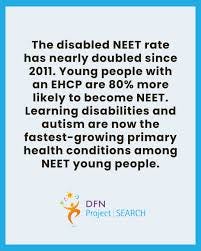
Third, Alan Milburn released his interim report from an inquiry into the rising numbers of young people (aged 16 to 24) classified as NEET (Not in Education, Employment or Training). Remarkably, more than a million young people (one in eight or 12.5 per cent) are in this group. Many of them have never had a job and most are not looking for one.
As the report explains, disability is a major part of the story: ‘In 2024 to 2025, nearly half of young people who are NEET in the UK, 45 per cent report having a disability – more than doubling from 21.1 per cent in 2013 to 2014. Disability prevalence among all 16 to 24 year olds has also doubled, from 10 per cent to 19.7 per cent over the last 10 years.’ Yet again, these figures suggest that 6 per cent of the cohort have significant learning difficulties and/or disabilities that are holding them back.
Behavioural problems including neurodevelopmental disorders such as autism and Attention Deficit Hyperactivity Disorder (ADHD) are driving much of this rise.
To me, the only surprising thing is that people are not more surprised by these trends. How can as many as 6 per cent – 1 in 16 – school aged children have autism and/or special educational needs that require extra support? How can double this number – one in 8 – be unable to secure work or training to get into work? What does it mean for our future if these are the trends?
It used to be said that rates of autism were going up because people were ‘better at spotting it’ or ‘more aware than they were in the past’. This narrative implied an under-diagnosis of neurodevelopmental problems in previous generations and it drove a dash to identify the ‘missing adults’ that would be needed for this to be true. It is a fantasy that the Autism Tribune has covered before.
In contrast, it is now more likely that people will say that the rates are going up because of overdiagnosis and the medicalisation of behaviours that would previously have been understood as normal. The implication is that people are making things up.
This argument is being advanced by the Centre for Social Justice. They have just issued a report called Change the Prescription highlighting the unsustainable rise in SEND and associated benefit payments (Child Disability Living Allowance and Personal Independence Payment, Carers Allowance and Universal Credit) that now cost at least £24billion a year (equivalent to the combined wage bill of every teacher in a state school in England).
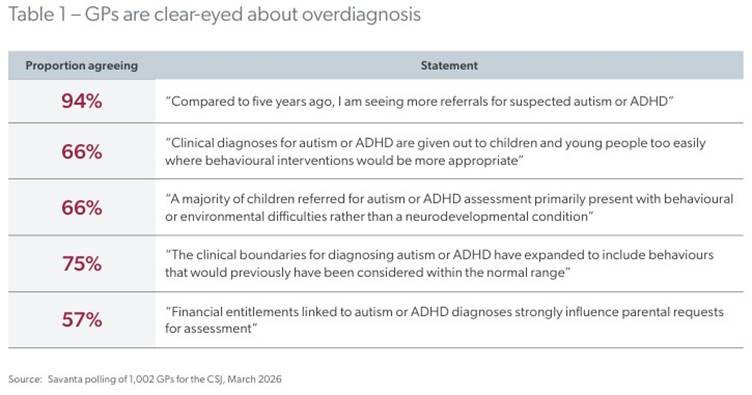
Pursuing the argument that this must reflect over-diagnosis, the report draws on a survey of 1,002 GPs to explore their experiences of requests for assessment and diagnosis of autism and ADHD.
Researchers found that the vast majority (94 per cent) had experienced a higher number of requests for assessment. Three-quarters (75 per cent) agreed that the diagnostic boundaries have widened too much. Two-thirds (66 per cent) believed that most of these patients were not suffering from autism or ADHD, even if they genuinely believed that they were.
In the past, GP referrals would have gone to specialist teams of NHS staff and involve personal meetings and thorough assessment. However, ever-lengthening waiting lists have opened up a market for private providers who will complete an assessment online.
NHS patients now have the ‘Right to Choose’ (RtC) to pursue an assessment with one of these private providers and local Integrated Care Boards (ICBs) will usually cover the cost. Patients might be steered to specified providers with whom budgets have been agreed in advance, and there might be variable implications for follow on care (such as access to drugs in relation to ADHD), but it provides the means for a faster and easier diagnosis than one provided by NHS staff.
The scale of this private sector activity has escalated very sharply in just a few years.
Earlier this year, an independent researcher called Ronnie Cane submitted Freedom of Information (FoI) requests to all 42 ICBs in England to ask about spending between 2023/4 and 2025/6. Three-quarters of respondents replied with data for at least one of these years and even with significant gaps in the data, the combined spending was £512.5million. This spending had doubled each year.
Only four of the ICBs had any idea about how many assessments their spending had purchased and none had any idea about the outcomes from the money they spent.
In his report, Cane highlights the woeful lack of scrutiny and accountability over this spending and as he suggests: ‘ICBs are commissioning hundreds of millions of pounds worth of neurodivergent assessments without measuring what that money buys. They receive invoices from private providers, they pay those invoices, and the numbers go up each year. Inputs are tracked. Outputs are not. Outcomes are invisible.’
As he later puts it, this is ‘not healthcare commissioning. It is invoice processing’.
Cane’s findings raise serious questions for the NHS and taxpayers, as well as the patients who secure a diagnosis that might be less than robust.
Given the length of waiting times for NHS services, it is not surprising that patients are requesting access to private providers – nor that ICBs are paying for the service because it reduces pressures on their waiting lists and ongoing complaints. However, it is remarkable that ICBs are handing over millions of pounds without adequate oversight of the services they are paying for, nor the outcomes for patients.
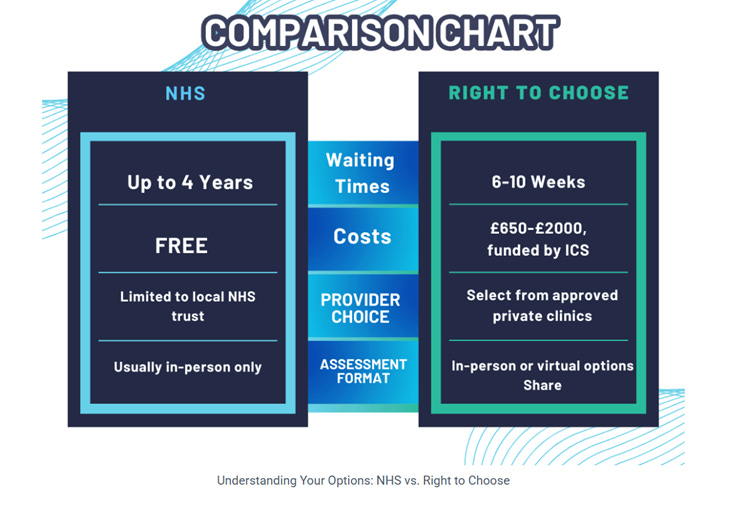
From: https://specialneedsresourcesdirectory.co.uk/
In the Wild West of neurodiversity assessment, the leading providers share information about how to persuade your GP to make the referral. Many of them include a draft letter outlining why you should be referred including the relevant RtC legislation to back it all up. Once referred, almost all the assessments will be processed online and require written and verbal evidence of autism or ADHD. The websites of some of the larger providers make all this clear: Psychiatry UK, Clinical Partners Ltd, The Owl Centre, Psion.
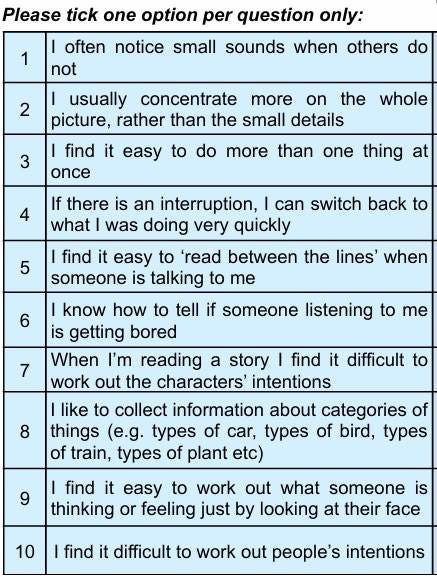
The ‘evidence’ they suggest often includes a simple questionnaire designed in 2012 by Professor Sir Simon Baron-Cohen and colleagues from the University of Cambridge called the AQ10. This is recommended for use by adults who suspect they have autism and has been sanctioned by the National Institute for Care and Clinical Excellence (NICE) as part of the guidelines developed for adult assessment (CG142). Baron-Cohen was part of the expert panel involved in this work. It has been designed as a ‘gateway’ tool to identify potential autism and is widely used in primary care, hospitals, education, policing and probation.
In 2021, NICE reviewed its autism guidance and determined that the AQ-10 was still a useful screening tool stating that a referral for a comprehensive autism assessment should be offered to adults who score six or above on the AQ-10 and/or where autism is suspected based on a clinician’s judgment.
This must have opened the floodgates on beleaguered GPs.
Anyone who is relatively self-contained or introverted, good at focusing, poor at suffering fools and with a low tolerance for nonsense could find themselves fitting the bill (me included). There is no mention of impairment or disability, or the necessity of having problems in childhood. The survey highlights the kinds of autistic traits that are widely distributed across the population-at-large and it is remarkable that this is recommended by NICE.
You can try it out for yourself. You get one point if you agree to questions 1, 7, 8, 10 and the same if you disagree to questions 2, 3, 4, 5, 6, 9. Score more than 6 and you can request an assessment; it’s as simple as that.
The situation is a sorry old mess.
People who need assessment and diagnosis – and care – are stuck in long queues and the private sector is filling the gap. However, this is happening without adequate oversight of the process nor the outcomes achieved. There is an obvious risk that patients end up with an insecure diagnosis based on poor quality assessments with implications for the rest of their life. Taxpayers are footing the bill with potential implications for health, education, welfare and social care costs. Public patience for those labelled autistic is likely to wane.
Surely the answer is to secure NHS control of the waiting lists and to stratify access to assessment and diagnosis in relation to the needs of the patient? The youngest and most obviously disabled people should have fastest access while older and less impaired patients are more able to wait.
Precious funding should be used to provide the most rigorous route to assessment via the most cost-effective approach. This might include private sector providers doing some of the work, but it must include face-to-face assessment and confirmation of serious and enduring impairment. All clinical activity should be subject to rigorous standards of assessment and diagnostic discipline, with regular patient reviews to check that the diagnosis still stands.
If we had confidence in the diagnostic decision-making, it would no longer be possible to dismiss the numbers as an artefact of either under- or over-diagnosis; we would have to accept the numbers as real.
We might even start talking about what is causing autism and start doing something about it. I pray for that day to arrive.
This article appeared in the Autism Tribune on June 17, 2026, and is republished by kind permission.