This is the last article about BBC programmes from the 40s and 50s, when the corporation was a much-loved institution broadcasting material the listeners wanted to see and hear. You can read earlier episodes here, and the first series is here.
IT WAS hard being a pop music fan in the 1960s. Young people now have unlimited access to any tracks they enjoy, but in those days (a) there was very little pop music on radio or TV and (b) you could hear a song only as it went out; there was no replay function.*
Therefore Sunday from 4pm to 5pm was an hour of paradise for teenagers: it was when Pick of the Pops was broadcast on the BBC Light Programme.
Starting in 1955, it is still going to this day after a number of gaps and many rebrandings, but this article focuses on the years 1961 to 1972 when it was presented by Alan Freeman.
This is the theme music, At the Sign of the Swinging Cymbal by Brian Fahey (1919-2007).
Fahey was born in Margate and learned to play the piano and cello. As a 21-year-old Gunner in the Royal Artillery, he survived one of the most notorious atrocities of the Second World War. When the Dunkirk evacuation began in May 1940 he was part of a group of around 100 British troops detailed to hold the road at the small town of Wormhoudt, 26 miles inland, to delay the German advance. They held off the enemy for five hours or more until they ran out of ammunition. They then surrendered to SS troops, assuming that they would be treated as prisoners of war according to the Geneva Conventions.
Instead they were marched to an isolated small barn, wounded stragglers being shot on the way, and locked in. The SS soldiers threw two grenades into the building. The grenades failed to kill everyone, largely thanks to two British NCOs who threw themselves on top of the grenades to shield their comrades. Realising this, the SS men called out survivors in groups of five and shot them, but decided this process was too slow; they raked the building with machine gun fire and left.
Eighty men were killed. Fifteen more were wounded but within 48 hours all but six died. Eventually the six were found by regular German Army medics and taken to hospital. After recovering from his wounds and the removal of a lung, Fahey spent five years in prisoner-of-war camps.
After the war he played in various bands, composed and produced arrangements, becoming principal conductor of the BBC Scottish Radio Orchestra in 1971. Another of his works, Here In a Smoky Room, was often used with the BBC test card. (Where did he get these odd titles?)
Pick of the Pops began life on October 4, 1955. The first presenter was Franklin Engelmann, then aged 47, and not, I would have thought, the obvious choice for a show presumably aimed at teenagers.
The 1955 ‘pop’ scene was in a very primitive state. The shellac 78rpm records were still being issued, though they would soon be overtaken by the vinyl 45s. Elvis had released his first single, That’s All Right,
in 1954 but it was not noticed in Britain; Bill Haley and the Comets’ Rock Around the Clock, usually hailed as the beginning of modern pop, was released in 1954 but did not become a hit until 1955. Top Ten singles in Britain in 1955 included Dreamboat by Alma Cogan, Stranger in Paradise by Tony Bennett and Let’s Have a Ding Dong by Winifred Atwell.
(This last one is a real treat, and readers might enjoy this video of her playing.)
In 1956 Alan Dell took over and the following year he started running through the Top Twenty chart. After a stint by David Jacobs, Alan Freeman became the host in September 1961. It must have been a breath of fresh air.
Freeman was born in Melbourne in 1927 and began work on Tasmania’s Radio 7LA, where he was continuity announcer, presenter of musical programmes including opera, ballet and classical music, DJ for the top 100, news reader, quizmaster and commercials reader. He came to England in 1958 and one of his first jobs was a summer relief DJ on Radio Luxembourg (I presume the shows were recorded in London and transmitted from Luxembourg. I had forgotten till now that the station could be heard in Britain only after dark, apparently because the radio waves bounced off the ionosphere. Well, that’s what it says on Wikipedia. To my eternal regret I was absent for physics at school; it lost me at ‘moments of force’.) Freeman started with the BBC in 1960 as presenter of Records Around Five, a programme about which I can find out nothing except that this was apparently when he adopted At the Sign of the Swinging Cymbal as his signature tune.
On Pick of the Pops he was an instant success, with his cheery welcome of ‘Greetings, pop-pickers!’ and catchphrases such as ‘Not ’arf!’
The programme had four sections: chart newcomers, new releases, LPs and the Top Ten.
Here is a complete episode from July 1964.
Needless to say there are none from this era on the BBC website.
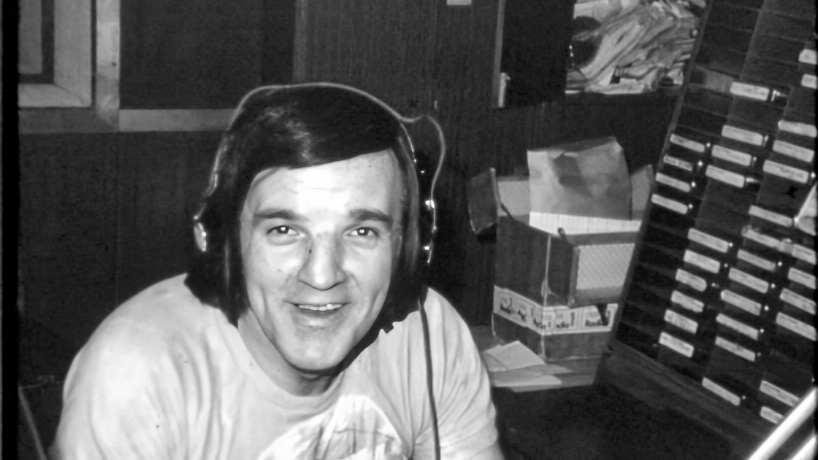
There are two versions of how he came by the nickname Fluff. The more likely is that he brought a submariner’s jumper from Australia when he came to England, and wore it till it went fluffy. I found this picture from the 60s in which he is indeed wearing a submariner-style sweater.
The other is that he ‘fluffed’ an intro to Cast Your Fate to the Wind by Sounds Orchestral, calling it ‘Cast Your Wind to the Fates’. This may indeed have happened but the record was released in 1965 and I am sure he had the nickname long before that.
In 1962 he recorded a dance single, Madison Time, with the Talmy Stone Band. This band was formed by Shel Talmy, the American record producer responsible for some of the biggest hits of the 60s including You Really Got Me by the Kinks,
My Generation by the Who,
(If Paradise Is) Half as Nice by Amen Corner
(on my all-time top ten) and Friday on My Mind by the Easybeats.
His magic touch failed with Freeman, however, and legend has it that the record sold 20 copies.
In the 60s Freeman did an advert for Omo washing powder ‘with exclusive WM7 for perfect whiteness’. Presumably the BBC did not have strict rules on advertising at that time.
Later there were adverts for Brentford Nylons, but these may have been after Pick of the Pops.
Pick of the Pops transferred to Radio 1 when it was launched in 1967 as part of Prime Minister Harold Wilson’s spiteful plan to kill off the popular pirate radio stations such as Radio Caroline and Radio London.
Try as I might, I cannot discover why Pick of the Pops was axed in 1972. The last edition was broadcast on September 24, and the Top Twenty section transferred to another programme called Solid Gold Sixty.
The playlist of the last edition is here, and you can listen to it here.
Freeman had a prodigious work ethic and continued presenting an assortment of programmes for the BBC, Capital Radio, XFM and Virgin Radio, including several revivals of Pick of the Pops on the BBC and Capital.He also did one-off classical music shows for Classic FM.
In 1987 he was the subject of This Is Your Life.
He eventually stopped work when he was 74 in 2001, by then having arthritis and asthma. He died on November 27, 2006, aged 79, at Brinsworth House, a retirement home for actors and performers in Twickenham.
*A lucky few, including me, had access to tape recorders. I recorded much of the 1963 series Pop Go the Beatles, as you can read here, but I don’t think it occurred to me to record Pick of the Pops. I wish it had.