Whether in her present numerous agonies of disorder, America can transcend despair and rebuild her national character is doubtful, impossible in the minds of some. But one thing is certain: It can happen only by fidelity to the American experience of a transcending Christian authority, and fidelity to the finest of her social values, customs, and traditions which are the basis of our ordered liberty.
“A positively abusive and vicious government ought to be changed, – and, if necessary, by violence, – if it cannot be (as sometimes is the case) reformed.” —Edmund Burke, Letter to Mons. Dupont, October, 1789.
Introduction
 In 1778, in the midst of our War of Independence, Samuel Johnson said: “I am willing to love all mankind – except an American.” Dr. Johnson clearly had a problem with our problem about the king’s authority. As a Tory he obviously did not share our Whiggish enthusiasm for independence or our criticisms of the British Crown.
We can compare his hostile view with that of John Jay when he described in words of well-deserved fame the character of the new country, America:
“With equal pleasure I have as often taken notice that Providence has been pleased to give this one connected country to one united people – a people descended from the same ancestors, speaking the same language, professing the same religion, attached to the same principles of government, very similar in their manners and customs, and who, by their joint councils, arms, and efforts, fighting side by side throughout a long and bloody war, have nobly established their general liberty and independence.” He continues: “and it appears as if it was the design of Providence that an inheritance so proper and convenient for a band of brethren, united to each other by the strongest ties, should never be split into a number of unsocial, jealous, and alien sovereignties.” (Federalist #2)
Sadly, Mr. Jay’s words do not describe America today, with its multi-culturalism, Marxism, multi-lingualism, and all around moral nihilism, held together, at its best, with the external procedures of voting, adjudication, etc. while the more important interior relations of values and identity which Jay described are largely missing. And this points to the important pre-requisites necessary for any prospect of renewal, if such a project is still possible, i.e., to the original virtues we seek to preserve and to restore to their rightful place. Three aspects of this issue will be examined here: authority, character, and the role of our institutions.
Authority
Often missing in discussions of authority is the Aristotelean emphasis on origin, or a treatment of its ultimate source to understand its nature, in favor of practical justifications for social order. America was founded among a people who took the revelation in Holy Writ seriously including its treatment of authority. As an early example, we may take John Winthrop, governor of the colony of Massachusetts, as witness. In 1645, he asked, “What is the source of authority?” Richard Weaver answers: “In a statement to the General Court of Massachusetts in 1645 he [Governor John Winthrop] said: ‘The questions that have troubled the country have been about the authority of the magistracy, and the liberty of the people. It is you who have called us into this office, but being called, we have our authority from God; it is the ordinance of God, and it hath the image of God stamped upon it; and the contempt of it has been vindicated by God with terrible examples of his vengeance.’ In other words, the leader may be chosen by the people, but he is guided by the right [his autonomous ideal]…”1 Winthrop was speaking out of an understanding of Christian teaching. We are all familiar with Christ’s statement before Pilot: “You have no authority but what has been given you from above.” This is elaborated again by the Apostle Paul in Romans 13:1 “All authority is from God…,” emphasizing it is not for nothing that governments bear the sword.
But “all authority” includes informal, non-political authority such as that of the household, family, marriage, church, and especially male/female relations. One example is found in the book of Esther. At his banquet King Xerxes commanded Queen Vashti to appear wearing her royal crown in order to display her beauty to the people and nobles, for she was “lovely to look at.” But she refused to come and the king was “furious and burned with anger.” Memucan, one of the king’s wisemen, replied in the presence of the king and the nobles, “Queen Vashti has done wrong, not only against the king but also against all the nobles and the peoples of all the provinces of King Xerxes. For the queen’s conduct will become known to all women, and they will despise their husbands…There will be no end of disrespect and discord.” He recommended a law deposing the queen and having it proclaimed throughout the realm. He said that then “all the women will respect their husbands, from the least to the greatest”… and proclaimed “that every man should be ruler over his own household.” (Esther 1:10-12) Note the close connection between rulership of the household and that of the nation, much like the Apostle Paul using a husband’s management over his household and family as evidence of qualification for the position of overseer in the church. The nature of authority is the same in both cases.
The Apostle Paul also gives clear guidance when he says concerning male/female relations that “the head of the woman is the man;… he is the image and glory of God: but the woman is the glory of the man. For the man is not of the woman but the woman is of the man. Neither was the man created for the woman; but the woman for the man.” (1Cor. 11: 3, 7-9) Again, he says, “I suffer not a woman to teach, nor to usurp authority over the man, but to be in silence. [subjection, vs.11] For Adam was first formed, then Eve.” (1Tim. 2:12-13) The root of authority is here metaphysical, of the order of creation, which is foundational for ordered liberty. It is universal, reaching all aspects of society, however unpopular that may be today. The stricture is not behavioral or meritorious, nor is it an untutored state of nature but a divine institution by means of which we apprehend our roles according to the law of our being which means, among other things, male and female roles are complementary, not competitive.
Similarly, the Apostle Peter says that a wife should follow Sarah’s example toward her husband, Abraham, showing him deep respect, and even calling him “lord.” (1 Peter 3:6) The use of that word “lord” in this verse (kyrion, κύριον) is also applied to gods, idols, and judges, as well as to Jesus Christ himself. It indicates a position heavy with authority, not a title of mere courtesy. It hath the image of God stamped upon it.
“We have no authority,” says Weaver, “to argue anything of a social or political nature unless we have shown by our primary volition that we approve some aspects of the existing world. The position is arbitrary in the sense that here is a proposition behind which there stands no prior. We begin our other affirmations after a categorical statement that life and the world are to be cherished.” It is as Weaver says a matter of recognizing “the rightness of right.”2 Male headship is a part of that beginning and that affirmation. But this principle is rejected by modern feminists even those already in the 19th century. They hold to a different, anti-Biblical metaphysic, namely, that there is no such patriarchal authority, that there was originally pure equality, no socially ordering principle as subordination.
By the late nineteen-sixties and early seventies this principle had not only been thoroughly rejected but had also become conflated with feminists’ objection to women being treated as sex objects. The objection hardly seemed persuasive, however, when the ceremonial bra burning of the time was followed by a period of braless women wearing see-through blouses. Closer to the mark is Moliere’s observation that the great ambition of woman is to inspire love, or perhaps in the instant case, lust. For this was followed by Xaviera Hollander’s popular book, The Happy Hooker, which was made into a film (1975) with two sequels. In the second one, The Happy Hooker Goes to Washington, film critic Leonard Malton describes the plot, saying: “Xaviera [Hollander]…is called before Congress to answer charges that sex is ruining the country and subsequently gets involved in a CIA escapade.”3
Fifty years later not much has changed. Princeton University announced it would offer courses on how to become a prostitute and make pornographic films. As one pundit commented, though, this offering is redundant given the numerous pornographic postings women already make.4 Freedom from husbands has meant freedom from morality.
Indeed, part of the movement has meant turning from husbands to trade sex for political and economic favors, and so, to lord it over men. How well has this liberation from traditional roles worked? After decades of this treatment, men are apparently turning from women. In a New Yorks Times article titled, “Men, Where Have You Gone? Please Come Back,” the author shows that current feminists have come to realize men are not chasing them anymore. In commenting on that article, Brandon Smith5 writes: “The feminist movement is built entirely around the notion that women can weaponize their victimhood as a means to control society.” But instead of blaming men for all things evil, they may need to do a little self-evaluation. “Women,” he notes, “initiate 70% of breakups and divorces and feminist influence over family law has made divorce easier and more lucrative than ever for women. The older a woman is the more baggage she has and the less likely a man is going to want to date her seriously, let alone put an expensive ring on her finger….Modern women,” he continues, “have greatly overestimated the usefulness of sex as a bartering tool for securing a man. If you want a man to stick around you’re going to have to show him love and respect, not just what’s inside your pants.” Since men want peace in a relationship and respect, he says, “If you can’t offer peace, then no man with any sense of self worth has a use for you. Feminists offer the opposite of peace, and so they have no value.”
The result for many women is loneliness, childless aging, and becoming elderly cat-ladies. Men, on the other hand, choose increasingly to live a life of singleness, which they do better than women, leading celibate lives focused on career and hobbies. This is not ideal but at least they have peace. Peace means order, the natural outcome of a man’s authority the rejection of which leads to our present aridity between the sexes. It is also true that this relational problem is a threat to family and by the reduction in population also to the nation. “In short,” Smith concludes, “if feminists want men to pay attention to them again, they will have to stop being feminists.”
However, instead of admitting the strategic error of the feminist project, some modern-day conservatives try to distinguish between different types of feminism. The current one is thought to be imbued with, and directed by, a Marxist ideology crafted in particular to cultivate a hatred for men. Thus Hanne Herland also summaries the present trends writing that “[t]here have been sharply different feminist movements in history. The early women’s rights movement fought for equal social and political rights and culminated in the Suffragette movement in the 1920s. I would argue that the early movement was based on a constructive realism rather than ideology, and produced better results.”6 [emphasis added.]
As an illustration of her meaning, Miss Herland refers to 18th-century feminist Mary Wollstonecraft’s book, A Vindication of the Rights of Woman (1792). She claims Miss Wollstonecraft held milder views, and acknowledged “that men and women are different by nature; that the woman is weaker physically and therefore is structured in such a way that she naturally fits into other roles than man…She states that the woman deserves to be more equal to the man, less dependent on social opinion and reputation, yet, she rendered modesty and chastity as important ideals for the woman.”7
Miss Herland’s polite interpretation of that book is not without merit, and yet it is also not fully convincing. For Miss Wollstonecraft (eventually to become Mrs. William Godwin) does promote certain ideologically-driven views which are the same as present-day feminists. For example, when dealing with various weaknesses of behavior in women or their vices, she concludes that “all the causes of female weakness, as well as depravity, which I have already enlarged on, branch out of one grand cause – want of chastity in men.”8 Again, she writes, “From the tyranny of man, I firmly believe, the greater number of female follies proceed…” With the romantic’s belief in the natural goodness of human nature she also says, “Let woman share the rights, and she will emulate the virtues of man, for she must grow more perfect when emancipated, or justify the authority that chains such a weak being to her duty.” So, men are to blame; the victim card is played well before the time of Karl Marx. She wants only liberation to realize her potential.
However, while affirming certain traditional virtues, Miss Wollstonecraft co-opts them in the service of Enlightenment ideology. She writes that the first duty of a woman is to herself as a rational being, and her second duty, motherhood, is to be understood as a civic duty, that is, in her capacity as a citizen. To practice virtue women must be free of their husbands and slavish obedience to them. After all, she says in a libertarian fashion, what good is virtue without freedom? Woman is not to be dependent on the bounty of her husband either during his life or after his death. She must be financially independent and so be able to become a physician, regulate a farm, manage a shop, or be involved in politics. In short, women must be allowed to render their private virtue a public benefit by having a civil existence in the state. And so far as marriage goes this independence will make her a better helpmeet. “[S]nap our chains,” she urges men, “and be content with rational fellowship instead of slavish obedience…” But if some women are not up to this task of independence, the state must help. “[I]s not that government then very defective,” she says, “and very unmindful of the happiness of one half of its members, that does not provide for honest, independent women, by encouraging them to fill respectable stations?” It is easy to see the first steps toward collectivism here: financial independence of the woman plus support by the state undermines marriage and the family as an intermediate institution between the individual and the state.
None of this is “sharply different” from today’s feminism. Even if not all the virulence of present-day Marxian-colored feminism is evident here, the destructive seed of its ideological nature is present. Women (and men) who wish to see themselves as “conservative” thus are misleading if not self-deceiving by postulating categories of wholly different feminist movements. This allows them to identify with “older movements” while rejecting the present one as ideologically-driven victimhood. They thus miss the continuity which this project maintains, natural extensions of the many-horrid thing. In this way yesterday’s radicalism becomes today’s conservativism. As a result, we have God’s judgment on his people where “children are their oppressors, and women rule over them.” (Is. 3:12)
And its radical nature of undermining marriage and family was understood early on.
Albert Taylor Bledsoe in his Liberty and Slavery (1856) pointed out that abolitionists conflated slavery with patriarchy. These are two different issues with authority. Slavery is historical/circumstantial, but patriarchy is of the metaphysical/ontological/creational order. In the first case we may be talking of a wrong use of authority, but in the second, it is a matter of principle, not misapplication. “Let these principles [of feminist abolitionists] be carried out,” he writes, “and there is an end to all social subordination, to all security for life and property, to all guarantees for public or domestic virtues…if, in studied insult to the authority of God, we are to renounce in the marriage contract all claim to obedience, we shall soon have a country over which the genius of Mary Wol[l]stonecraft would delight to preside, but from which all order and all virtue would speedily be banished…and there is no deformity of human character from which we turn with deeper loathing than from a woman forgetful of her nature, and clamorous for the vocation and rights of men.”9 [emphasis added.]
Why do feminists hate the principle of submission and obedience? Men submit and obey in modes that are appropriate to their masculinity, such as in the military and in rough sports, and even in gangs. Men used to follow the rules of courtesy toward women, until feminism destroyed them. Jesus Christ himself submitted and obeyed: he submitted to becoming a man; he obeyed the law of Moses perfectly; he submitted to the Sanhedrin and to the Roman authority under Pontius Pilate; he endured the agony of the cross. He learned obedience through suffering. He was a man of sorrows and acquainted with grief. By his stripes we are healed. By his submission we have salvation. But feminists reject being subject to their own husbands and to the very principle of subordination. They think they are better than Jesus Christ. And in so doing they make themselves anti-Christs.
A return to social order requires a return to a proper relation between men and women and where each serves according to capacity, purpose, and identity. Surrender to the law of their being is not defeat but fulfillment rooted in the ordered liberty of original creation. Equality of ontological status – both men and women are equally creatures before God – does not mean identicality of function or purpose.
It should be underlined here that this authority, this patriarchy in Christian terms. is rooted in love. Professor Thomas Molnar points out authority and love go together. Authority “is indeed a way of channeling love; instead of a general and ubiquitous emotionalism, love becomes structured, apportioned, is made directive…love is formative and humanizing when coupled with authority; in combination, the two are the cement of the family structure.”10 In nature and Christian teaching that authority resides in the male.
Unfortunately, under the pressure of modern or post-modern egalitarian ideology, American men have allowed their natural desire for peace to control their obligations to provide domestic and social order. They have forgotten that before peace, there must be order. Instead, they have turned acquiescence into abdication. They have succumbed to a false chivalry that has turned them into sheep. They do not always appreciate the seriousness of “authority” whether of the individual or of the institution, or that the social order flows from the created order. Authority is seen often as a regrettable evil and men are reluctant to exercise it even when appropriate. Sometimes they even apologize for it. With such an attitude it is no wonder, at times all too often, again, that men fail to use it. In his Reflections Edmund Burke notes that Louis XVI in “a series of concessions to his subjects, …was willing to relax his authority…” Eventually, this unsatisfactory relaxation made it, in Burke’s words, “necessary to provide force against the desperate designs manifestly carrying on against his person, and the remnants of his authority…” Unfortunately, the effect of feminization of men has been more than a relaxation of their leadership role, but a complete rejection of it, coupled often with unspeakable hatred and belittling commentary. Men have failed to see that the meaning of sex includes the social ordering quality of their headship – which is the image of God marked in their character. Instead, they have allowed themselves to succumb to the titillating sexualizations – from government, academia, corporations, and churches – of misandric ideologues. A genuine, robust renewal of American society can only occur when men retake their rightful positions as the avatars of authority – without apology.
Character and the American Gentleman
According to the ancient dictum, “To govern is to lead what is governed to its appropriate end.” But when we hear of being “governed” we usually think of our political arrangements at the federal, state and local levels. But the appropriate “end” scholastic theologians had in mind was the development of Christ-like character, and this was not done by governmental authority alone, nor by famous leaders only. Authority in its highest and best sense is often times diffused and unceremonious, and a matter of leading by individual example. Parallel to formal government and famous men, there are the customs and habits of ordinary people and especially of “gentlemen” in American society who have been the unofficial legislators of conduct. Their authority is derived from their demonstrated adherence to accepted values.
In understanding America, then, we have to look away from what sometimes were the corrupt boutique philosophies which dominated the circles of academia and law, and look instead to men who operated within the circle of Christian influence and who influenced others, setting the tone for American society. This is what Prof. M.E. Bradford emphasized when he wrote that the American character is revealed in studies of private lives. In his words: “but to practice a more complete piety,” he writes, “[t]he best way to know from the inside the kind of America Patrick Henry hoped to leave us intact is to plunge submissively into state and county histories, reminiscences, and letters – into the bygone world of country and village and town as managed by ordinary citizens according to the mos majorum and their own particular lights. From such studies and from the evidence of American literature, as opposed to the more conventional searchings after nuance and refinement in the record of political thought, we can approach that interior knowledge: for there is theory in the private history of free Americans living privately in communities, within the ambit of family and friends: living under the eye of God out of the memory of their kind. Theory is evident for such students as are prepared to begin in the proper places and to seek out the proper contemporary guides in framing language for the translation of actions into thought – theory usually better than the disembodied kind.”11 [emphasis added] Bradford’s “theory” is the informal American way of providing for ordered liberty through a conservative populism.
And these ordinary folk relied predominantly on the Bible as their chief authority, for ordering their lives privately and publicly, so that there was a natural harmony between social form and individual freedom. West of the Alleghenies, Kirk writes, the common man still “read his Bible, accepted as good the political framework which he inherited from the Atlantic seaboard and from Britain, and took for granted a moral order that was his custom and his habit.” This was not merely the heritage of the common man and the well-educated Episcopalian minister; it applied even to the frontiersmen and the backwoodsmen. Kirk emphasizes it was America’s moral order which underlay and sustained her social order.12
Out of that heritage had arisen in England, and was transplanted to America, the concept, and, more importantly, the social class of the “gentleman.” The gentleman was no longer understood as an aristocrat or knight engaged in combat. The social form had changed but not its essential character. The “gentleman” was a social source of order running parallel to and independent of actual governments of the state and federal levels, but still exerting a powerful influence.
We see this at work in the functioning of the county government of early Virginia. Succession to certain offices was done by a rather casual, personal procedure, not by aristocratic right, nor by popular vote, but by selection from existing office holders based on good character, which gave them title to such leadership. In the North such as Massachusetts, the locus of the governing body was the town or the township, but here, too, the gentleman played a significant role. To illustrate, Russell Kirk retails for us the lives of John Winthrop and his sons. He also argues that after the election of Andrew Jackson the role of the gentleman class as social leaders was diminished but it did not disappear.13 To show the truth of that we turn to another Puritan scion of the 19th century, Charles Butler.
Mr. Butler born in New York in 1802 and died in 1897. His father was attorney general under Martin Van Buren and he became a lawyer, passing his bar exam in 1824. He wanted to give young men who were about to enter a mercantile career a guide, a moral and social compass. His standard for the conduct of a “gentleman” was George Washington, the exemplar for his book titled The American Gentleman (1836). In the front of the book is a picture of General Washington standing by his horse with the motto: “He needed no patent from the hand of royalty.” For Washington, as for all American gentleman, the title came from his own conduct as a man of honor, not a right or privilege conferred by the king. It was an authority based on custom, achieved by self-authentication through the trials of ordinary life. Like Governor Winthrop, though, Butler saw a divine connection. “Washington,” he says, “was stamped by the touch of his Maker…” And inseparably connected to that authority was the advice he gave to young men in the first chapter: “Love truth and dare to speak it at all events.” This was the American ideal.14
In the body of the book, Butler warns of dangers and details the correct activities and attitudes and gives counsel in a time of corruption on manly virtues. Good morals are necessary, he says, for civil liberty: “From the most impartial review of history, and from considerations on the nature of man, I am convinced, that good morals and intellectual improvement are necessary to the existence of civil liberty and to the continuance of national prosperity.” [emphasis added] He also advises young men on the cultivation of good manners, on good conversation, on the pleasures of the garden, and on the cultivation of flowers and the need to make room for a measure of solitude and reflection. His penultimate essay is on happiness and domestic life, concluding that “the truest happiness is to be found at home.”15
One chapter is titled: “Chastity A Valuable Virtue in a Man.” Actually, he describes chastity “as the noblest male qualification.” The young modish people of both genders, however, may find this virtue laughable. “[B]ut,” he says. “in spite of all the raillery of the world, truth is still truth, and will have beauties inseparable from it.” He gives three examples to illustrate what he calls “heroic chastity.” First is the well-known biblical account of Joseph who fled the attempts of Potiphar’s wife to seduce him. For Butler, the heroism consists in Joseph’s refusal to do what could have been done with impunity. But for us, we may add that, besides fidelity to his master’s trust, his refusal reflects a proper sense of his stewardship prerogatives, which did not include the wife. Because Potiphar’s husbandly headship was itself derived from God, Joseph understandably asks, “How could I do this great wickedness, and sin against God?”
Butler then recounts an episode from the story of Cyrus the Persian and his captive, Panthea (based on Xenophon’s Cyropaedia), the wife of Abradatas, king of Susa. When given the opportunity to meet her, Cyrus declined lest her great beauty incite his passion beyond his control. He answered the man who was willing to make the introduction to her: “If I should visit her upon your introduction, now I have leisure, I don’t know but I might go again upon her own invitation when I ought to be better employed.” He does in fact stay away from her.
Butler concludes his treatment of virtue with an admonition: “As for the portraitures which I would propose, as the images of agreeable men and women, if they are not imitated or regarded, I can only answer, as I remember Mr. Dryden did on like occasion, when a young fellow just come from the play of Cleomenes, told him in raillery against the continency of his principal character, If I had been alone with a lady, I should not have passed my time like your Spartan; ‘That may be,’ answered the bard with a very grave face; ‘but give me leave to tell you, Sir, you are no hero.’”16 And, he might have added, no gentleman. He did not realize that his duty was to protect her chastity as he preserved his own.
Mr. Butler lived up to his own advice. During his long life he exhibited the character of a gentleman in the highest sense of that word. His business dealings were always characterized by honesty and integrity and concern for others and for the Christian faith. He gave generously to numerous organizations including Union Theological Seminary, to local churches and Bible societies. Throughout his life he was known as “a finished gentleman.”
I cite briefly three specific examples. When Martin Harris approached Mr. Butler urging him to publish what turned out to be the Book of Mormon, he refused and would not recommend others to invest in it. (In his lending practice he would not lend or recommend others lend to someone unless the potential borrower was proven to be of good character and good moral habits. He had his doubts in this case.) In another instance, he helped farmers of western New York convert from being tenant farmers to being independent freeholders through low cost loans which allowed them to escape the debt owed to the original land banks. Finally, after the Civil War, he helped Southerners who were impoverished from the war, and also recently freed blacks whose condition was immediately worsened by liberation from slavery. Given his pro-Northern views this was an act of chivalry towards a fallen foe. When Butler passed away in 1897, at his funeral service, Thomas Carlyle’s assessment of him was read: “He was the truest gentleman I ever knew.”17
There is a final point to note about Mr. Butler’s views. In the 1880’s a dispute arose at Union Theological Seminary over the appointment of a professor who adhered to the “higher criticism” school.18 Consistent with his generous nature he sided with the candidate. It could be argued that here his generosity and openness clouded his judgment about biblical authority. In America the Bible was the consummate authority and for Mr. Butler to support the “higher criticism” candidate, he was favoring a position which would guard neither his cherished public truth nor his personal faith. Indeed, it would undermine the authority of his own class which he had otherwise so well exemplified.19
His endorsement was a step toward that apostasy to which institutions are susceptible and from which they need periodic correction. He was, of course, clearly aware of the need for correction: “It has been said, that, in order to preserve a political constitution in its original purity, it is necessary at certain intervals, to reduce it to its primary principles. Deviation from right and encroachment from error, are the natural consequences of human infirmity, in the progressive revolution of affairs. It is, therefore, as necessary in morals as it is in politics to return to principles and manners which have been insensibly forsaken in the pursuit of innovation; and the manner of our ancestors in the mercantile line, which we now despise as simple and unrefined, will be found, in many instances, more conducive to national and individual happiness than many among the nominal improvements which have superseded their prevalence.”20 Such were the innovative and nominal improvements of theological progressivism and liberalism so rampant in that period and which came to characterize Union Theological Seminary in particular. The case also raises the question whether the gentleman so well-groomed by the institutions he serves is the best one to correct matters.
However, primary principles of a “political constitution” and moral character of individuals are so intertwined that it is sometimes difficult to determine which to emphasize. In an earlier effort at renewing America, Russell Kirk contrasted a Burkean view from a Johnsonian one. “Burke…believed that the particular system of social organization under which a people exist helps to shape their moral character, and therefore must receive the most sedulous attention.” Johnson “thought that political institutions are superficial: what preserves or destroys justice and freedom is the moral temper of a people.”21 Kirk himself, though, was in this case being Johnsonian, meaning he was “preaching a respect for the idea of order” with little comment about the practical application to the orders of the United States, arguably more conducive to a different, less sociable kind of individualism. We see this tension also in Richard Weaver’s treatment of two kinds of individualism.
American Individualism: Randolph and Thoreau
Richard Weaver compares two kinds of individualism embodied in two famous American figures. One is John Randolph of Virginia and the other is Henry David Thoreau of Massachusetts. In the early days of the Republic, Randolph, a plantation owner, exemplified a more defensible individualism according to Weaver. Though always defending the smaller unit and local autonomy against encroachments of centralized power, still, in Weaver’s words, “it was the essence of his position that the battle [for local rights] must be fought within the community, not outside the community and not through means that would in effect deny all political organization…. Randolph could not visualize men’s solving political questions through simple self-isolation”… at least, “not in any normal situation.” This position Weaver calls “social bond” individualism. In his defenses, though, Randolph was at times given to an extreme form of rhetoric and was not always knowing in his use of terms (“dialectic” and “rhetoric”) and could become quite hot-headed. But Weaver excuses these behaviors, praising his brilliant use of language in the service of rhetoric, and his tirades against dialectical, i.e., abstract, thinking.22
“Dialectical thinker,” though, describes Henry David Thoreau, the representative of what Weaver calls “anarchic individualism.” While Randolph was a reluctant secessionist, Thoreau had fewer scruples. “[W]hat Randolph saw,” says Weaver, “as a last and a problematical choice, Thoreau was inclined to see as a first step.”23 Thoreau was a New England Transcendentalist, friend of Ralph Waldo Emerson, widely known for his book, Walden, and his essay “On the Duty of Civil Disobedience.” But the statement Weaver particularly objects to is found in Thoreau’s essay “Life Without Principle,” published posthumously in 1863. The essay is about finding more fulfillment in work, with many points a Southern Agrarian like Weaver would find agreeable. In fact, Weaver refers to Thoreau favorably a number of times in his book, Ideas Have Consequences. But in this essay, Thoreau finds the economy has too much business in it, and not enough truth but merely a reflection of truth. And the effect on character is deplorable. “Pray,” Thoreau says, “ let us live without being drawn by dogs, Esquimaux-fashion, tearing over hill and dale, and biting each other’s ears.” After consideration of many points, Thoreau, near the end of the essay, renders the reader that dictum which Weaver finds objectionable: “where there is a lull of truth, an institution springs up.”24 This is disdainful, irresponsible individualism reflecting Thoreau’s self-isolation from community and all received institutions; a view Weaver rejects.
And Weaver is right. That institutions are essentially lies goes too far. It is absurd for Thoreau to imply that his individualism could substitute for the institutions every healthy society must have. I understand Weaver to mean that Thoreau’s Truth, to be socially operational, must have some sensible way of being apprehended, like liberty. It does not exist (socially) in the abstract. So, of course, institutions exist to reflect and further a society’s understanding of truth. What is missing in Thoreau’s thinking of business and economy is an admission that good institutions do exist, even if imperfect, and so do good businessmen of the caliber of a Charles Butler.
And yet, if we extend the same courtesy to Thoreau which Weaver extends to Randolph, that is, not always taking his extreme statements literally, allowing a rhetorical flourish or exaggeration to color his discourse, we can see a way to reconcile the two. It’s a simple matter of timing. When institutions are working well, Randolph’s approach is the preferred way. If Randolph’s last step is Thoreau’s first one, it is because Thoreau only had one step, the step taken when institutions fail, when they become apostate. Then Thoreau shows us how to stand alone. Then come the moments when his ungentlemanly unsociability – so often the character of those who go against the tide – is needed. Thoreau points to the poet, Decker, who called Christ “the first true gentleman that ever breathed,” since he preferred the substance of character to the shells of mere manners. But he might have pointed to Christ’s role as the ideal prophet, too, which Thoreau at least approximated better than that of the model of a gentleman, in the accepted social sense, as a product and defender of the existing institutions.
Institutions are forms of power which over time attract those who are solely interested in power. Thus starts a form of corruption which Thoreau points to. The irrevocable changes are those of moral decay. Then it’s time to say “no” to the policy at issue, to practice, as it were, a form of private nullification, but still one rooted in the social values betrayed by those corrupted institutions. We don’t revolt for light and transient causes, but we do for serious ones. This, too, is a part of the American experience.
It is impossible to overstate the seriousness of Thoreau’s position. Samuel Johnson explained that in the case of a serious social conflict between some citizens and the state, the magistrate must enforce the law against those who make themselves enemies of the state. If they wish to oppose the law, they must be convicted in their hearts that they have, in Samuel Johnson’s phrase, a mandate from heaven and be willing to become martyrs in its cause. There is no other way to do it. They cannot operate within the system for it is not self-correcting. It takes a trial by ordeal to settle the issue. That is Thoreau’s rhetorical call to action to correct the apostate institution which has left its original purpose. In unBurkean fashion he declared: “Action from principle, – the perception and the performance of right, – changes things and relations; it is essentially revolutionary, and does not consist wholly with any thing which was.” And since “the rich man…is always sold to the institution which makes him rich,” we cannot rely on those too wedded to the system to change it. So, we must rely on the man of principle: “If the injustice is part of the necessary friction of the machine of government, let it go, let it go…but if it is of such a nature that it requires you to be the agent of injustice to another, then, I say, break the law. Let your life be a counter friction to stop the machine.”25
Men of that caliber are uncomfortable to be around, and we feel perhaps they should be kept in the desert until needed. Thoreau did not need camel-hair clothing, and locusts and honey to identify him as an unsettling prophet. His writings and action make it plain. His is the figure of the disciplinarian who calls us back to the right path when the settled community deviates from it. Angular and unfriendly, he was not the type of man you bring home to dinner. He was not, in short, a gentleman in the most robust sense of the word. Truth was his overriding concern which, since it involved the searching of roots, was a thing a conservative is not eager to do. Thus, his friend Emerson (in his Journals) says of Thoreau: “If I knew only Thoreau, I should think cooperation of good men impossible. Must we always talk for victory, and never once for truth, for comfort, and joy? Centrality he has, and penetration, strong understanding, and the higher gifts – the insight of the real, or from the real, and the moral rectitude that belongs to it; but all this and all his resources of wit and invention are lost to me, in every experiment, year after year, that I make, to hold intercourse with his mind. Always some weary captious paradox to fight you with, and the time and temper wasted.” And yet Weaver says we are “fascinated” by Thoreau, even though he is so thoroughly dedicated to his criticisms and abstractions. I would say, that is because we still admire a man, however disagreeable he is, for having the spine we so often lack, to insist on Truth everywhere, all the time. He upholds a truth with ease where we so easily tremble. Nothing is more fascinating.
Russell Kirk tells the story of an acquaintance of his declaring that Dr. Kirk “espoused conservatism with the vehemence of a radical.” But Kirk adds: “The thinking conservative, in truth, must take on some of the outward characteristic of the radical, today: he must poke about the roots of society, in the hope of restoring vigor to an old tree half strangled in the rank undergrowth of modern passions. The conservative does not much enjoy this unaccustomed function, for, with Randolph of Roanoke, he has found the philosopher’s stone, which is this formula: never disturb, except under the greatest necessity, a thing that is at rest. That dread necessity, however, is upon us…”26
Like the gentleman, the prophet derives his authority from adherence to the society’s core values, except that in his case he is trying to correct institutions, separating, in Thoreau’s rhetoric, the diabolical from the divine, speaking for the institution as it should be, its principle, its truth. (In the case of Thoreau himself, we must separate wheat from chaff, for where he deviates from the received truth, his authority is undermined, but he is not always wrong. It is not only when his content is right, but it is his character, that is, his willingness to stand alone which commands our attention, if not always our respect.)
Another way of putting this is to observe that the practice of authority always requires a measure of separation, or limited alienation, to avoid over-identification with the ruled object whether that be an institution like government or one like marriage. A ruler must stand outside, as it were, to make correct decisions, which means in other language, he must have a platform to transcend the object of his concern, i.e., to exercise his authority. Authority and transcendence go together. In America, that relation produced her ordered liberty rooted in Christian, biblical teaching.
The character of the critical outsider is rooted in a latent, original authority, like Robinson Crusoe, the authority of the individual endowed still with all the riches of his culture. Both of Weaver’s individualists are a part of our heritage and struggles, which form our identity as Americans, especially seen in the fires of 1776 and 1861 and most now be rekindled in the agonies of 2026. But at the crucial moment, Thoreau was not quite as self-isolating as Weaver claims, for he was still participating in other empirical communities and certainly in the metaphysical community of objective values. It is in going back to these roots that we find ordered liberty derived from a pre-constitutional metaphysical order, God’s order of creation, and the nature of man created in His image. Thoreau may not have articulated all this very well. He was busy being too forceful for finesse. But neither was he totally immune to his cultural, communal heritage. The problem is finding the balance between unsettling reform and axiological continuity, when to listen to the prophet without forgetting the priest. Today, we need to be pre-constitutional again. That is our essential American contribution to the solution of form and freedom.
A Further Problem of Renewal
Conservatives dread Kirk’s “dread necessity” of looking into the moral and social roots of American order. They prefer keeping the origins of familiar institutions respectfully covered and to accommodate, that is to overlook, deleterious changes. Instead of abstraction and arguments by definition, conservatives continue to rely on the resilience of custom and habit to provide stability without corruption. This view itself becomes a habit which becomes a manner of compromise with the socially and morally disordered inclinations of the day. Kirk refers to Cicero’s view that, “Through our vices, rather than from happenstance, we retain the word ‘republic’ long after we have lost the reality” (De Re Publica). At the “Thoreauan” moment of compromise, Cicero’s loss of reality is Thoreau’s “lull in truth” and the institution experiencing this lull becomes a new institution, as it were, and a lie; it counterfeits the outward appurtenances of the genuine original order whose name it still bears.
“[T]he conservative,” says Kirk, “accepts certain things as given in history, and reconciles irrevocable change to certain unchanging values.”27 But this formula omits any standard by which we can judge good from bad changes or whether they are actually irrevocable. And how is an unchanging value reconciled to an irrevocable historical change? It is a problem, especially on Burkean terms, for if institutions are so vital to moral character, their irrevocable change in the wrong direction is damaging to that character, and the unchanging values cannot themselves get actualized in society. Once installed, a bad policy has time on its side; it becomes embedded in the social system with numerous agents pursuing their self-interest, and so becomes more difficult to dislodge. We see these changes, whether irrevocable or not, in American today: so-called marriage among same sex partners, marriage with multiple wives, unlimited immigration, to name a few social alterations whose name is legion.
Accommodation is sometimes justified by claiming that a radical backward-looking alteration is quite as perilous as a radical forward-looking one. But Weaver puts the matter better when he says we are not trying to set the clock back, but to set it right. Restorative change can only be accomplished with a willingness to engage in the dread necessity of arguments from definition and abstract principle. Even Burke was willing to admit that violent change is sometimes needed. This is where anarchic individualism becomes social bond individualism, where the prophet and the gentleman agree.
Final Comment
If you go to Rockville, Maryland to a small Catholic chapel and cemetery close to the highway, you will come upon the graves of F. Scott Fitzgerald and his wife, Zelda. Like some of his famous novels, his own life’s story became the subject of a film, years after his death. In the movie Beloved Infidel, at a critical downturn in his life, Scott’s friend reminds him of Emerson’s saying, “It is upon the debris of our despair, that we build our character.” Despair may well describe the feeling of many Americans at their country’s 250th anniversary. Whether in her present numerous agonies of disorder, she can transcend despair and rebuild her national character is doubtful, impossible in the minds of some. History is full of failed attempts in other countries. Or whether, Aeneas-like, or like the original settlers who left England, we reconfigure our borders and establish a new regime, the American values may still be rescued. Or like the colonists of 1776, it may be possible to establish modified institutions through force. Only Providence can say. But whichever way, building or rebuilding our national character can happen only by fidelity to the American experience of a transcending Christian authority, and fidelity to the finest of her social values, customs, and traditions which are the basis of our ordered liberty. An authentic America, in her highest and best form, can survive, only when her sincerest adherents re-adjust their metaphysical dream, and stop limping on two opinions. If their hearts are right, their minds will follow.
Endnotes
- Weaver, Richard M. 1948. Ideas Have Consequences. University of Chicago Press. Chicago, p. 76.
It is common to pit freedom against authority, and then ask how to balance the two. But in the present, the matter can be framed a little differently, and instead speak only of authority, different kinds, levels, and degrees of authority. When we speak of the freedom of the individual we mean the authority, the rightful power, the individual has to make certain decisions appropriate to his nature and condition, and which are not fitting for government to make. The authority of the one is the limit (freedom) of the authority of the other. And this is indispensable for coordination of human activity and social peace. We have federal, state and local authorities but we also have the authority of the family, the employer, the professional association, and we have customs, habits, traditions, and other informal sources of authority, all of which establish our social order. These also should be understood in terms of Aristotle’s “first growth and origin.”
- Ibid., pp. 19, 130.
Aristotle in Politics (BK I: CH. 13,1260a 30) quotes the poet (Gorgias) that “silence is a woman’s glory.” Silence means subjection as in verse 11of 2 Tim. 2. Johannes Althusius in Politica (I, §12) flatly states: “For all government is held together by imperium and subjection; in fact, the human race started straightway from the beginning with imperium and subjection. God made Adam master and monarch of his wife, and of all creatures born or descendant from her.”
- Maltin, Leonard (ed.). 1988. Leonard Maltin’s TV, Movies and Video Guide. A Signet Book. New York, p. 437.
- Princeton University to offer courses in prostitution and how to make porn films – Paul Craig Roberts. See also his Societal Death by Feminization – Paul Craig Roberts.
- Feminists Are Begging For Men To Come Back But Still Blame Them For Everything – Alt- Market.us. All quotations from Mr. Smith are taken from this source.
It is nowadays almost a commonplace to find criticism of feminist behavior in podcasts and elsewhere, but seldom is it placed on a biblical footing, except in rather rare Christian sources. Since the early days of post-WWII feminism, or, as it was often called then, women’s liberation, a conservative Christian view became increasingly rare.
- Herland, Hanne N. “Jordan Peterson and How Marxist Feminism Creates Conflict and Chaos” in The Herland Report, November 14, 2025.
Already in the early 20th century, feminists were undermining marriage by promoting sexual promiscuity. Researching the role of Fabianism in British history, Sister M. M. P. McCarran points out: “Under the newly emergent state seen by [Bertrand] Russell, ‘economic utility of the fathers will entirely disappear.’” The argument she is criticizing, “extra-marital freedom,” and a rejection of “exclusiveness in love,” can be described today as favoring “inclusivity.” This was in 1930. (See Sister M. Margaret Patricia McCarran. 1954. Fabianism in the Political Life of Britain, 1919-1931, (2nd ed.). The Heritage Foundation, Inc. Chicago, p. 483, n89.)
Rose Martin writes of feminist Francis Willard, “ever an ardent advocate of women’s causes,” that she was so enamored with Edward Bellamy’s book Looking Back (1888) that she believed the author wasn’t really a man, but a “big-hearted, big brained woman.” She was also the “moving spirit” of the International Women’s Christian [sic] Temperance Union and, as a number of other early feminists, she joined the Fabian Society of London. (See Rose Martin. 1966. Fabian Freeway: High Road to Socialism in the USA. Western Islands, Boston, p. 118.)
- Ibid.
- See A Vindication of the Rights of Woman | Online Library of Liberty by Mary Wollstonecraft. All quotations are taken from this source.
There is a complementarity of weaknesses: man’s desire for peace and feminist woman’s desire for victimhood work together insofar as the former acquiesces to the latter, who is always able to discover new sources of male tyranny. Her contention that women’s vices are due to a lack of virtue in men is an indirect argument for better male leadership, not feminist liberation.
Wollstonecraft’s arguments are reminiscent of Wilhelm von Humbolt, stressing the importance of self-development of the individual and hence the need for expansive freedoms which allow this kind of virtue experimentation. Humbolt’s sampling of other cultures reminds one of today’s multi-culturalism. Humbolt, though hardly in Wollstonecraft’s court, does move in her direction at one point when he says “woman is…nearer to the ideal human nature than man…If it were not somewhat fanciful to suppose that every human excellence is presented, as it were, in one kind of being, we might believe that the whole treasure of morality and order is enshrined in the female character.” (See Humbolt’s Limits of State Action, Liberty Fund, Indianapolis, p. 25) Both authors are influenced by Rousseau and both are writing about the same time (c. 1792). The sense of the need for liberating the inner benevolent character imprisoned by social institutions would in the minds of some suggest a similarity with secular Gnosticism.
Miss Wollstonecraft appears to have followed her priorities. She wrote her book first fulfilling her duty to herself as a rational being; then fulfilled her civic duty by becoming a mother; and lastly got married. During the French Revolution the General Assembly showcased a prostitute as being a mother without being a wife. Burke, in commenting about the entire scene, says there was a rough equity in giving women the same licentious power of easy divorce as men. “The reason they assigned was as infamous as the act: declaring that women had been too long under the tyranny of parents and of husbands. It is not necessary to observe upon the horrible consequences of taking one half of the species wholly out of the guardianship and protection of the other.” (First Letter on a Regicide Peace, 1796.)
- Bledsoe, Albert T. 1856. Liberty and Slavery. J. B. Lippincott & Co. Philadelphia, pp. 224, 225.
The undermining of the principle of subordination began even earlier according to Samuel Johnson (in Boswell’s Life of Samuel Johnson). Though “subordination” is necessary for order, it was undermined for two reasons. First, the wider use of money made the people less dependent upon their Lord of the Manour destroying “feudal subordination.” Secondly, there has been a “general relaxation of reverence.” “No son now depends upon his father as in former times. Paternity used to be considered as of itself a great thing, which had a right to many claims.” [emphasis added] One can easily transfer this feudal case to the family and its dependency traditionally on the husband/father for leadership and care: men’s patriarchal/paternal role was made irrelevant by granting a false independence to women and other dependents. The institutional form is different but the principle is the same: lack of reverence for the metaphysical order. A metaphysical right for Johnson is a right from creation, much like Weaver’s metaphysical right of property, the “rightness of right,” the beginning one starts with, not the conclusion from a long chain of ratiocinations. It implies perpetuity, and is socially and circumstantially unconditioned. (On the concept of property understood metaphysically involving a person’s identity, including male/female relations, see my essay, “Richard Weaver and the Metaphysics of Property,” in The Intercollegiate Review (spring 1992, vol. 27, no. 2, pp.33-43).
On some of the philosophies and policies which have contributed to our current divided condition, see Richard M. Gamble’s excellent work, The War for Righteousness: Progressive Christianity, the Great War, and the Rise of the Messianic Nation, (2003), ISI Books. Wilmington, Del.
- Molnar, Thomas, “On Authority,” in A Public Philosophy Reader, (1978, Richard J. Bishirjian, ed.), Arlington House, New Rochelle, New York, p. 222.
- Bradford, M. E. 1979. A Better Guide than Reason: Studies in the American Revolution. Sherwood Sugden and Company, Publishers. La Salle, Illinois, p. 108.
- Kirk, Russell. 1977. The Roost of American Order. Pepperdine University Press. Malibu, California, p. 448.
The root of our ordered liberty is best exemplified by the theomorphically ordered soul of the American gentleman, where universal principles and the particular historical traits and cultural forms are combined in the context of a specifically Christian, transcendent revelation to yield the American experience.
- Ibid., pp. 319-320, 322, 327-8.
- Butler, Charles. 1839. The American Gentleman. Hogan & Thompson. Philadelphia, pp. vi-vii, 17. (First published in 1836.)
On George Washington’s character see M.E. Bradford’s A Worthy Company, Brief lives of the framers of the United States Constitution, (1982), Plymouth Rock Foundation, Marlborough, NH, pp. 130 – 140. See also Gary L. Gregg II’s essay. “George Washington’s First Command” in Rethinking the Teaching of American History (2012, Michael P. Federici, ed.), Butler Books, Louisville, Kentucky.
- Ibid., pp. 63, 285.
- Ibid., pp. 122-124. Butler’s “heroic chastity” can be understood as the cornerstone of a man’s sexual identity which includes his male headship/authority. Losing the former undermines the latter, and likewise, losing his “identity-as-authority” leads to moral laxity.
One can see the classical/traditional education that is assumed in the work. Butler, for example, mentions Dryden’s Cleomenes but doesn’t explain anything about the play. He assumes his audience knows about it based on their liberal education. This gives him the “spaciousness” for rhetorical maneuver as Weaver explains. He can speak of commonly accepted values without having to defend them or statements which assume them; he can use allusions that communicate because they are based on the same classical education. This is speaking in a society out of its common understanding of itself. That is clearly not the case today.
Another rhetorical note is the subtle sense of informal authority expressed in manners and politeness. There are boundaries which should not be crossed, a respecting of the jurisdictions of others, such as types of conversations which are acceptable depending on whether one is speaking to a superior, an equal, or an inferior, or a member of the opposite sex. These are Weaver’s “reticences and priorities” and distinctions of what is pertinent and impertinent which civilized societies observe. How can the egalitarian society do this? Egalitarians arrogate to themselves the authority to speak out on any topic to anyone they choose. (See Weaver’s Ideas, op. cit., p. 108, and his The Ethics of Rhetoric,1953, Henry Regnery Company, Chicago, pp. 164 – 185).
A common source of education in manners in the 19th century was The Gentlemen’s Book of Etiquette and Manual of Politeness by Cecil B. Hartley (1860).
- #11 – The life and letters of Charles Butler, by Francis Hovey Stoddard … – Full View | HathiTrust Digital Library, pp. 115-121, 125-128, 320-321, 350, 355.
- Ibid., 314-315.
- I am following here Richard Weaver’s assessment of the role of the gentleman for the decline of the philosophiae doctor, the latter being able to provide the proper basis of authority. However, in the case of America, I would say the religious grounding of authority, which Weaver says was missing in the European case – of how any man is better than any other – was alive and well in the American religious tradition, so that the early American gentleman was free to operate knowing his authority was securely established, albeit in another venue. See Weaver’s Ideas, op cit., pp 54-57.
- Butler, op. cit., p. 32. The effect of the “higher criticism” is seen in the case of Bishop James. A. Pike, a famous liberal theologian from Union Theological Seminary. The Bible training there left him with nothing better than “a handful of pebbles.” When later engaging in certain occult practices, it was clear he lacked “the critical norms to judge the phenomena he was experiencing.” The thought that he was experiencing evil spirits was too disturbing for him and so he buried it. See Os Guinness’ prescient book on this and other matters, The Dust of Death, 1973, Intervarsity Press, Downers Grove, Illinois, pp. 302-303.
- Kirk, Russell. 1962. A Program for Conservatives. Henry Regnery Company. Chicago, p.246.
- Curtis, George M. and James Thompson, Jr. The Southern Essays Of Richard M. Weaver. Liberty Press. Indianapolis, pp. 82. 83, 84, 88.
- Ibid., p. 85. Paul’s emphasis that our true citizenship is in heaven supports the view that the Christian’s experience of transcendence prevents him from over-identifying with his society which is especially helpful when Kirk’s “dread necessity” is upon us making it thus a little less dreadful.
We see the problem in Butler’s compromise with higher criticism, for example. A social order such as education which is in harmony with society’s public truth, and so not alienated, is taken for granted, is referred to with friendly humane names, rhetorical in nature. But Thoreau reserves the name “institution” for a separated, apostate, or subversive order established to promote an untruth, though still dialectical in character.
We don’t have to approve of all of Thoreau’s perspectives to admit that he sometimes sharpens our view of policies and common habits. So, long as he gets to the heart of the corruption, we can find his insights useful. This not unlike the Apostle Paul’s view that so long as the Gospel was preached, even by selfish and greedy men, he was satisfied. (See Phil 1: 5-18.)
See here for Thoreau’s LIFE WITHOUT PRINCIPLE.
- Ibid., p. 102.
- In his essay “On the Duty of Civil Disobedience.” It is Americans’ lack of self-understanding that has allowed nationalism and exceptionalism to play their corruptive role, not to mention admitting entirely alien philosophies to enter their minds through the educational system.
- Kirk, Program, op. cit., p. 8.
- Ibid., p. 247. Here Kirk’s reliance on the illative sense, that sense of judgement which balances many complex factors, is especially appropriate.
__________
The Imaginative Conservative applies the principle of appreciation to the discussion of culture and politics—we approach dialogue with magnanimity rather than with mere civility. Will you help us remain a refreshing oasis in the increasingly contentious arena of modern discourse? Please consider donating now.
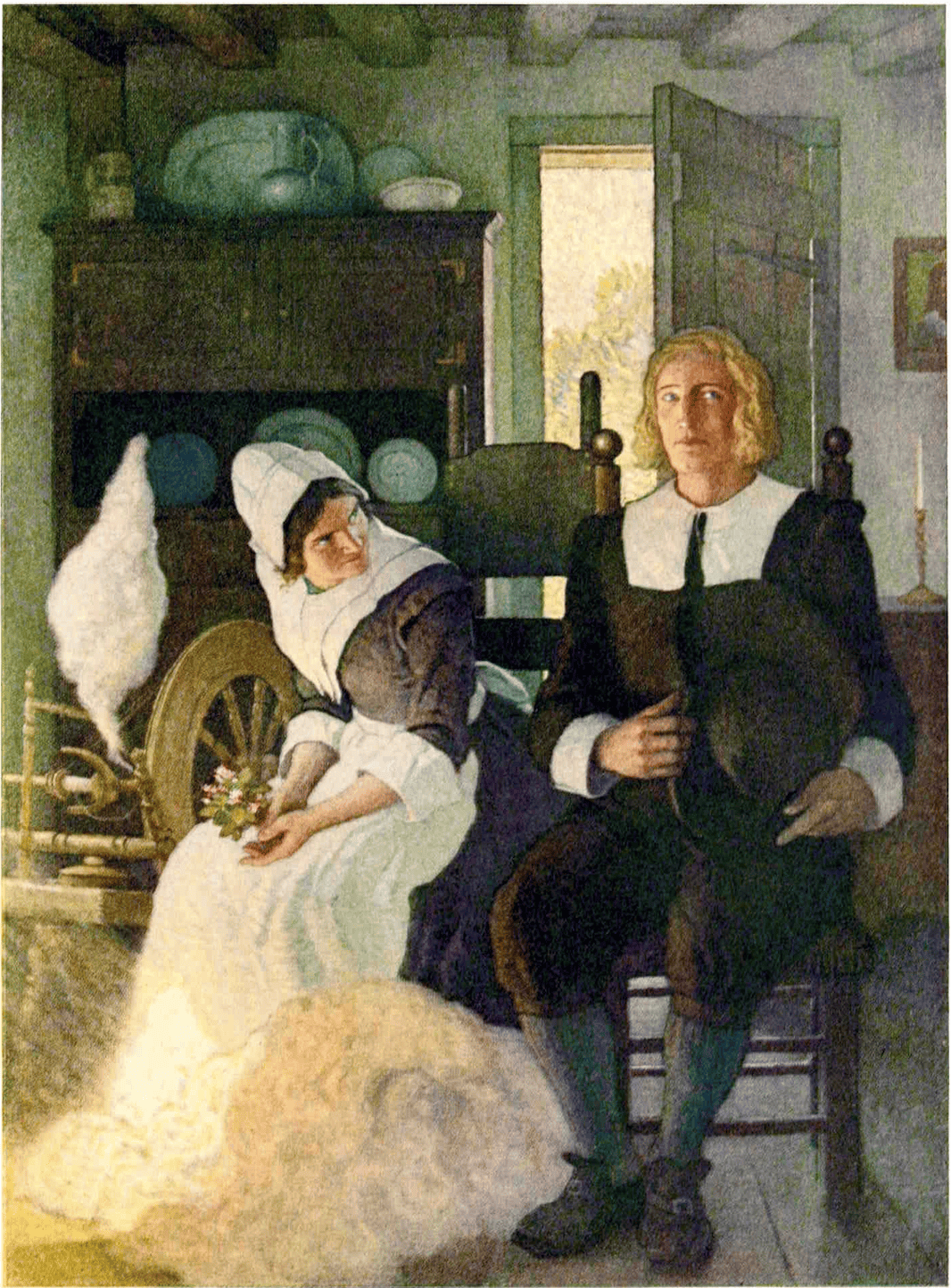
The featured image is “The Courtship of Miles Standish” (1906), by N.C. Wyeth, and is in the public domain, courtesy of Wikimedia Commons.