Among the many characters who played a part in the assault on the citadels of Whig and Anglocentric history was one Malcolm Vivian Hay of Seaton, a Scottish laird, soldier, politician, independent scholar, and polymath. As many-sided as his several pursuits and vocations was the unlikely assembly of loyalties, religious and cultural, that Hay somehow reconciled within himself.
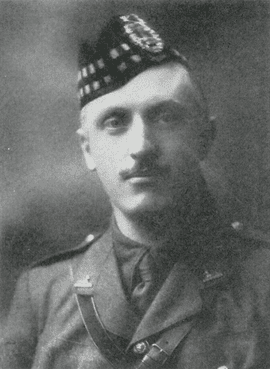
Malcolm Vivian Hay
The writing of Catholic history underwent something of a revolution between the end of the First World War and the summoning of the Second Vatican Council. As with most alterations in the atmosphere of literary culture, it is difficult to summarize briefly the causes of this change. But so much at least can be said: Prior to the opening of this period, it is easy to detect in “Romish” writers of history a sense of apologetic inferiority, and afterward an equally distinct tone of unabashed triumphalism. The difference reveals itself in a thousand points, and anyone who has taken a fair survey of the field may seize upon an abundant handful at hazard. Consider as one example the picture of Philip II as drawn by Lord Acton in his Lectures on Modern History, on the one hand, against the later biographies of W.T. Walsh and Charles Petrie. In the first the Hapsburg king emerges as a standard-order Machiavellian without even the circumspection that is one of the better qualities of Machiavellianism. In Walsh’s and Petrie’s later books there appears a strikingly different portrait: Philip is no longer simply a remorseless imperialist or crowned inquisitor, but a conscientious ruler to whose character a steady and patient sense of duty contributed as much or more than the harshness and bigotry with which he is often charged. The reputation of Mary Tudor, who had been for so long an embarrassment to English recusants and a favored target to sectarian polemicists from Foxe downwards, was similarly humanized by the efforts of Theodore Maynard and Hilda Prescott. One conclusion to be drawn from this is that there is a tidal effect in the valuation of historical figures, and that the tide is predictably inconstant.
Among the many characters who played a part in this assault on the citadels of Whig and Anglocentric history was one Malcolm Vivian Hay of Seaton, a Scottish laird, soldier, politician, independent scholar, and polymath. As many-sided as his several pursuits and vocations was the unlikely assembly of loyalties, religious and cultural, that Hay somehow reconciled within himself. He was a Catholic and a Zionist; a man of cosmopolitan education and connections who was drawn to Scottish nationalism; a Liberal in politics whose writings on British history have a discernably Jacobite flavor. In Hay’s upbringing privilege and tragedy were mixed in equal parts. His parents and elder brother had all died before he had reached his teenage years. His education was unevenly divided between parochial and preparatory schools and private tutors, one of whom was the author Frederick Rolfe, the self-styled “Baron Corvo”, a failed priest, occasional fraud, and man of letters best remembered today for his strangely ingenious novel Hadrian VII and an absorbing and untrustworthy history of the House of Borgia. After the death of his mother, Hay and his brother were removed by maternal relatives to France and settled in a chateau near Angouleme. Throughout his early life Hay moved in exalted circles where encounters with English royals and French pretenders were fairly regular occurrences. His years in France brought their advantages, even if he never felt entirely at home outside of his native country. Certainly he understood his patria better for the formative period he spent abroad. The time of his adolescence looks about as near as an orphan’s life can come to a charmed existence.
Despite the patchiness of his education and his inability to gain entrance into any university, Hay read broadly in history and several bodies of European literature and displayed a preternatural ability to absorb languages (he read Latin, Italian, and French with ease). At school also he appears to have acquired his lifelong attachment to the underdog, which sympathy would become the leitmotif of most of his later literary efforts. As a young man he was briefly employed as the secretary to a member of the House of Commons, and his first important assignment found him sent to Ireland for the purpose of gathering information about the chief republican agitators in that country. Upon his return, his written summary of his fact-finding there was deemed by his superiors too positive in its assessments of the nationalists and not entirely friendly to the prospect of continued English rule in John Bull’s Other Island. Thus Hay was sacked for his trouble. It was the first time Hay found himself harshly dealt with for something he had written, and by no means the last.
In 1914, Hay held an officer’s commission in the Gordon Highlanders, and was in the thick of the fighting during the first actions on the Western Front, where he was captured after receiving a severe head wound at the Battle of Mons. This almost mortal injury put him under the necessity of learning to walk again in a German prisoner-of-war camp, from which he was released the following year. His war experiences supplied the subject of his first book, Wounded and a Prisoner of War, which was published in 1916 during his period of recuperation after being liberated in an exchange of captives. More important work would follow only after several years. It was his second book, A Chain of Error in Scottish History, that brought Hay to the attention of reviewers and the world of historical scholarship, where it provoked a number of vitriolic rejoinders. The thesis he pursued in it was roughly this: that the history of Scotland, especially in its religious aspects, had largely been in the keeping of men who were determined to minimize and belittle the contributions of the Catholic Church to the development of that nation in the centuries that preceded the Reformation, which, in their telling, was little more than the fulfillment of a long-felt desire for independence from the Roman See stretching back almost to the beginning of the Middle Ages. Hay exposed the baselessness of the theory of an “Independent Scottish Church” by reference to the letters of St. Columbanus and other rarely consulted documents of Scotland’s religious past. Reading the Chain of Error today brings to mind the too little emphasized truth that the mistakes of preeminent historians have an irritating habit of surviving them and being passed down as Whiggish heirlooms to their uncritical successors. So thoroughly did he build his case that certain of his public opponents in the controversy the book had raised were compelled finally to raise the white flag and confess the essential soundness of Hay’s argument. The book and the trouble which it raised won Hay friends as well as enemies among the literati of the day: Hilaire Belloc was delighted with it, and Ronald Knox, in an exuberant notice of the work, called it “A book which, were I a millionaire, I would send to every manse in Scotland, for the better instruction of its inhabitants.” Other books on historical figures and incidents followed. Hay’s penchant for independently evaluating the legacies of causes and men too often treated as “settled” led him to write defences of the Jesuit Order and King James II, each constructed to the same almost obsessive standard of comprehensive research.
But the book by which he is best estimated was nearly his last: In 1950, Hay brought forth a volume entitled Europe and the Jews, a definitive history of Antisemitic prejudice and violence from the last centuries of the Roman Empire until the Holocaust. It is his least palatable book and easily his most moving. Hay recognized and acted on the principle that to write the unexpurgated history of anti-Jewish hatred, an author must be no respecter of persons. Though staunchly Catholic himself, he was no more sparing in his treatment of the sufferings inflicted upon Jews by Catholics than in his denunciation of Protestant, pagan, or secular oppressions. Cicero and St. John Chrysostom, Erasmus, and Luther, Pascal and Voltaire, divided by so many generations and shades of belief or disbelief, all make their appearance as representatives of the same age-old enmity against the descendants of Abraham. The book is predictably grim. One of its most heroic qualities is Hay’s refusal to seek facile explanations or designate too narrow a set of historic causes for twenty centuries of sins against European Jewry. He gave proof of the best liberal virtues: a love of fair play, a contempt for bullies, and a willingness to take a stand for the trampled and despised. These shine all the more finely in his writing for being untainted by the liberal’s corresponding vices: bloodless optimism and a shallow habit of believing that goodness and humane decency advance in the public forum in direct proportion as religion departs from it. Hay was well aware that the worst evils perpetrated by Christian kings and bishops against their Jewish neighbors grow rather pale when measured against the crimes of the almost entirely irreligious dictators and commissars of his own time.
As with his earlier studies, Hay wrote Europe and the Jews with a view to explode, or at least to challenge, widespread falsehoods shared by many thousands of the educated or half-educated who take their sense of the past at secondhand. Most of his books were exercises in reaction, and while valuable, they never reached the large audience open to many of his literary peers. His arguments, whether regarding the reputation of the Jesuits or the mistreatment of the Jews, did valuable service in their day, even if they have, along with the author who made them, largely been forgotten or overlooked by the custodians of the historical record. This might not have added much to Hay’s list of regrets. He was not the kind of character to worry much about curating (awful word) his authorial standing, being otherwise occupied in shining his light on some small forgotten acre of the truth. His was not one of the immortal talents of his generation, but it would be hard to point to another more honestly and dutifully employed. This may well have gratified him more than some more dazzling legacy.
___________
The Imaginative Conservative applies the principle of appreciation to the discussion of culture and politics—we approach dialogue with magnanimity rather than with mere civility. Will you help us remain a refreshing oasis in the increasingly contentious arena of modern discourse? Please consider donating now.
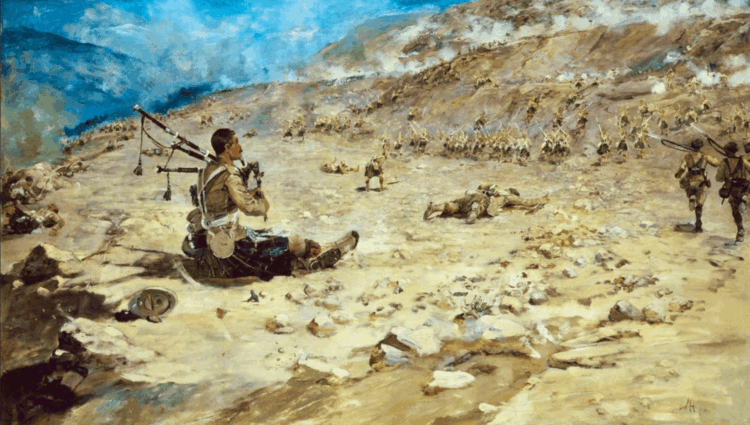
The featured image is “Piper George Findlater (1872–1942), Gordon Highlanders, Winning the Victoria Cross at Dargai, 1897, by Edward Matthew Hale, and is in the public domain, courtesy of Wikimedia Commons. The image of Malcolm Hay is courtesy of Wikimedia Commons.