Georges Tamer does a masterful job at analyzing the impact of medieval Islamic philosophy on Strauss. The author’s findings will surprise many readers who know Strauss chiefly from his reputation in conservative intellectual circles.
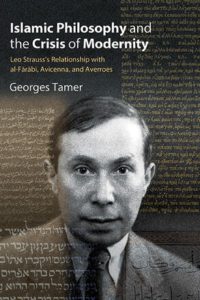
Islamic Philosophy and the Crisis of Modernity: Leo Strauss’s Relationship with al-Fârâbî, Avicenna, and Averroes, by Georges Tamer (336 pages, SUNY Series in the Thought and Legacy of Leo Strauss; Albany: State University Press of New York, 2024).
 It’s true. A spoonful of sugar does help the medicine go down. But it’s the medicine we need, not the sugar. With this understanding, one may happily recommend Georges Tamer’s recently translated book, Islamic Philosophy and the Crisis of Modernity: Leo Strauss’s Relationship with al-Fârâbî, Avicenna, and Averroes. The author makes clear arguments, and his translator writes good English prose. But the book is not light reading. It is a prescription dose of deep research and astute scholarship. Following two hundred pages of densely argued text are 120 pages of appendix, endnotes, and bibliography. Tamer draws information from a multitude of authorities, both primary and secondary. He uses sources written in Arabic, Latin, English, German, and French. Whatever this approach sacrifices in readability, it makes up for in credibility. Tamer knows what he is talking about.
Born in Lebanon and raised in Germany, Tamer currently serves as Professor of Oriental and Islamic Studies at the University of Erlangen-Nuremberg in Bavaria. His degrees include a Ph.D. in philosophy from the Free University of Berlin and a higher doctoral designation in Islamic Studies from Erlangen-Nuremberg. A student of Jürgen Habermas, Tamer has taught and done research at the Free University of Berlin, Ohio State, and Princeton. He is an active member of the Antiochian Orthodox Church for which he helped start a parish in Berlin. This book is an adaptation of Tamer’s doctoral dissertation. It first appeared in print in German in 2001.
For most readers, and especially for American readers, the book’s main allure will be Tamer’s take on Leo Strauss. The author’s findings will surprise many readers who know Strauss chiefly from his reputation in conservative intellectual circles. The book is neither a panegyric nor a polemic. Tamer’s chief purpose is to understand Strauss not to defend or attack him. Tamer’s deep dive into the original sources and scholarly literature are illuminating. He credits Strauss with genuine insight but also reveals flaws in his scholarship. Serious scholarly work on Strauss has boomed in the last couple of decades, both in Europe and in the United States. SUNY Press, for example, publishes a series on Strauss’s thought (nineteen monographs and counting). Such work has flown under the radar. Most non-specialists, whether Straussian or anti-Straussian, have focused on the movement’s influence on contemporary politics and institutions. Such concerns remain tangential for Tamer. He keeps the focus on Strauss and his thought, and his judgments are more convincing for that fact.
Indeed, the book does a masterful job at analyzing the impact of medieval Islamic philosophy on Strauss. In two informative introductions (one for the original edition and one for the English translation), Tamer reviews the literature on Strauss as a philosopher. He then lays out his own scholarly modus operandi. Tamer intends his book to be “a detailed, philologically rigorous, and source-based criticism of both Strauss’s interpretation of al-Fârâbî, Avicenna, and Averroes, and his own understanding of Islamic philosophy.” (xvi) He then asserts that this approach differs significantly from Strauss’s own.
Tamer claims, for example, that Strauss misunderstood and knowingly falsified the writings of the Islamic philosophers. Using library records from the University of Leiden, for instance, he proves that Strauss knew Avicenna relied heavily on a “pseudo-Platonic” fabrication. Records show that Strauss had this book checked out for more than a year in 1931 and 1932. Therefore, he had to know that the book (which included ideas based on sharia law) was obviously “an Arabic forgery” and “not composed by Plato.” (xviii) But Strauss kept this knowledge to himself. He “self-consciously misrepresented,” that is, “certain ideas developed by Avicenna in a manner that served his purposes despite his own self-proclaimed hermeneutic imperative to understand philosophers as they understood themselves.” (xix, 221) Tamer argues that Strauss consistently over-secularized and over-Platonized the Islamic thinkers to make them fit his own philosophical theories.
Tamer also criticizes how Strauss presented his teaching. Throughout his career, Strauss “used interpretation as a means of philosophizing,” He embedded “his own philosophical views within the interpretation of other authors’ works,” but provided no “key” for readers to discern his own ideas. Tamer deprecates this method. By attributing ideas to past thinkers which they did not actually express, Strauss was “projecting” his own ideas onto the past. (xxi) Moreover, Strauss overstated the need for Muslim-world philosophers to hide their actual ideas for fear of persecution. “None of them,” Tamer argues, “were in danger for their philosophical views, not even [the Jewish] Maimonides.” Unfortunately, such misunderstanding fed Strauss’s own esotericism, a mode of philosophizing which Tamer firmly rejects. Philosophy, he says, should be “rationally demonstrable” to “enlighten society.” It “is not to be practiced only within a small, secret circle of philosophers.” (xxii) Certainly, Tamer continues, Strauss’s ideas deserve serious treatment. One should neither dismiss them out of hand nor blindly accept them as incontrovertible “theses of the guru.” (xxiv)
In his introduction to the original version of the book, Tamer reviews previous analyses of Strauss’s work. Among these treatments are those of Strauss friends, such as Allan Bloom, and Strauss enemies, such as Miles Burnyeat and Shadia Drury. Various readings of Strauss have pictured him as primarily a Jewish writer, a Platonist, an atheist, a true believer in revelation, and as an esoteric thinker in the mode of Maimonides and Baruch Spinoza. Too frequently, says Tamer, such books have evidenced “a polemic tone.” Those in Strauss’s circle must accept his judgments while other commentators must shoot at camouflaged target.
These various critiques share two main faults. They all 1) “treat Straussian philosophy one-dimensionally” by focusing on a single central characteristic, and 2) “undervalue his relationship with medieval Islamic philosophy.” In his own work, on the other hand, Tamer pledges to eschew esoteric analysis by “soberly” taking Strauss “at his word.” He vows to explore how engagement with the Islamic thinkers impacted Strauss’s work (including his early, interwar scholarship) and how such engagement affected his “critique of modernity.” (22)
Tamer’s narrative details the development of Strauss’s ideas in the 1920s and 1930s (following his inglorious wartime service in the Imperial German Army). After the war, in serial order, Strauss turned his intellectual gaze from the medieval thinker Maimonides to Spinoza to Averroes (1126-1198) to Avicenna (980-1037, then finally to al-Fârâbî (870-951). Spinoza provided Strauss’s gateway out of the Jewish orthodoxy of his youth and into the world of medieval Islamic philosophy. Tamer demonstrates that these Islamic thinkers were central to Strauss’s principles of philosophy from quite early in his career.
Averroes’s ideas about religion, for example, “remained decisive for the development and formation of Strauss’s political thought.” Three principles were key: 1) religion was a legal code promoted by the intelligent to control the masses 2) religious sanctions and promises of happiness promote social order and are necessary 3) real happiness was only available to “a few wise people.” (29) The purpose of religion, to Strauss’s Averroes, was to uphold the status quo. To this end, religion was an essential part of political philosophy. Strauss read Averroes to say that philosophy had free reign to deal with any matters not specified in the Koran. Early in his career, based on his understanding of Spinoza and Averroes, Strauss accepted a version of “double truth,” a philosophical truth for the rational minority and a mythical truth for the unreasoning masses. (35)
Next up was Avicenna. Strauss interpreted him through a Platonic lens, learning that revelation was essentially political and so a proper subject for political philosophy. (41) By relying on a “pseudo-Platonic” text and putting “words into Avicenna’s mouth,” Strauss overstated both the supremacy of politics over religion and the ability to distinguish true and false prophecy in Avicenna’s thought. A prophet, to Strauss’s Avicenna, is “the mouthpiece of God.” The prophet’s views on revelation take priority even over those of philosophers. (46-47) Tamer then demonstrates conclusively that Avicenna relied heavily on this pseudo-Platonic source. Knowing the truth, Strauss pretended that he relied instead on Plato’s Laws. This double reliance on a forgery, says Tamer, “considerably weakens Strauss’s basic assumptions.” (51-52) Regarding Avicenna, he concludes, Strauss undercut his own most basic analytical principle: understanding the philosopher as he understood himself. Failing to address reliance on this bogus source, Strauss “did not understand Avicenna correctly.” (54)
The most influential Islamic philosopher for Strauss’s thought was al-Fârâbî. Drawing extensively on the ideas of this tenth-century thinker, Strauss had by 1936 developed “the substrate of his entire mature philosophical program.” In future years, according to Tamer, Strauss “would merely extend these fundamental insights to specific topics or adapt them to the American context.” (56) Many ideas garnered from al-Fârâbî appear in Strauss’s book Philosophy and the Law published in German in 1935. According to Tamer, this book showed that Strauss (whose bête noir was historicism) was himself an historicist. Only understanding and interpreting “the history of philosophy” in the manner of al-Fârâbî, Strauss thought, allowed one to purge philosophy both of false religious accretions and of Enlightenment skepticism. Strauss regarded “al-Fârâbî as the philosopher responsible for reestablishing philosophy after its destruction by the domination of religious dogma.” His “medieval rationalism,” Tamer argues, comprised the nucleus of “Strauss’s simultaneous critique of modernity and religious orthodoxy.” To make this critique work, however, Strauss had to secularize al-Fârâbî, ignoring his focus on the afterlife and wrongly portraying him as an atheist. And because Strauss misstated al-Fârâbî’s access to the original Greek sources and understood Arabic imperfectly, his “interpretation of al-Fârâbî lacks a solid foundation.” (ch. 3)
Fundamental to Strauss’s approach was rejection of any “synthesis” between philosophy and revelation. (81) Therefore, he remained interested in the Islamic and Jewish conceptions of prophecy, wherein a prophet sets forth divine law which stands above ordinary law. In this “Islamic Platonic” formulation, “religion is equated with the Platonic ideal state,” and “the prophet corresponds to the Platonic philosopher-king.” (91) Strauss himself, however, believed such revelation merely “functional” and that “revelation must cede it eminent position to philosophy and politics.” (94, 98) For al-Fârâbî, on the other hand, prophet and philosopher unite as the perfect man who founds the “perfect society.” (101) In Tamer’s view, Al-Fârâbî’s vision (unlike Strauss’s) “presupposes the belief in the existence of revelation.” (104)
Citing Strauss himself, Tamer argues that he saw “the Islamic and Jewish religion of revelation ‘primarily as law.’” (105) Yet divine law is dangerous because it is eternal and universal. Not geared—like ordinary law—to the welfare of a particular political entity, it is likely to cause social discord. (111) Strauss interprets Averroes to say that philosophers must contemplate truth, uphold the law in case of any conflict, and share doubts about the law only with a small circle of intimates. Strauss mostly agrees with this view but thinks religion itself demands interpretation. (124-27) For Strauss, the truth of revelation itself is not accessible to reason. But revelation remains necessary for “social peace” and so philosophy must understand its political dimension. In short, says Tamer, “Strauss is an Averroist” who uses religion “as an instrument.” To fight both atheistic liberals and religious true believers, he “forges the weapon of a political philosophy that rests on a theological foundation.” (130-31)
Though “not interested in history per se,” Strauss uses his understanding of the past to promote political philosophy. He considers the latter to be the most important philosophical discipline. (133-34) Strauss interpreted al-Fârâbî to suggest that the greatest happiness of “speculative philosophy” was unavailable to most people (non-philosophers) and therefore that religion/law (practical philosophy) was necessary so that the masses might fruitfully pursue happiness. (136-37) Only life in a political community, says Strauss’s al-Fârâbî, makes such persons “human.” Indeed, those outside society “should be treated as animals.” (138) Philosophers must keep their true (anti-Islamic) ideas secret so that the unphilosophical majority does not turn on them. Thus, philosophers honor religion in public but know that politics comes first. (139)
As the foremost science, political philosophy aims to retain the good in existing societies while purging the bad. It aims to “know” the good (albeit secretly) and not simply to voice prevailing opinion. According to Strauss’s al-Fârâbî, it must avoid contamination from “neighboring disciplines” including history, theology, and ordinary political science. (144) It aims to educate the wealthy because only they have “time and energy to devote to philosophy. (147) Such philosophers are not directly political but rather promote their vision “through the education of aristocrats.” (148, 150) Political philosophy viewed in this way is not simply, as per the Greeks, public action regarding the polis. Rather, it is the art of ruling based on “the natural inequality” of the “ruled and the ruler.” (154)
Strauss, says Tamer, “can only have come to this conception through his engagement with Islamic philosophy, and particularly with al-Fârâbî.” In Tamer’s analysis, the engagement rests partly on the implications of an Arabic word which “originally meant the management and training of animals, especially horses,” whom the trainer needs to make obedient and to ride. (153-54) Thus, philosophers (the metaphorical horse trainers) “come to constitute an elite class.” Even across time and space they share a stronger bond (true knowledge) with one another than possible with non-philosophers (the metaphorical horses). (157) “Noble lies” and “pious deceptions” allow the philosopher (or his student) to function as a “secret king” ruling the common people for their own good. According to Strauss, Marsilius of Padua and Machiavelli merely extended these ideas which began with al-Fârâbî. Pursuing real happiness, then, means using politics to achieve philosophical ends, with religion an expedient and instrumental smoke screen. (161-62) Underlying this interpretive matrix is an assumption that “contemporary philosophical problems” remain the same as those of the past, thus denying “historical contingency.” The “central political problems” remain the same from age to age in Strauss’s view. Recovering the solutions of ancient thinkers therefore is pertinent to the present. (167-68) Suspicions that such esoteric truths, as championed by Strauss, chiefly serve the self-interest of philosophers are, says Tamers, “quite justified.” (169)
Thus, Strauss saw religion as a matter of law rather than of faith. Only philosophers had the “capacity for reason” which could lead to actual knowledge. Between them and “ordinary people,” there lay an “unbridgeable gap.” (173) “Strauss’s critique of religion,” according to Tamer, “contains a hidden critique of Christianity [as more overtly philosophical].” (175, 259-60) Meanwhile, Strauss ignores metaphysics. Yet al-Fârâbî (his muse) put it “at the forefront” of his philosophy. (176)
Next Tamer shows other key differences between Strauss’s al-Fârâbî and the actual al-Fârâbî. Instead of two truths, for example, the medieval thinker urged two paths “to the same goal: to know God through creation.” He urged the use of plain, rather than esoteric, language in striving toward this goal. Philosophy and revelation were both paths to truth, and religion “surpass[ed]” philosophy by being able to draw on both reason and revelation. (178-79). Happiness comes not merely from contemplation but also from personal virtue exercised in the community. (183-84) Tamer shows that al-Fârâbî “was clearly no atheist,” (184) while he believes that Strauss was (232-33). Moreover, the good regime for the medieval thinker is “directed to God.” Its members seek to live ethically by His rules and to know the truth of His creation. (185)
At the end of the book, Tamer credits Strauss for resurrecting the ideas of medieval thinkers “whose books had heretofore been gathering dust.” One “undeniable merit” of Strauss’s approach was to take “the continuity of history seriously.” Thereby Strauss connected different eras and cultures “to each other as though by an umbilical cord.” Instead of a “clash of cultures,” as per Samuel Huntington, Strauss saw “conflict between philosophy and society.” This “meeting of the minds” approach provided a needed corrective to confront “a self-satisfied modern culture.” Critics should take interest in his thought. (185) But scholars, and other interested persons, should also take to heart Tamer’s criticisms of Strauss. He demonstrates conclusively that Strauss got many things wrong. And that fact—perhaps a bitter pill to some and without lots of literary sugar—is the medicine Tamer provides his readers.
__________
The Imaginative Conservative applies the principle of appreciation to the discussion of culture and politics—we approach dialogue with magnanimity rather than with mere civility. Will you help us remain a refreshing oasis in the increasingly contentious arena of modern discourse? Please consider donating now.
The featured image is a detail from “The School of Athens,” by Raphael, and is in the pubic domain, courtesy of Wikimedia Commons.