The ideal for personal and communal renewal is not to return endlessly to man-made programmes to make oneself into a perfect human being, but to God-made love to make us into the perfect man which is Christ. This is why the revelation to St Francis about the primacy of love is of such absolute importance.
 At the first Jesuit retreat that I ever attended, Fr Gittings SJ, the retreat master said that the first Jesuits were the Apostles. They were the first to be admitted to the “Society of Jesus” for almost three years before Christ’s death and Resurrection. The invitation was left open and I wanted to accept it. Who would not want to be admitted into the “Society of Jesus” like the first Apostles? I was only about twelve at the time, but my mind was made up. When the time came for me to take the step that I had been planning for years and my dyslexia ruled it out, it did not stop me wanting to know more about Ignatian Spirituality although I had become a Franciscan. The more I came to know about it, as you have already gathered, then the more disappointed I became. It became evident to me that although Fr Gittings had every right to suggest that the Apostles were the first to enter into the society of Jesus, at least metaphorically, their spiritual journey did not end there, nor did they immediately start out “to set the world on fire”. After the Resurrection they did not immediately rush out to convert the world. They had to wait for the sending of the Holy Spirit, and then wait for that Holy Spirit to remake and remould them into the image and likeness of the One whom they were going to represent.
The first, the sending of the Holy Spirit was instant, but enabling the Holy Spirit to remake them into the image and likeness of their Lord took much longer. It took them many years living in retreat, in Jerusalem, while another apostle, St Paul took almost ten years doing the same in the Arabian desert, and then near his own home, Tarsus. Before the sending of the Holy Spirit they had indeed been members of the “Society of Jesus”, if you want to put it that way, but after the sending of the Holy Spirit the apostles were invited, not just into the society of Jesus, that they had so enjoyed before, but into an even greater deeper and more profound relationship with him. They were invited into, what would later come to be called Christ’s Mystical Body, where, as Jesus had promised at the Last Supper, they would become closer to him than they had ever believed possible. However, love is not magic, nor is the love of God, his Holy Spirit. It has to be freely received, and in years rather than months to bring about an inner purification, so that the fruits of God’s love could animate them, as it had animated Christ. This love would fill them with all the infused or God-given virtutes, that they needed, to do what Christ had done in the Holy Land, in the rest of the world.
That is why the Apostles sought out the time and place for this mystical purification, to prepare them for a union with Christ that could not have taken place before his glorification. The Apostles did not just teach the truths that Jesus had told them to hand on, but the most sublime truth of all, that all were called to a mystical marriage with their Risen Lord for which they would have to be purified, not just for a few years because their purification would, for the vast majority, last for the best part of a lifetime. This purification took place inside the mystical body of Christ, and as it developed, the Apostles were further united with their Risen Lord. It was a mystical union with his mind and heart, with his body and soul, and with his human emotions and feelings too, so that through his human but glorified body, they would be united with his loving of his Father. Remember once again that the word mystical only means invisible, unseen and therefore secret, because onlookers could not see this mystical journey progressing though they could see its fruits in the extraordinary behaviour of those who had been taken up into this Mystic Way. Those who chose to take up their daily cross in prayer to follow this mystical journey came to be called mystics, and their teaching, that grew into a body of specialized knowledge, came to be called mystical theology.
As the most important part of our spiritual journey involves the mystical purification that makes possible our mystical marriage with Christ, for which we were created, it seems incredible that those who choose to join the “Society of Jesus” know nothing about this mystical purification, or the mystical theology that explains it. To deny this teaching, belittle it or even pour cold water on it, and then positively take steps to insulate themselves against it is unforgiveable. It is indeed unforgivable not just to fail, but to refuse to teach young men how to love God by entering into a mystical union with Jesus Christ, by denying them the ancient, age-old teaching of mystical theology, that will alone enable them to do this. Furthermore, it is outrageous to put in its place a programme of self-help, self-awareness, and methods of self-perfection so that they are asked to do for themselves what is primarily the work of the Holy Spirit. In the mainline Catholic tradition, renewal always means going back to prayer, most particularly the mystical prayer where alone a person can be prepared for the mystical marriage to which they are called. In Ignatian Spirituality it means endlessly going back to a programme for beginners that is predominantly anthropocentric, which they not only see as the best possible way to perfection for themselves, but which they endeavour to impose on all others whether they belong to the older orders which are theocentric, or not. The meditation that is detailed in the Exercises is clearly God-centred but when it leads a person to true mystical contemplation there is no further teaching that can lead them onward in the mystic Way, as I, like many others found out for myself. Rather than realizing that the fervour that is lost is one of the signs that may indicate that mystical contemplation has begun, it is more often than not seen as a sign of personal sinfulness or some psychological problem that needs to be resolved before ongoing fervour can be resumed. Always putting the blame on some sort of personal blockage that comes from a person’s spiritual or psychological life is one of the reasons that prevents a director seeing that the Holy Spirit has led a person on and into mystical contemplation. It also absolves them of giving the sort of spiritual help for which they have not been trained and have no knowledge. In this way what is called gaslighting takes place in which the person who is being called to mystical contemplation and purification is made to feel that they are the problem when the problem lies within the ignorant spiritual director who is only competent to help spiritual adolescents. He is only able to help with minor problems, not to assist the Holy Spirit in the major problem of preparing an unpurified human being for union with God. Sadly, this form of spiritual gaslighting is not confined to the narrow boundaries of spiritual direction. When the Jesuit Superior General, Fr Everard Mercurian, heard that one of his priests was supporting St Teresa of Ávila on her mystic way, he immediately sent word that under obedience he had to lead her back to the Exercises devised by his founder. If she had listened to a beginner from another tradition, instead of to her own tradition, the Church would have been deprived of one of the greatest mystical Doctors of the Church. If Jesuits are capable of doing this to St Teresa of Ávila, then they are capable of trying to do it for all, and anyone, as they have been doing for over four hundred years, and to the great impoverishment of the Church.
They must be told forthwith that they must stop spiritually abusing the “great men” that they attract, by omission. By omission I mean by failing to teach them the fulness of the Catholic Church’s Spiritual tradition, and that of course includes its mystical tradition. They must start teaching it from the very beginning of their training in the noviciate, including the teaching of the two great Mystical Doctors of the Church, St Teresa of Ávila and St John of the Cross. If they will not comply then they must be denied the privilege of receiving new novices until they do. If they continue to defy the authority to whom they are bound like no other congregation, then they should be suppressed as should other orders and congregations who follow their bad example. For if this is not done, they will continue to pervert those who come to them, and the faithful at large, not just by omission but by positively propagating pernicious teachings that always prevail amongst all who do not live out the fulness of the Catholic Spiritual tradition. It is not enough merely to live in the “Society of Jesus” as did the first apostles before Christ’s death, they must choose to go onward to die with him, and to die to what St Paul called the “old man” so that they can be reborn by the action of the Holy Spirit to become the “new man” which is Christ.
Their own endeavours may well be able to make them into the image and likeness of Marcus Aurelius, but never into the image and likeness of Jesus Christ. Only love, not our love, but God’s love transforming our love from within can do this. No amount of self-imposed ascetism or suffering can do this, as so many had come to believe in the “Dark Ages”, until God chose to reveal again what he had revealed before, to a lowly draper’s son who abandoned his life to him in such a radical way. This revelation is so important that I would like to tell the story of how it happened, and its implications for a Church desperately trying to renew itself at the beginning of the thirteenth century. We need to hear this revelation again, at the beginning of the twenty-first century, or we will continue to think, behave, and act, as if we can do what only God can do, working through those, who are prepared to radically abandon themselves to him, as St Francis did.
On the morning of the fourteenth of September, the feast of the Holy Cross in 1224, St Francis was praying with his arms outstretched in the form of a cross immediately after Mass and before sunrise. He began to pray for the two things that he believed would enable him to attain perfect identity, with the one he called Brother Jesus before he died. Firstly, he prayed that he would be given the privilege to experience the suffering that Christ endured on the Cross. Secondly, that he would be given the privilege of experiencing the love that drove him to give his all for others. As he was praying he felt a flame of love burning within him with ever increasing intensity. Then he looked up to see an angel that he was given to understand was a “Seraph”. Although it had six wings, two above its head, two to cover its body, and two with which to fly, it had a human body, the body of a crucified man, which he saw was Christ. As he gazed upon the vision with fear and trembling, he was simultaneously filled with joy.
When the vision finally disappeared Francis experienced Christ’s love as never before, while at the same time his body was transformed into the likeness of the crucified man before him who was enfolded by the wings of the “Seraph”. The sources are all in agreement that he was left not just with wounds, but with nails in those wounds. The heads of the nails were in his palms and on the top of his feet while the sharp ends curled round underneath in such a way that it was possible to put a finger through the ring that they made. He was unable to walk until St Clare made a special pair of shoes for him. There have been other Saints who have received the stigmata after St Francis, some invisibly like St Catherine of Siena, some visibly like St Padre Pio, but none of them experienced the pain of the nails in the wounds. This was no psychosomatic phenomenon. It was the real thing never experienced before or after St Francis in quite the same way. Although he tried to hide his wounds from his brothers, the blood was such that it soaked his clothing, particularly the blood from the wound in his side. Despite this Francis was in a continual state of joy which he expressed in a hymn that he composed praising the God who had granted him all for which he had prayed, followed by his beautiful poem to Brother Sun, when he returned to Assisi. In order that we do not misunderstand or misinterpret the meaning of the sufferings for which he prayed, and which he eventually experienced, it is important to understand the secret revelation that Francis received from Christ moments before he received the stigmata.
It was at this moment that Francis received a revelation that would determine the very essence of Franciscan Spirituality and the profound theology that it would inspire. The revelation was simply this. He was given to understand that although he had prayed to experience something of the sufferings that Jesus had experienced on the cross, believing this to be the way to union with him, it was in fact not by suffering, but by the inner flame of God’s love that he would be transformed into Brother Jesus. The very moment that the vision faded he began to feel that flame within him, whilst at the same time he began to notice the marks of the crucifixion looming large on his body. The sublime union that was now taking place, however, was not caused by the wounds that he could see as they became ever more visible, but by the invisible flame of love within that consumed him. For those who could see, this revelation represented a shaft of light that pierced the thick pall of gloom that hung over mediaeval spirituality, giving hope where all seemed hopeless before. A new spirituality was born with a new theology to explain its profound implications. It was Francis who inspired this new spirituality that proclaimed the Primacy of Love, and it was Blessed John Duns Scotus who made it the starting point for the most profound and spiritual theology of love ever written.
From the beginning, authentic Catholic spirituality has been besieged and even overrun at times with alien pagan philosophical “spiritualities” that insisted that the body is evil, or the prison of the soul that must therefore be subjugated by harsh and harmful forms of asceticism that you find nowhere in the Gospels. This is the suffering they chose to bear through self-imposed asceticism, that they believed would lead them to union with God. The Gospel says otherwise. God is love and it is only by love that we can be united with him. It is not our love, but the love of God, sent on the first Pentecost day and on every day to those who are open to receive it. The first Christians were taught how to come to know and love God, by loving his love-made-flesh-and-blood in the person of Jesus Christ through daily meditation. As they learnt to love him and continued to love him when contemplation followed meditation, the deep inner transformation began. In the very act of loving him, these acts of love became a habit of loving that raised a sort of spiritual superhighway that enabled their love, as it can still enable our love today, to rise to him and his love to descend into us. In this way divine and human love meets, mixes, and then merges into one another, enabling us to be united with the God for whom we have yearned for as long as we can remember.
This is the way to God, the way to true happiness and the way, to experience even in this life something of the eternal happiness that God has prepared for us in the next. That is why the revelation to St Francis about the primacy of love was of such absolute importance to people emerging from the “Dark Ages”. It was not revealing a new doctrine of the Church but an old one that had been forgotten; they had forgotten the God-given “spirituality of the heart” that prevailed in the early Church, and how to generate a new form of love in which human love was so suffused and surcharged with divine love that the intimate union with God that had been inconceivable before became, not only conceivable, but possible for all. It was not even the suffering of martyrdom, whether it was “blood martyrdom” or “white martyrdom” that united you with God, but love; the love of God that penetrated pervaded and propelled human loving, that was developed in deep personal prayer, and purified and perfected in mystical contemplation.
If there were some acts of heroism, and even eye-catching feats of asceticism in those early days, they were not the acts of Catholic stoics trying to make themselves perfect. They were outward expressions of men, women and children animated by and inspired with the love of God. Later admirers who were inspired by them and wished to emulate them, made the mistake of thinking they had to copy their acts of superhuman asceticism if they wanted to follow them. What was in fact needed, as the revelation to St Francis underlined, was that they should rather generate the quality of personal prayer that could alone enable them to generate the love that could unite them with the One who makes all things possible, even the impossible. It was for this reason that, as you can still see today all over Franciscan Italy, hermitages were built to enable the friars to generate this love, and the mystical contemplation in which their loving would synchronize with the loving of Christ directed toward God in prayer, and indirectly in loving God in the neighbour in need.
Salvation, sanctification, and sanctity then does not involve the arduous task of trying to free oneself from a world in which all things are evil or infected by evil and imposing on oneself a form of inhuman ascetism that you find nowhere in the teaching of Christ, but everywhere, where the influence of Manichaeism still abounds. Nor does it consist in submitting oneself to a code of Spiritual Exercises that promise to make you perfect by methods, techniques and practices that have more in common with Socrates, Seneca, and Marcus Aurelius than with Jesus, Mary, and the first apostles. That is why the ideal for personal and communal renewal is not to return endlessly to man-made programmes to make oneself into a perfect human being, but to God-made love to make us into the perfect man which is Christ. In his diary, St Ignatius wrote that above all other saints he wanted to emulate St Francis of Assisi. What a pity that he never really understood him and the revelation of love that enabled him to re-introduce the God-given spirituality of love that prevailed in the early Church.
I have never been privileged to receive any revelations except one that I was so unpurified that it took years for me to understand it, so it took years for it to get through to me. However, I did finally get the message that I now hand on to you. Give all the time and energy that you have been giving as a Catholic stoic to making yourself perfect, to God. More specifically give it to him in daily prayer as the first Christians did, and he will do what you can never do for yourself, through his Holy Spirit. Then I promise you that the perfection that you desire will be brought about by being transformed, not just into a perfect human being, but into the most perfect human being who God created for that very purpose. What happens next is, “as they say”, history, the Salvation history that we experience being brought about within us, as it is brought about in all who, like that young draper’s son, abandoned himself totally to the Lord of History.
___________
This essay is chapter fifty-eight of The Primacy of Loving and is published here by gracious permission of the author.
The Imaginative Conservative applies the principle of appreciation to the discussion of culture and politics—we approach dialogue with magnanimity rather than with mere civility. Will you help us remain a refreshing oasis in the increasingly contentious arena of modern discourse? Please consider donating now.
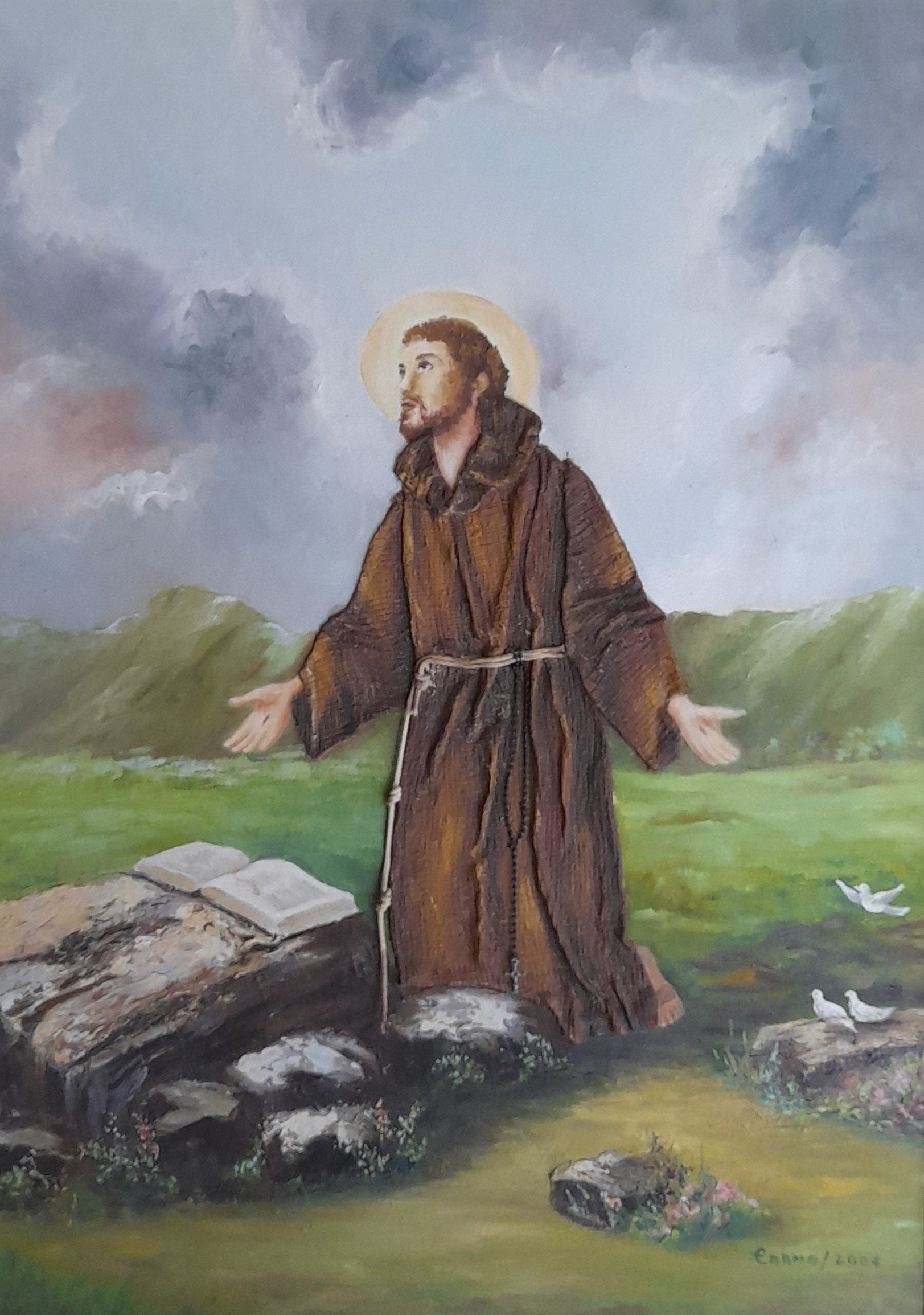
The featured image, uploaded by Pedra do Sal, is “São Francisco,” by Chagas Ducarmo Teles. This file is licensed under the Creative Commons Attribution-Share Alike 4.0 International license, courtesy of Wikimedia Commons.