Maurice Baring’s novel “The Lonely Lady of Dulwich” takes us from the calm before the storm, through the storm itself, to the peace that emerges after it. It would not be appropriate to reveal the lonely lady’s secrets, which are for the readers of the novel to discover for themselves.
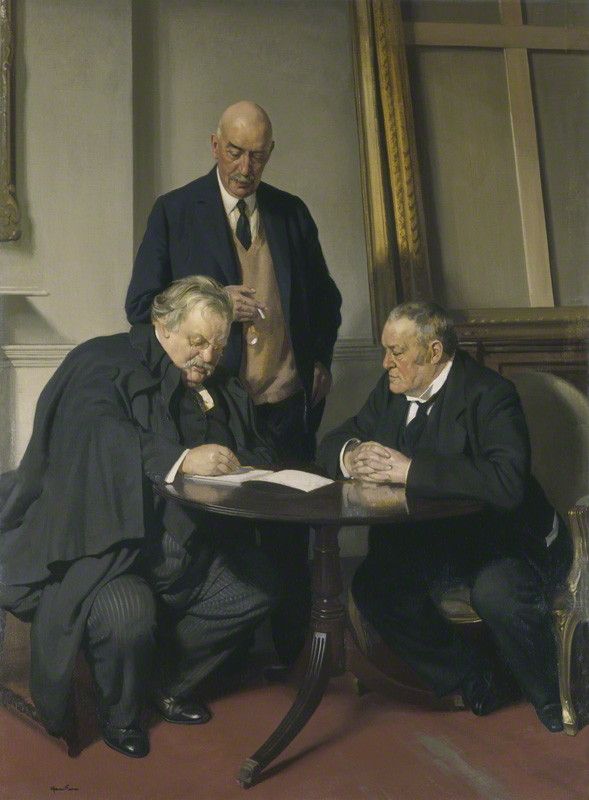
By Sir James Gunn, oil on canvas, 1932 (National Portrait Gallery, London)
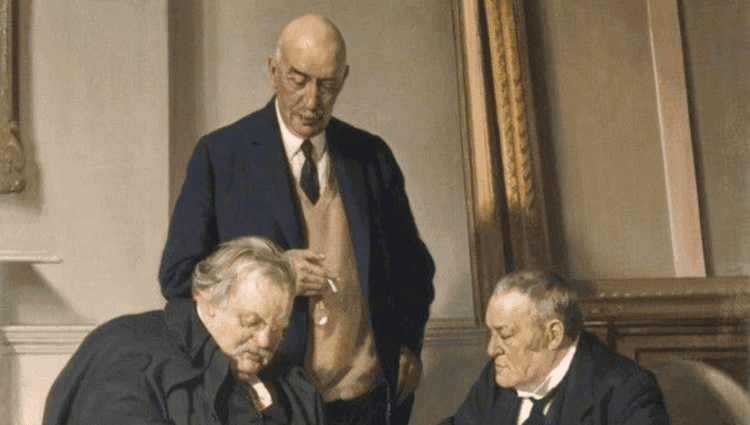
Before Maurice Baring’s lonely lady can be introduced, it will be necessary to introduce Maurice Baring himself. Although he is largely unknown today, he was one of the most famous writers in the English-speaking world a century ago, and not merely in the English-speaking but in the French-speaking world also. He was a celebrated member of the “BBC” immortalized in a famous portrait by Sir James Gunn, which was first exhibited at the Royal Academy in 1932 and can now be found in London’s National Portrait Gallery. The “BBC” in question was not the recently founded British Broadcasting Corporation but the triumvirate of great Catholic writers, Belloc, Baring and Chesterton. In the portrait, Baring is to be found standing between the seated figures of his two great friends, both of whom are better known today than he is. With his customary whimsical wit, Chesterton named the painting “Baring, Over-Bearing and Beyond Bearing”.
Some indication of Baring’s importance to the Catholic Literary Revival can be found in Melanie McDonagh’s recently published book, Converts, which has the somewhat convoluted subtitle: “From Oscar Wilde to Muriel Spark, Why So Many Became Catholic in the 20th Century”. In McDonagh’s book, Maurice Baring has a chapter of his own, sharing equal billing in this regard with Oscar Wilde, Evelyn Waugh and Graham Greene. As for the other two members of the “BBC”, they have to share a chapter entitled “G. K. Chesterton and the Chesterbelloc”.
Having established Maurice Baring’s fame and celebrity status in the period between the two world wars, let’s examine the reason for such fame and celebrity.
During the period between the wars, Baring was a bestselling novelist, whose novels were very popular internationally, being translated into French, Spanish and Portuguese. Born in 1874, the same year as Chesterton, he would die in 1945 from the debilitating effects of Parkinson’s Disease. All his novels, on which his reputation chiefly rests, were published between 1921 and 1935. A convert to Catholicism, he was received into the Church in 1909. His popular and highly regarded novels include Robert Peckham, an historical novel set during the Tudor terror of the sixteenth century, and several novels set in contemporary England and Europe.
Hilaire Belloc considered one of Baring’s novels, Cat’s Cradle, to be “a great masterpiece… the best story of a woman’s life that I know”. G.K. Chesterton wrote that he had been “much uplifted” by Baring’s novel The Coat Without Seam, comparing it “with much of the very good Catholic work now being done, especially in France”.
The theme of his first novel, Passing By, is self-sacrificial love and the destructive consequences of its sinful absence. This understanding of love informs all his novels, as does a real sense of divine providence, a fact which earned him the respect of the great French novelist François Mauriac. “What I admire most about Baring’s work,” Mauriac wrote, “is the sense he gives you of the penetration of grace.”
The presence of grace, of which Mauriac speaks, is discovered in the mundane events of everyday life, in the little and almost unnoticed sacrifices made by his characters, and in the manner in which they embrace the sufferings of life. One such character, a priest, in Baring’s final novel, Darby and Joan, explains that the acceptance of sorrow is the secret of life. When we understand this, he says, we will understand everything. The secret is not sorrow itself, or suffering, but its acceptance. It is in the acceptance of suffering, the taking up of the cross, that grace is present in Baring’s novels. From a Christian perspective this is also the way that grace becomes present in the real world. In this sense, we can say that Baring writes realistic fiction, rooted in the supernatural realism of God’s presence.
Another facet of Baring’s work is its aestheticism. A highly cultured man, deeply aware of the presence of beauty, his novels demonstrate the power of art to change lives. This power permeates the whole of Baring’s finest novel, C, his magnum opus. In this marvelous work, the protagonist, who is known simply and enigmatically by the solitary initial, which gives the novel its title, is molded by his experience of the arts. The young protagonist is swept away by Romantic poetry and by the epic sweep of Wagner’s operas. The arts don’t merely influence him in some passive sense, they possess him. It is almost as though his identity is subsumed within the artistic reality of Romance and epic melodrama so that he no longer knows who he really is. The arts forge him and also make a forgery out of him, turning him into something counterfeit and less authentic than he is meant to be. It becomes a false god, an idol. There is in the protagonist’s experience something that reminds us of Dante, an intertextual dimension highlighted by the appearance in the novel of the aptly-named Beatrice, a character who offers an alternative vision of beauty. The novel is slow, the first part of it documenting C’s engagement with the arts, but the reader’s perseverance is rewarded as the conflict between aesthetic ideals and ethical truths runs its course.
Although Baring was best-known as a novelist, he also wrote plays and poetry. With respect to the latter, he is one of the finest poets of the twentieth century. His sonnets on Mozart, Beethoven, Wagner, Tolstoy and Dostoevsky demonstrate the breadth and depth of his masterful engagement with the finest culture. A gifted musician, he was also a polyglot who had mastered Greek, Latin and French as a child, and German, Swedish, Italian and Russian during his travels as a diplomat and journalist.
Part of the reason for the decline in Baring’s popularity is the general decline of cultural literacy. The coming peril was not bolshevism, said Chesterton, but standardization by a low standard. It is this dumbing down of culture to the lowest common denominator of crass banality which makes Baring unreadable to many in what Evelyn Waugh called our deplorable epoch. When reading Baring, we might be reminded of what Chesterton said of his friend, Father Vincent McNabb. Speaking of Father McNabb’s sanctity, Chesterton wrote that the saintly Dominican walked on a crystal floor above his head. When reading Maurice Baring, we might feel that he is also walking on a crystal floor above our heads, not so much in the sense of his sanctity but in terms of the breadth of culture that he possesses and which we lack. He is so well read in so many different languages and so well-versed in the full panoramic landscape of western literature, that we find ourselves in awe at the depth and the breadth of cultural experience from which his deep draughts of brilliance are drawn. Reading him is humbling. It is hard work. It makes us aware of our limitations. His great but neglected genius is nonetheless worth the effort because the gain far outweighs the pain.
Having introduced Maurice Baring, it is time to mention his “lonely lady”, the eponymous protagonist of his novel The Lonely Lady of Dulwich, published in 1934. Zita Harmer (née Mostyn) is the youngest of the three daughters of Oliver and Dolores Mostyn. Her father was “half Irish, with a dash of French blood, educated in Germany and Paris and widely travelled”. Her mother, née Foyle, was “an American from the South, who had been brought up in a French convent”. They had met in Paris and were happily married, in spite of Oliver’s failure to make much money, his being “nearly successful in so many enterprises and undertakings”. The family’s poverty, exacerbated by Oliver’s addiction to gambling, led to Dolores pinning her hopes on her daughters marrying well.
Zita marries Robert Harmer, “a North-country Englishman, a banker, successful and well-to-do”. He is not worried that she is a pauper, nor that she is a Catholic. “[H]e thought it did not matter what the religion of women was, and not very much what that of men might be, unless it made things inconvenient.” Zita “was not in the least in love with him” and their marriage, conventional and outwardly successful, becomes a source of great loneliness for her. She craves friendship and warmth from a husband whose stoic aloofness keeps him always at an emotional distance. The vacuum created by the emotional distance between husband and wife is filled with temptations. There are the advances of a passionate French poet and the understated charms of an up-and-coming British journalist, who had lived and worked for some years in America.
It would not be appropriate to reveal the lonely lady’s secrets, which are for the readers of the novel to discover for themselves. It might be said, however, that the secret of the novel itself is to be found in the Latin epigraph by Thomas á Kempis which the novelist chooses to place at the very beginning as both a clue and a curtain-raiser for all that follows: Post tempestatem magna serenitas. After the tempest, great serenity.
The Lonely Lady of Dulwich takes us from the calm before the storm, through the storm itself, to the peace that emerges after it.
No more should be said. Having introduced Maurice Baring’s lonely lady, the present writer hopes that his readers might want to know her better. They are invited and indeed encouraged to introduce themselves to her by opening the pages of the novel.
__________
The Imaginative Conservative applies the principle of appreciation to the discussion of culture and politics—we approach dialogue with magnanimity rather than with mere civility. Will you help us remain a refreshing oasis in the increasingly contentious arena of modern discourse? Please consider donating now.
The featured image is courtesy of London’s National Portrait Gallery and is used here with permission.