I cannot, by myself, eclipse the darkness of disconnection, growing illiteracy, and lives filled with an infinite scroll. But in my work as an artist and especially in these sincere, thoughtful encounters with art, I can offer a small light showing the way out, and, hopefully, a permanent reminder etched into hearts of who we have been and who we can still become.
 We are becoming illiterate.
For many older demographics, this is true in a kind of atrophied or analogous way. The pre-internet age grew up differently, and now we are becoming less intellectually muscular as our attention frays due to the rapid influx of stimuli in our online worlds.
For the young, however, “illiterate” is becoming an increasingly literal, accurate term.
The conversation around this phenomenon is growing everywhere, in person and online. Anecdotally, professors and teachers are stumbling into new thresholds of shock at the degrading of the interior life and intellectual formation in those they teach.
Many of their students, increasingly, can barely read or comprehend what they are reading.
The effect seems to worsen every year.
Corporately, our attention is fading, as every age group grips onto short-form video like a kind of life ring in a sea of chaos, blocking out “wars and rumors of wars,” both real and symbolic, and signaling a constant, numbing, apocalyptic threat while we sip our lattes.
Reading time, even among the academics and previously avid readers and writers, is plummeting. Everyone is disappearing into a cloud of incessant noise and simulacra. We are Odysseus without the mast, with our entire lives passing us by as we are spellbound by our technological sirens.
While I believe I have some solutions, I am not immune to this, and have become fascinated by the extended experiment my life has become.
As iPhones first began to enter human social life, I was digging through Aristotle and Aquinas and Bernanos, ravenously underlining difficult passages of Kant, learning and teaching polyphony, and wandering over cobblestone and through art museums in Vienna on the occasional day off. Despite the full schedule, when we needed a break, we met for time-indulgent dinners. We froze in the brutal cold of winter, speaking through chattering teeth as we huddled over mulled wine at the Adventmarkt. We stopped to chat on the gravel walkway, even when late for class. We got milk and sauerkraut from the local farms. We prayed. Somewhere in those 80-hour, all-consuming weeks, I still regularly wrote songs.
I had no sense whatsoever of the tectonic shifting taking place away from my infinitesimally small castle-turreted corner of the world.
I was shocked the first time someone took a phone out mid-conversation some time in 2014 after I had moved on from my studies and returned to Canada. Immediately, without a blink or warning, this little handheld machine had incinerated the human connection.
I learned that day that a machine could be more important than the sentence I was forming specifically for the person in front of me. I learned how rapidly the glitter of the machine could rob us of everything that mattered.
I fought to keep the attention I had remarkably not lost in a time when it had already rapidly faded for others. Not only had I not lost it, but the opposite was the case: I had been strictly and deeply cultivating it for years on end prior. My entire life was focused attention, even to the point of exhaustion. I knew it was hard won, and precious.
By the time I got to Los Angeles in 2018, still trying to hold the line of my attention, I was relieved to be in a place with so much going on so that my free time could be filled with people, artistic projects, and the buzz of the city rather than the growing Goliath temptation to scroll away my life.
But with the virus shut downs of 2020, and my truly human life utterly dependent on relationships and locations outside of my home, I caved. I have since watched the rot enter and transform my own time, life, and ways of relating.
I, too, am slowly becoming less literate.
I, too, am slowly becoming less human—less deeply engaged with reality.
There is no easy way out of this. All we have is the hard road of consistently re-wiring our brains around intentional reality, presence, and the work of the mind, heart, and body. It is not lost on me that the stakes have become almost infinitely higher with the ubiquitous use of AI.
(It is also not lost on me, either, that I struggled notably to access the word “ubiquitous”—what’s that word again?—and asked AI for help.)
I believe meaningful encounters with the deeply human, but especially the things which point even deeper toward our own essence and into the Divine, is the most effective way to re-engage our desire for more out of life and re-wire our brains and hearts away from compulsive entertainment. Thoughtful artistic avenues, especially those with a heavy emphasis on audio and visual to start, seem to be a real route back. Where the mind may lag in lethargy due to the atrophy of attention, the heart can yet burst forth from the depths, responding from a place less easily and immediately wrecked by the war on our vulnerable neuroplastic synapses.
Directed engagement with art, especially that of others which whets our own unique desire to create, seems to be a critical bridge back.
To this end, although more from intuition than stark intentional contrast, I created my Art Episodes a few years back: a guided encounter with mixed media to allow, for a brief half hour, the choice of attention, reflection, presence, and a personal response.
Filmed monthly during Covid with limited studio possibilities in my home space, they carry an unmistakable mark of the imperfect real. There is little sheen. This lack of veneer has become, I believe, only more of a feature and less of a bug as many grow weary of the dominant artificial.
I have now formed them into a course format, believing that a few small but focused and sincere encounters with the world of art can help claw back some of our humanity again. A meaningful encounter with something deep, beautiful, and real, calling on the truest parts of ourselves, can transform a life forever. Bringing about that encounter in our current milieu is a worthy challenge.
While all of us are increasingly in need of this encounter of the heart with reality, it is especially true for the very young.
Many of us still have the memory of a world where attention was the default; where boredom was common and offered a precious vacuum for inspiration; where we hadn’t been so conditioned to immediate return and gratification from things that demand nothing of us. We sense a choice before us, even while we usually override the good inspirations to read, pray, slow down, deeply live. We need something to help us regain what has been lost and help us choose the good we know.
But for someone raised on the machine, in a degrading commons, at a fever pitch of politics and division, and by the inattention of many of the adults around them—as most of our young have been—we need to give them this gift of our memory while it is still in view.
I cannot, by myself, eclipse the darkness of disconnection, growing illiteracy, and lives filled with an infinite scroll. But in my work as an artist and especially in these sincere, thoughtful encounters with art, I can offer a small light showing the way out, and, hopefully, a permanent reminder etched into hearts of who we have been and who we can still become.
I would love to see many—individuals, parents, teachers—benefit from these encounters as a tool to begin the hard work of tilling the soil of souls: our own and those of whom we love.
__________
The Imaginative Conservative applies the principle of appreciation to the discussion of culture and politics—we approach dialogue with magnanimity rather than with mere civility. Will you help us remain a refreshing oasis in the increasingly contentious arena of modern discourse? Please consider donating now.
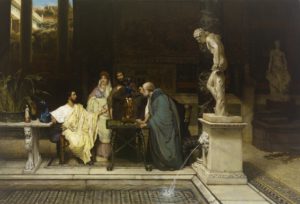
The featured image is “An Art Lover (1868), by Lawrence Alma-Tadema, and is in the public domain, courtesy of Wikimedia Commons.