The problems of what passes for higher education today are many and deep and entrenched. The time for major reform is at hand. This collection of essays, edited by Kevin Roberts, is an important part of the effort to hurry this process along.
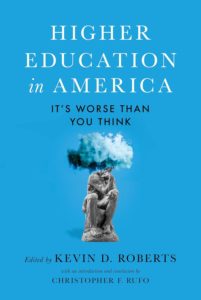
Higher Education in America: It’s Worse Than You Think, ed. Kevin D. Roberts (291 pages, Encounter Books, 2026)
 This promises to be a book review, if one of a somewhat unusual, maybe even highly unusual, sort. Bear with me at the outset, since the outset will be briefly autobiographical and far from devoid of questions—questions that might seem to be pointless, even irrelevant, but aren’t.
I was a graduate of a Jesuit college long enough ago that it was an actual Jesuit college (as opposed to one operating somewhere in alignment with “the Jesuit tradition”). Following college, I was off to the University of Minnesota and graduate school in history with the vague goal of someday teaching at a college similar to the one that I had attended.
Married and with a child on the way, I was an ABD (all-but-dissertation) when I took a teaching job at a suburban Minnesota community college. My academic adviser strongly suggested that I reject the offer, since I would then be “typecast” as something other, and something less, than a college prof. No matter. I needed the job, and at a time when academic appointments were becoming increasingly scarce to obtain. Besides, my father was one of the founding fathers of what had initially been the two-year “junior college” movement in the state. In addition, I had spent the first two years of my post-high school education at the local JC. I thought that doing so was something that I owed to my father.
Well, typecast I became and remained, and not just while I ground out the dissertation, but for multiple decades beyond. Hitting the classroom in the late stages of the war in Vietnam and in the immediate aftermath of the heyday of the original civil rights movement, I viewed part of my task as giving my students a left-of-center account of American history. In any event, such a task came somewhat naturally to me. The other half of me is Irish-Catholic and solidly Democratic, meaning pro-FDR, pro-Truman, and very much pro-Hubert Humphrey and the Minnesota DFL (as in Democratic Farmer-Labor party). That leaves my Iron Range Swedish-American father to be factored into the equation. Let me just offer that I can still close my eyes and see both his large Humphrey button and his even larger Stevenson button.
But now let’s leap to my early teaching days and my self-assigned task. How did that go? In a few words, not at all as I had expected. Why not? Put simply, it didn’t take all that long for me to realize that the main story that many of my students already knew was essentially the same story that I was intending to teach them. In other words, I would estimate that the long march through the institutions has been going on for a very long time and on many different levels.
Still, being a sometimes slow learner, it perhaps took me longer than it should have to tilt in the other direction. And I have been tilting in that direction, and I hope not at windmills, ever since.
At the same time my students could not readily or easily tell. In fact, if I had a new intention it was to be as apolitical as possible in the classroom. And yet there could be a giveaway, maybe even a dead giveaway. For example, one day a student stopped by my office to ask a question: “Aren’t you on the conservative side?” Yes, I conceded. But now it was my turn to be curious, so I asked him how he had detected that slant, if it might be called that. “You defend the founding of the country,” he quickly replied. Well, yes, as a matter of fact, I did—and do.
Now for a few more questions, questions that I trust—and I hope you trust—will soon lead to a few comments on the book. Years ago I recall asking a relative who worked for a large company what sort of education her company looked for when hiring recent college graduates. Her immediate response was this: liberal arts majors with at least a B average.
Not business or marketing majors, I pressed. Not at all, she replied. We can teach them what we need them to know about the business. We just need to have some assurance that they can think, and read, and write.
Fair enough, but one wonders if that would be the response today. After all, liberal arts majors are a) in much shorter supply; and b) cannot necessarily assure employers that their string of straight-A work in a hodgepodge of courses is evidence of any degree of mastery of the processes of thinking, reading, and writing.
Jumping to more recent times brings me to a different sort of question. Now a very veteran teacher, I was giving students my opening-day, congratulatory pep talk on the virtues of taking their introductory survey courses at a community college. Of course, if you can afford Minnesota colleges such as St. John’s or St. Olaf or Carleton, go for it, I would add. But here (as opposed to the University of Minnesota or a state college) you get twice the deal for a fraction of the cost. Why? Because I read and grade your exams and papers, and not a teaching assistant. And as an added bonus, I can be on hand to answer your questions and enjoy a cup of coffee with you.
At that point a student, in point of fact, had an immediate question of his own: Didn’t I think that we should do things here the way that things are done in Europe and pay for students to go to college?
Sometimes it can take me at least a day or two to think of any, let alone the right, response to a question. But this time I bettered my usual self: Well, in the first place an open-door, second-chance school like this simply wouldn’t exist, I told him. Secondly, did he think that Europeans would tax themselves and endorse government expenditures for just anyone to go to college? Instead, in most European countries students are tracked, maybe even typecast, as early as the age of twelve. Finally, did he think that wily Europeans would be so foolish as to pay any and everyone to major in what they might choose for a major?
One more biographical note, if I might. Sometime in the late 1980s, I began to experience a then-strange new presence in my classroom, perhaps even a hidden presence. In other classrooms their presence might be labeled as curve-wreckers, but not in mine since I didn’t employ that grading device, preferring no A’s or a few A’s or many A’s, as the case might be.
In some classrooms, that label could get tossed around in reference to adult students, mostly women to be sure, but now and again I would have an occasional member of the opposite sex in a class. While I may have had many of one and a few of the other, there was nothing that could be hidden about the non-college age of any of them.
Have you by now guessed the general identity of this strange new presence? If not, here it is: homeschoolers. And if you were at all impressed with my quick response to the “free college” question, you are at liberty to be highly critical of my initial reaction to my becoming aware of their pre-college learning experience. At best, that reaction was one of suspicion, not hostility, mind you, but genuine suspicion, tinged with negativity.
That conceded, it generally didn’t take me all that long to realize that these were, far more often than not, easily among my best students. In other words, I’ve long been of the mind that public grade schools, middle schools, and high schools in America are also, to borrow from the subtitle of this book, “worse than you think.”
Which finally brings me to the book actually under consideration here. In one way or another, it deals with much that coincides with my own history as a student and as a teacher—hence the above paragraphs that might, but I would hope not, be dismissed as an unnecessary detour at best or completely irrelevant at worst.
This book is a collection of essays that can easily be summarized in a very few words: Yes, the authors of these essays are convinced that the shape and practice of higher education in America is worse than you think, and possibly even much worse than you might suspect. And while I am at, I am in full agreement that they are very much on target.
Who then might be the intended target for this collection? Any concerned citizen, of course. But a more specific roster would include parents and their high school juniors and seniors and/or the equivalent thereof, state legislators, and boards of regents/overseers, college alumni especially those willing and able to respond favorably to dollar pleas from their alma maters, and millionaires and billionaires who might have a considerable pot of money to put to use to start a new college from scratch.
Why not current or retired college faculty and/or administrators? They likely fall into one of two categories: 1) Those like me who need no convincing; 2) Those who are part of the problem and therefore want no part of ending either the gravy train that exists as it is or the student indoctrination that is taking place.
There might well be a dividing line of a very different sort among the authors of these essays. On the one hand, there are those who think that the existing system can be reformed, especially by way of creating classical centers within existing institutions; on the other hand, there are those who have become convinced that the only solution is to start over by creating entirely new institutions. No doubt there is plenty of room for both.
At the same time, there is also no doubt that the Robert Conquest rule of thumb ought to be kept in mind: Any institution that is not explicitly conservative will gradually move to the left over time.
At the risk of repetition and overload, one more “no doubt” must be added. The fact that serious, thoughtful, concerned people have arrived at the second conclusion, meaning the start-over conclusion, is solid evidence of the depth and intractability of the problem.
There are those on the left who like to think of America today as unfortunately lodged somewhere in another gilded age, akin to that of the late-nineteenth century. If so, one might hope so, especially when it comes to higher education. During the original Gilded Age, the well-monied created Stanford, Vanderbilt, and the University of Chicago. Maybe it’s high time that this happened again. Strike the “maybe”: It IS high time for such a time.
In addition, it was during those years when all-encompassing research universities began to become prominent. The case was made then that it was high time that higher education in America get above and beyond being little more than providing finishing schools for the elite and/or would-be poor imitations of seminaries for their undergraduates.
There is a certain irony about this. One of the themes that runs through more than one of these essays is that colleges have become not much more than country clubs for undergraduates. It’s time to get back to the basics. In other words, no more college as a different sort of finishing school, and no more college as ideological seminary/training ground for would-be political radicals/revolutionaries.
Christopher Rufo offers a final essay in which he provides brief, but pithy summaries of his fellow contributors. His own summary of what needs to happen is equally brief and pithy: It’s time to “make college hard again.”
The Heritage Foundation has assembled a fine cast of characters to comment and assess everything from the state of college finances and curricula, the lack of political and intellectual diversity, and issues of recruitment, accreditation, wokeness, plagiarism, ant-semitism, among not a few others. Among the better-known essayists are, in no particular order: Mark Bauerlein of Emory and First Things; Patrick Deneen of Notre Dame University; Larry Arnn of Hillsdale College, Kyle Washut of Wyoming Catholic College; Carol Swain of Vanderbilt University; and George Harne of Christendom College.
Among the lesser-known essayists, some speak to me more than others. But each of these essays is also well worth reading, and each will speak in its own way to any number of potential readers.
At the risk of giving too much away, but in hopes of stirring wider interest, a closer look at a few entries ought to at least nudge the entire piece a bit further in the direction of serving as a traditional book review. One Inez Feltscher Stepman, senior policy analyst at the Independent Women’s Forum, examines “How Colleges Undermine Men and the American Family.” Her opening assumption is indisputable: “Women currently dominate higher education.”
On one hand, women earn just under 60 percent of all bachelor’s degrees. More than that, according to a Pew Research Center poll, among young adults, ages twenty-five to thirty-seven, 47% of women, compared to 37% of men, have an undergraduate degree. A good deal flows from that.
It is that “good deal” that most concerns Stepman. For example, women “cluster in majors” that often result in lower salaries after graduation; therefore, women hold almost two-thirds of outstanding student-loan debt. More than that, the same jobs that not that long ago did not require degrees or debt now require both.
Veering into the consequences of this, she notes not just delayed marriages and smaller families, but the “increasing polarization of politics by sex.” Put simply but directly, married women, married men, and single men all vote Republican by relatively moderate numbers (somewhere between 52% and 59%), but a “whopping 68 percent of single women vote Democrat.”
Far from finished, Stepman contends that “an overproduction of a female college-educated elite has changed the culture of truth-seeking on campus.” Still not finished, she adds that this has “worsened the debt crisis, delayed family formation, and driven polarization by sex.”
STILL not finished, she cannot resist adding that getting a college degree “has never been more of an antagonistic endeavor for men.” Which brings me back one more time to my own college teaching career. Not long before I retired, I had a young man in class who seemed to be quite interested and serious about his education. Then came his first bluebook exam. I would always read such exams with the cover page turned back, so that I did not know the name of the student. In this student’s case he answered the first question, and then I turned the page. At that point he simply wrote me a note.
The essence of his communication to me was that he didn’t want to be in college. What he really wanted to do was work with his hands. I wrote a note to him, wished him well, and commended him for his self-discovery. He did not complete the course, but I mailed him his exam with my comments.
Clearly, we are forcing too many young men, and young women, into colleges. Just as clearly, many families are discovering and deciding that college is a waste of time and precious resources. As a result, colleges are not just downsizing, but in some cases closing.
A significant part of the current enrollment decline is indirectly traceable to excessive college enrollment over the course of many previous decades. And that excess was encouraged by the routine accessibility of federal loans, as more than a few of the essays in this collection rightly note.
The ease of obtaining such loans spiked the number of enrollees, and the increased numbers were placated with easier and easier courses, accompanied by higher and higher grades. It was assumed to be a win-win-win situation for all concerned, meaning students, parents, and the institutions. And perhaps for a short time it was. But that time is long past.
Instead, it’s now time for the federal government to get out of the undergraduate loan business. Turn this task over to the colleges themselves and/or to private lending institutions. Maybe then, more care will be taken when it comes to searching for a loan and/or extending a loan. Over the years too many students have discovered that their degrees have not led to well-paying jobs or jobs that actually require a college degree. In all likelihood, such discoveries would be minimal if college money or private lenders were on the line for the loan, and not the taxpayer.
In any case, the problems of what passes for higher education today are many and deep and entrenched. More than that, they are many and deeper than simply numbers. The time for major reform is at hand. In truth, it has been at hand for a good while now. This book is an important part of the effort to hurry this process along. It deserves the attention of a great number of people, even a retired community college teacher of American history who wonders what he might try to do for a career if he happened to be starting all over again.
__________
The Imaginative Conservative applies the principle of appreciation to the discussion of culture and politics—we approach dialogue with magnanimity rather than with mere civility. Will you help us remain a refreshing oasis in the increasingly contentious arena of modern discourse? Please consider donating now.