
We must accept the reality that our spouse is God’s gift—all of our spouse. We can’t merely “put up with” our spouse’s splinters in long-suffering frustration. If we take seriously God’s providence in giving us this husband or this wife, their vices are what we’ve needed, and what we should love.
 We’re seeing a New Dawn of the Church here: young male conversions, and young marriages to the wives of soon-to-be-large Catholic families. Our small parish alone has two dozen families with five-plus kids, and the newer families are still growing. Our diocesan youth ministry is overrun with young men, seeking wives. We’ve attended eight weddings of twenty-somethings this past year. It’s miraculous. The Spirit blows where it will. Pray it blows your way.
Inevitably there are issues. Many young men had absent or uninvolved fathers, so they lacked that all-important model of how married couples interact. Lacking domestic reflexes, they lean into a YouTube channel. They want to know the rules and take charge. So my Gen-Z daughters, tapped into all this, are seeing all the issues. Particular concerns are young fathers who act out a cartoon of paternal authority, “the traditional father.”
My daughters report one young husband, for example, who quotes Aristotle saying, “Women do not possess reason,” so he denies his patient wife any say. What Aristotle really says is, “Women possess reason, but they’re not ruled by it.” Saint Paul agrees, telling wives: “The husband is the head of the wife” (Ephesians 5:22). Yet he tells husbands, “Love your wife as Christ loved the Church and gave himself up for her… So men ought to love their wives as their own bodies.”
At the centre of the body is the heart. So we’re tempted to say, if the husband is the head, the wife is the heart. And as Pascal said, “The heart has its reasons, which reason does not know.” After all, something must explain our common experience of highly intelligent but foolish men, married to retiring but wiser women. The union of paternal and maternal authority in a family can’t be simply head-bossing-heart. So what does it look like?
In my youth, I hung out at the home of a friend whose parents lived in domestic harmony. Dave and Mary MacDonald were a typical post-war, blue-collar Catholic couple. They married young and raised six kids in a dilapidated but debt-free, 800 square-foot shack: the parents and two girls up, and four boys in two cubbyholes down, either side of massive old coal furnace (the Beast), converted to gas. Their only luxuries were a monumental crucifix and honest poverty.
Dave was guileless, a good man who worked his whole life for the railway. After work, summers, he’d garden until dark. Winters at the kitchen table, he’d carve wooden wildlife plaques to sell at local flea markets (and they sold). He was a long-time Knight and parish usher (in a bright sports jacket), and terse, even inarticulate, except about “those damn politicians.”
Mary was smart and cheerful, perceptive yet charitable about people, unflappable even when a son, watching hockey on TV, threw a beer bottle through the living room wall. Saturdays, she’d fill a pot with meat-balls-and-gravy, so family and friends could graze all day. When they finally built their retirement dream home on a local lake, she said simply, “I’m still poor in spirit. I could give it up tomorrow.”
Where’s this going? After decades selling plaques, Dave had saved enough for their lake home. So they sat down at the kitchen table. Kids milling about, Mary laid things out: their savings, a possible lot, and the cost of a hardware store plans-and-parts packages. She mused about other options, maybe waiting longer or checking out other lots. What did Dave think?
“Let’s do it,” he rumbled, his jaw set. Mary nodded and smiled. Dave smiled. Decision made.
Some might interpret this cynically: clever Mary stacked the deck to get what she wanted from not-so-clever Dave. If you told her that, she’d first fail to understand, then pity you for thinking that way. In reality, being female and risk adverse, it was hard for her to discard all the other options and discount inevitable difficulties. Heart. The real burden would fall on Dave. It had to be his decision.
Dave, being a man, saw the binary: on or off, yes or no. Head. Wanting to please Mary, he spontaneously accepted the burden of the choice and most of the labour. Plainly, to the outsider: they were a team.
Most of us lack such teamwork. We wrestle with the fact that, husband and wife, we’re different. We try to “take the splinter” from our spouse’s eye. Yet St. Augustine counsels, “If you take the log from your own eye, you no longer see the splinter in your [spouse’s] eye.” Their vices are primarily our projections.
We must accept the reality that our spouse is God’s gift—all of our spouse. We can’t merely “put up with” our spouse’s splinters in long-suffering frustration. If we take seriously God’s providence in giving us this husband or this wife, their vices are what we’ve needed, and what we should love. Love their vices? Love gets easier with practice, and it’s better than whining.
How do we communicate this to anxious, authoritarian young husbands? Patient listening. Short of real abuse, they’re better with any family rather than none, wherever they start. Calm listening. Most sort it out, especially if a wise wife remembers the maxim, “A woman needs to be loved, but a man needs to be admired.” Do not complain that wifely humility is unjust. Nurturing love betwixt head and heart, justice cannot be an issue—again, short of real abuse.
__________
The Imaginative Conservative applies the principle of appreciation to the discussion of culture and politics—we approach dialogue with magnanimity rather than with mere civility. Will you help us remain a refreshing oasis in the increasingly contentious arena of modern discourse? Please consider donating now.
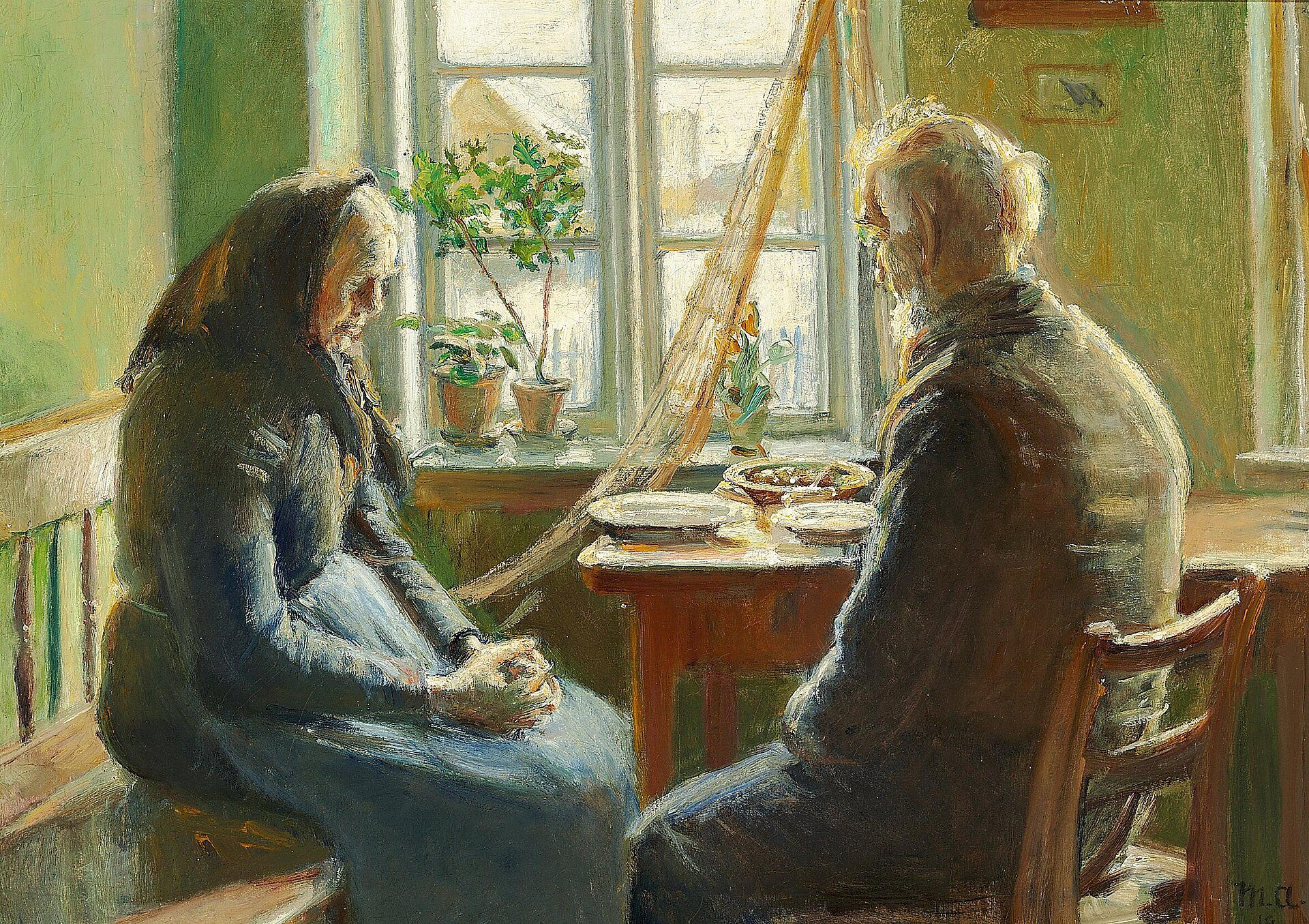
The featured image is “The Grace” (1919), by Michael Ancher, and is in the public domain, courtesy of Wikimedia Commons.