 The Hopeful Mysteries are a new set of meditations on the rosary, the beloved Catholic devotion. They arose within the Diocese of Pensacola-Tallahassee in Florida in 2024 and were approved by the local bishop, William Wack. The bishop’s approval signified that this new set of mysteries are “worthy of pious devotion anywhere,” although they have yet to be promoted for the universal Church. If the latter should come to pass, the Hopeful Mysteries would join the established sets of Joyful, Sorrowful, Glorious, and Luminous Mysteries (the latter added and officially promoted by Pope John Paul II in 2002).
As did the Luminous Mysteries, this new series of meditations developed out of a perceived need to fill a theological gap. In instituting the Luminous Mysteries, Pope John Paul II wanted to bridge the gap between the events of Jesus’ infancy (ending with the Finding of Jesus in the Temple) and the onset of the Passion (inaugurating the Sorrowful Mysteries with the Agony in the Garden). There is a longstanding tendency in popular Christian preaching and devotion to pass over the significant events of Christ’s ministry and skip right to its culmination, the events of the Passion. In doing so, much richness is lost, including things that can illuminate the mysteries of the Passion and everything that follows. John Paul II therefore added the following mysteries: Jesus’ Baptism in the Jordan, The Wedding at Cana, The Proclamation of the Kingdom, The Transfiguration, and the Institution of the Eucharist. This choice of episodes drives home the centrality of the kingdom of God in Jesus’ preaching and ministry, and allows those who pray the rosary to achieve a more integrated picture of the history of redemption.
This noble goal is further promoted by the Hopeful Mysteries. They aim to fill another gap, that between the Old Testament and the New. What were the decisive steps along the way to redemption that took place before the Annunciation? What mysteries were significant to Mary, Jesus, and the other Jews of the first century? And how might these in turn give us a richer sense of the history of salvation and our spiritual heritage?
Accordingly, we have the five Hopeful Mysteries: The Creation, The Flood, Abraham’s Sacrifice, Passover, and The Immaculate Conception.
The Diocese of Pensacola-Tallahassee has issued an official brochure/prayer card of the Hopeful Mysteries. It is clear that much thought and reflection have gone into their conception, and the brochure functions as an excellent guide to praying the mysteries. These mysteries all bear a double aspect of suffering along with the promise of future deliverance, justifying their designation as “hopeful.” Here they are, with some brief comments of my own.
1. Creation: Original Sin and the “First Gospel”
It was a fine idea to emphasize from the start the mystery of creation, whereby God freely and generously fashioned of all things in heaven and on earth, and man and woman in his image. This is much needed as a cornerstone for the entire rosary cycle. It is crucial to maintain this creational basis for our spirituality, because the narrative of our faith is essentially one of creation, loss, and restoration in Christ.
After the glory of creation comes the bitter note of humankind’s prideful rebellion, causing sin and death to enter the world. But God’s promise that “the Woman and her seed” would eventually triumph over evil offers the first foretaste of the Good News. The Annunciation, which opens the Joyful Mysteries, is already hinted at in this early mystery of Genesis.
2. The Flood: God’s Universal Covenant
The next stage in salvation history shows God’s grave and effective judgment of sin in the world. Yet his choice of Noah and his family to carry on the human race shows his enduring mercy, sealed by the rainbow. This was an excellent mystery to include because the story of Noah shows forth the mystery of new creation, of how God regenerates what was dead and brings hope where none existed. It points to the ultimate mystery of the new creation, the resurrection of Christ. Through Noah the human race was reborn, and in his antitype, Jesus, humanity is definitively reborn into new and eternal life—the life of the coming age, called by Jesus the “regeneration” or “renewal” (palingenesia).
3. Abraham’s Sacrifice: God’s Promise of Fruitfulness
This is not one I would have expected, but it too is pregnant with the themes of the hopeful cycle. Just at the point when Abraham seemed poised to fulfill his call to become the patriarch of God’s people, God commanded the unthinkable: that he should sacrifice his only son, Isaac. This was to test Abraham, and Abraham passes the test: by placing his trust and obedience in God’s plan, the angel stays his hand and saves Isaac. Isaac receives his life back, and God renews his covenant with humanity through Abraham (just as he had done with Noah). This mystery foreshadows the Resurrection and the birth and growth of the Church.
4. Passover: God Saves His People, the Exodus
Surely no mystery looks forward to so many elements of our Christian faith as the Exodus and Passover. They are the foundation of Jesus’ sacrifice on the cross and the Eucharist. God’s deliverance of his people from slavery in Egypt is the model for his ultimate, definitive deliverance of his people from the very sources of evil itself. The journey of the church through time is on a continuum with these experiences of Israel.
The Exodus story is full of substories: the plagues and the Passover lamb; Israel passing through the Red Sea; God’s feeding his people with heavenly manna in the desert; the giving of God’s law, the Torah, at Mount Sinai. These mysteries all speak of God’s undying love and providence, our need for salvation, and God’s long-developing plan of rescue. Noah, Abraham, and Moses are all chosen instruments of God who point to the Messiah, Jesus. All these elements make this a particularly rich mystery to add to the rosary.
5. The Immaculate Conception: God Prepares a Mother for His Son
The essence of the mystery, of course, is that everything starts with Mom.
Connections between Eve and Mary were perceived very early on in the history of Christianity. The idea that Mary “undid” Eve’s sin is found in the theology of St. Irenaeus (second century), among others. And this led to the widespread belief that Mary was sinless: the stain of original sin was not transmitted to her when she was conceived in the womb of her own mother, St. Anne/Hannah, and she committed no actual sin during her life.
To some extent this was a simple logical deduction: since God created Adam and Eve without sin, it stands to reason that he would create the new Adam and Eve without sin. If Jesus (the new Adam) was without sin, then Mary (the new Eve) must be also. This was not from her own merit, but from the pure grace of God working retroactively through her Son. *
In this way, Mary is the beginning of the new creation, in which sin will be overcome. It is a fresh start for humanity, fulfilled in Jesus but prepared by his Mother. The Florida diocese puts it beautifully: “She is the harbinger of a final masterpiece brought into being by the God who makes all things new.”
How do all these mysteries (not just the last) relate to Mary? A whole volume would be necessary to expound on this. For a start, consider how she exemplifies the ideal of righteousness and devotion to God implied in the whole story of Israel, and her role as the new Ark of the Covenant, bearing God’s Son within her. The implication of the rosary has always been that Mary is central to the whole story of our faith.
The Hopeful Mysteries began from a small seed, namely a suggestion from a parishioner in the Florida diocese. But many worldwide traditions in the church have grown from such local beginnings. These mysteries are vital and necessary in a world in which hope often seems to be lacking. They move our faith in a solidly biblical direction, showing the continuity of the Old and New Testaments. And they complement the existing mysteries, helping to complete and round out the whole experience of the rosary. I would argue that with these Hopeful Mysteries the rosary has become greater than ever before. I believe they are, themselves, a sign of the new creation.
__________
*Brant Pitre, Jesus and the Jewish Roots of Mary
Note: More information on the Hopeful Mysteries, as well as the official brochure, is available here.
The Imaginative Conservative applies the principle of appreciation to the discussion of culture and politics—we approach dialogue with magnanimity rather than with mere civility. Will you help us remain a refreshing oasis in the increasingly contentious arena of modern discourse? Please consider donating now.
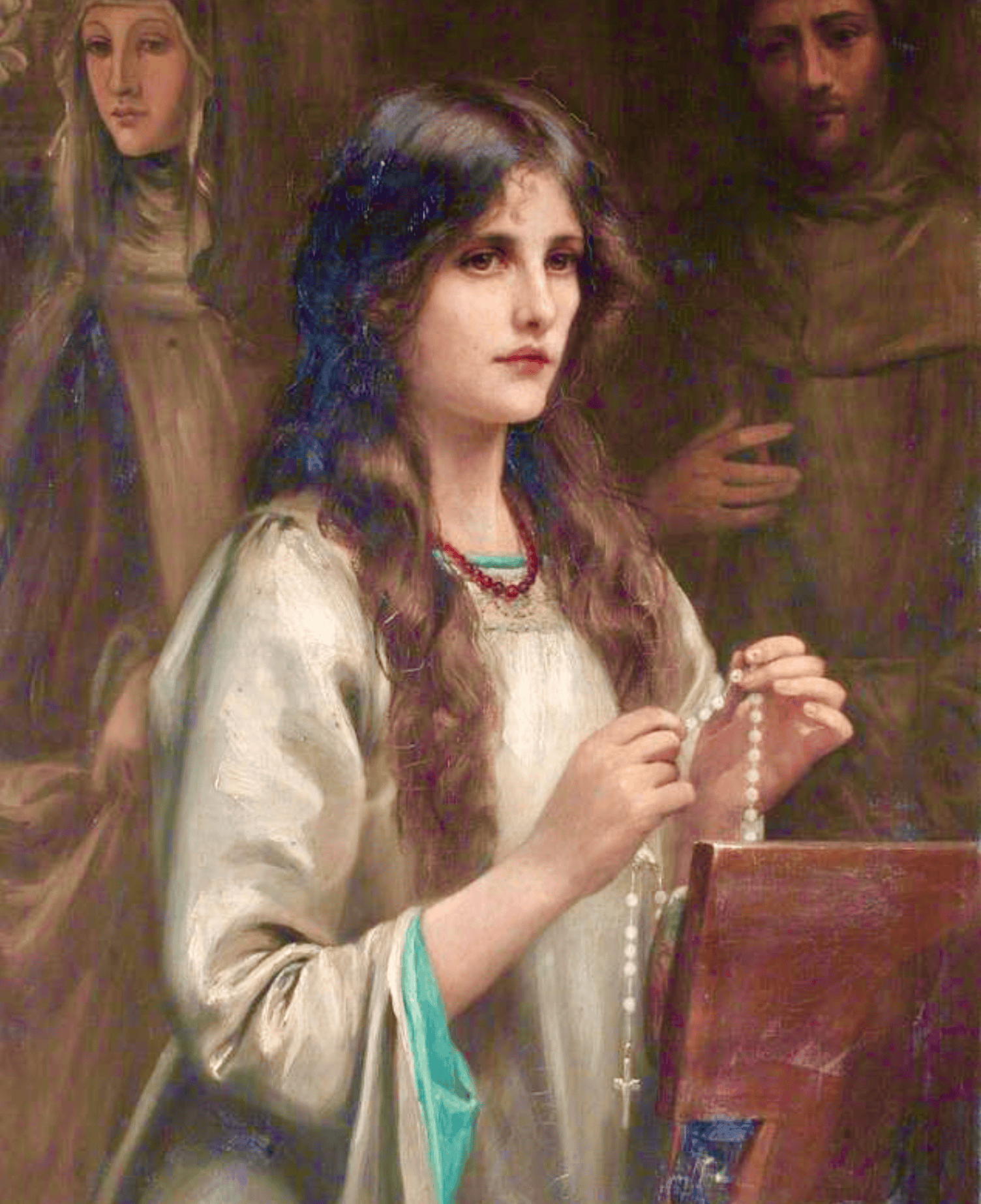
The featured image is “The Rosary” (between circa 1900 and circa 1920), by Beatrice Offor, and is in the public domain, courtesy of Wikimedia Commons.