
J.D. Vance’s post-election X post caused quite a stir, as it should have. It was a political manifesto wrapped up in the clothes of an election analysis, and it was unusually frank coming from a vice president who, in real respects, was rebuking his president.
EXCLUSIVE: A meeting Wednesday morning at the White House was aimed at aligning the admin on post-midterm messaging. But after the huddle, Vice President JD Vance sent out an X post breaking with Trump on foreign policy. Vance is seeking a new alliance with disaffected Trump voters after crushing midterm losses, a source told Fox News Digital. He is aiming messaging to the “new right,” which includes changing the nature of America’s relationship with Israel. Full story here https://t.co/nfz2ylOANF
— Fox News Politics (@foxnewspolitics) November 4, 2026
EXCLUSIVE: A meeting Wednesday morning at the White House was aimed at aligning the admin on post-midterm messaging. But after the huddle, Vice President JD Vance sent out an X post breaking with Trump on foreign policy.
Vance is seeking a new alliance with disaffected Trump voters after crushing midterm losses, a source told Fox News Digital.
He is aiming messaging to the “new right,” which includes changing the nature of America’s relationship with Israel.
I am always skeptical of anonymous insider accounts, and it’s clear the race for the 2028 nomination is already underway, so I won’t speculate on Vance‘s motives or even rebuke him, despite disagreeing with some but not all of his points.
Trump hasn’t exactly trashed Vance for what some see as disloyalty, and others…well, others think Vance had to do it to distance himself from unpopular policies, and politics ain’t beanbag.
Listen closely to how Trump talks about Vance. https://t.co/akuI7IKwZI
— Samantha Ettus (@samanthaettus) November 4, 2026
Trump himself seems to have taken it in stride, but many of his supporters are sorting themselves out on one side or the other. The Iran War supporters are very much against Vance’s arguments, and the MAGA folks who hated the war and think Israel has too much influence loved it.
Given the heat, I wondered…how good is Vance’s analysis? After all, J.D. wrapped his manifesto in the trappings of a poll analysis and attributed his argument to one of the smartest pollsters he knows, so how well did that analysis match up with what voters actually said at the polls when asked?
Not that well, actually, if you trust the NBC News exit polls, especially on the issue of support for Israel, and quite well on the issues of energy prices (which are downstream of the war) and affordability. Vance also largely avoided one of the issues that ranked very high in the polls: tariffs, which, according to the exit polls, were a major factor in how people voted.
Before I dive into the numbers, a warning: exit polls have the same problem as all polls, and Axios reported that polling errors in this election cycle were actually worse than in previous midterms. It just doesn’t APPEAR that way because they were directionally correct, but way off in magnitude, so people haven’t noticed how bad they were.
The number of people who answer exit polls is huge, and larger than any individual poll taken during an election cycle by orders of magnitude. But you have the same problem as always: people eager to answer polls aren’t like everyone else, and neither are their opinions. We can’t say how far off they are because…you can’t get a random sample, and one supposes that they are, if anything, worse than other polls. But even that is a guess.
But exit polls are what we have, so let’s look at the most controversial question relevant to Vance’s argument: support for Israel. Most Republicans agree that the war has not gone as planned and attribute at least some of the trouble in the election to it, although mainly because the war has impacted oil prices.
The issue on which the most debate is taking place is whether the voters sent a message that Israel is too influential, and on that, I would argue, Vance has misread the room, especially among Republicans, in two ways: first, our relationship with Israel did not move many votes in the election, and of the voters who want a weaker relationship with Israel, almost none of them were Republicans or gettable voters.
Overall, the country is split 50-50 on the issue, with about half of all voters wanting a weaker relationship with Israel — which supports Vance’s point a bit — but the other half think our relationship is about right or that we don’t support Israel enough.
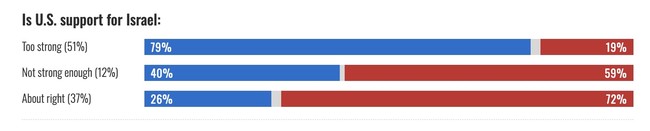 If you look at the numbers, the split between the two groups of voters is 51-49%, or basically 50-50 on whether we support Israel too much. Of the people who think we do, only 19 percent were Republicans, which matches our observation of there being a hard core of Republicans who think Israel has too much influence on American politics in general and Trump in particular.
No surprise there.
But on the 49 percent side, Republicans overwhelmingly think that our relationship with Israel is either about right or not strong enough.
Looking at the numbers, the message is that Vance is right that some Republicans want a weaker relationship with Israel and that an awful lot of Democrats and some Independents do, but moving in that direction costs you an awful lot of Republican votes. As a group, rather than at an individual level, support for Israel is very strong among Republicans.
So, in a sense, Vance is right that there is a large group of people — about half of voters — who want a “different relationship with Israel,” as he put it.
It’s just that they aren’t Republican voters, and most of them aren’t “gettable” voters for Republicans.
It’s similar to arguing that if a Republican changed his opinion on rent control in New York City, he would do better; no, he wouldn’t, because people who like rent control don’t vote for Republicans anyway.
Now let’s look at the issue Vance left OUT of his analysis: Tariffs. Everybody here has a different opinion about the wisdom of tariffs, which is fine, but let’s look at what the PUBLIC thinks about them.
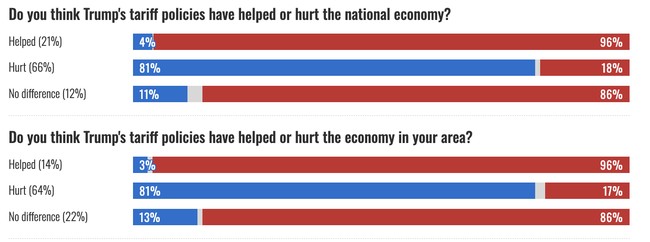
Only 21 percent of voters think that tariffs have helped the national economy, and 14 percent think they have helped in their area. 66% think they have hurt the national economy, and 64 percent think they have hurt their area.
In other words, they are wildly unpopular, including among many Republican voters. You can argue whether Trump was right to impose them, but you can’t argue they were popular, because they most certainly were not.
You can agree or disagree with Vance, but the data does not unequivocally support his argument. Many people argue that tariff policies will benefit America in the long run, and I concede there are good arguments for that, even though I think Trump’s approach to tariffs and trade negotiations has not been helpful.
But politically, they certainly haven’t been popular.
Vance’s analysis was, as befits someone who intends to be a future candidate, motivated. That’s fine. Every candidate spins things in their favor, and you’d be an idiot to trust anyone running for office on everything they say.
But looking at the data, especially on the question of supporting Israel, the numbers don’t back him up.
Editor’s Note: Do you enjoy HotAir’s conservative reporting exposing the radical left and woke media? Support our work so we can keep bringing you the truth.
Join HotAir VIP and use promo code FIGHT to receive 60% off your membership.