Though probably least known of the books I mention here, Paul Elmer More’s “Pages From an Oxford Diary” is a triumph of humility. In it, the great Christian Humanist and Princeton scholar of Plato writes tellingly on his deathbed.
 Previously, I happily wrote about five of my top ten books—that is, those books that have had the greatest influence on me. I very intentionally left out the Bible. Additionally, I tried to avoid too much repetition of authors. That is, rather than have a whole list of Tolkien books or Kirk books, I chose just one or two from each of them. So, back to the list.
Paul Elmer More, Pages From an Oxford Diary. Though probably least known of the books I mention here, Pages From an Oxford Diary is a triumph of humility. In it, the great Christian Humanist and Princeton scholar of Plato (arguably one of the greatest and most important Platonists anywhere in anytime in the course of Western Civilization), writes tellingly on his deathbed. Literally, he is writing this book days before he dies. It serves, then, not inappropriately, as a kind of confession. Inspired by Friedrich Nietzsche, Elmer More admits to becoming apostate from his Christianity sometime around the age of 12, just as Nietzsche had rejected his Lutheran pastor father at the same age. From there, Elmer More confesses, he did everything possible to construct his own vision of the universe, absent of any God or transcendent. Eventually, though, through his intensive and extensive study of Plato, Elmer More came to believe not only in God but in the Christian Trinity. When he did, he converted to Anglicanism, possibly and most probably influenced by his friends T.S. Eliot and C.S. Lewis. The last two pages of this hard-to-find book are some of the finest pages in the English language in the twentieth century. Not only does Elmer More apologize to God for all his sins and his hubris, but, most critically, he notes that when he meets God face to face, he will reveal several things. “And so I sit and wait, in patience and serenity—for the end which is no end. I turn over in my mind the various possibilities of the long journey, amusing myself with fancies that I trust are not purely fanciful. Only of this I am assured, that some time and in some way, spirit to spirit, face to face, I shall meet the great Lord of life, and, falling before Him, tell my gratitude for all He has done, and implore pardon for all I’ve left undone.” Elmer More passed into eternity only shortly after having written these lines.
Plato, The Crito. For twenty years now, I have had the privilege of beginning every fall semester’s opening core course for the incoming freshmen with The Crito. Day one, meet Socrates. Day one, meet Crito. Day one, meet Plato. Understandably, students are always a bit overwhelmed and more than a bit intrigued. Three things, especially, stand out with this Platonic dialogue. First, Crito awakes Socrates from a peaceful sleep, a sleep in which Socrates dreams that a beautiful woman in white has assured him that on the third day, he will be in the land of Pthia, the land of his ancestors. Socrates takes the dream literally. Second, Socrates explains to Crito what will be known in the Western Tradition as Socratic Ethics. It is, he demands, never right to do any evil in the name of a good. There are no circumstances, times, or places, in which any allowance of evil is allowed without it tainting the good. This is an incredibly hard teaching. Brilliant, but difficult to the nth degree. Here, of course, Socrates has anticipated, four centuries earlier, Christ’s arguments about turning the other cheek. Third, Socrates insists that he must take the hemlock. Though Athens might be unjust at the moment, she is, over time, just. Though I’ve taught this for twenty-eight years now, I believe I will get as much out of it as I always have, for the next 28 years.
Russell Kirk, A Program for Conservatives. When Kirk wrote and published The Conservative Mind in the spring of 1953, he instantly became a household name. More than 75 major publications and serials reviewed it, sometimes as many as three times. For all intents and purposes, Kirk’s book—originally his two-volume massive dissertation—synthesized all non-leftist and anti-progressive schools of thought that existed prior to the Second World War. Kirk, however, never envisioned his book to be primarily a political one, but because of his employment of the word “conservative,” almost every reviewer, hostile or friendly, chastised Kirk for not explicitly offering a program forward for conservatives. Livid, Kirk wrote A Program for Conservatives—the title intentionally mocking—in a white heat, sometimes completing its individual chapters in a single sitting and session of typing. Consequently, the book is blistering as it brilliantly analyzes the current state of society and possible avenues of correction and reform. The book reveals more of Kirk’s Christian Humanism, perhaps, than it does his conservatism. For example, in the chapter on economics, Kirk notes with some glee and some distress that almost everyone—capitalist, socialist, and communist—is a materialist, hoping to impose a quasi-dystopia upon us all. But, the best part of the book is at the conclusion of the opening chapter. Here, Kirk throws down the gauntlet. What exactly is the program for a conservative? Why, it comes down to one thing and one thing alone: the need to love one another. Here, I must also note, that as a teenager, I was deeply influenced by two books similar to Kirk’s. First, I was rather taken—especially during my freshman year of high school—with Robert J. Ringer’s Restoring the American Dream. Second, a year later, I encountered Milton Friedman’s Free to Choose. Both books inspired me to be, one day, an author. Though written in the same vein, Kirk’s Program is far, far superior to either Ringer or Friedman.
T.S. Eliot, Complete Poems and Plays. I first encountered the work of T.S. Eliot in my senior year of high school. To graduate, I was required to memorize and recite The Hollow Men. I was instantly a fan of Eliot, not only of his cadence and choice of word but also of his insight and brilliance. Sometime shortly after high school (though I cannot remember exactly when), I purchased the best of, Complete Poems and Plays, 1917-1950. That book, now battered and torn and heavily annotated from so much usage, sat on my nightstand for years and years, along with my New English translation of the bible. Indeed, few books have brought me as much spiritual comfort as has Eliot’s. In good times and in horrible times (such as when Dedra and I lost our daughter, Cecilia Rose, at birth), Eliot had never failed to bring me a certain calm. His meditations on humanity, on time, on eternity, on the Virgin Mary, on God, and everything else under the sun just never seem to exhaust themselves. Though I would consider The Lord of the Rings as the greatest work of art of the twentieth century, The Four Quartets, especially, are just only a smidgeon below that trilogy in terms of depth and glory. Or, how many times have I read and been inspired by Murder in the Cathedral? I couldn’t even count how many. Or, the choruses from The Rock? Again and again, I retreat into the fantastic worlds of Eliot.
And, no. 10? Still to come, along with an appendix of other books….
__________
The Imaginative Conservative applies the principle of appreciation to the discussion of culture and politics—we approach dialogue with magnanimity rather than with mere civility. Will you help us remain a refreshing oasis in the increasingly contentious arena of modern discourse? Please consider donating now.
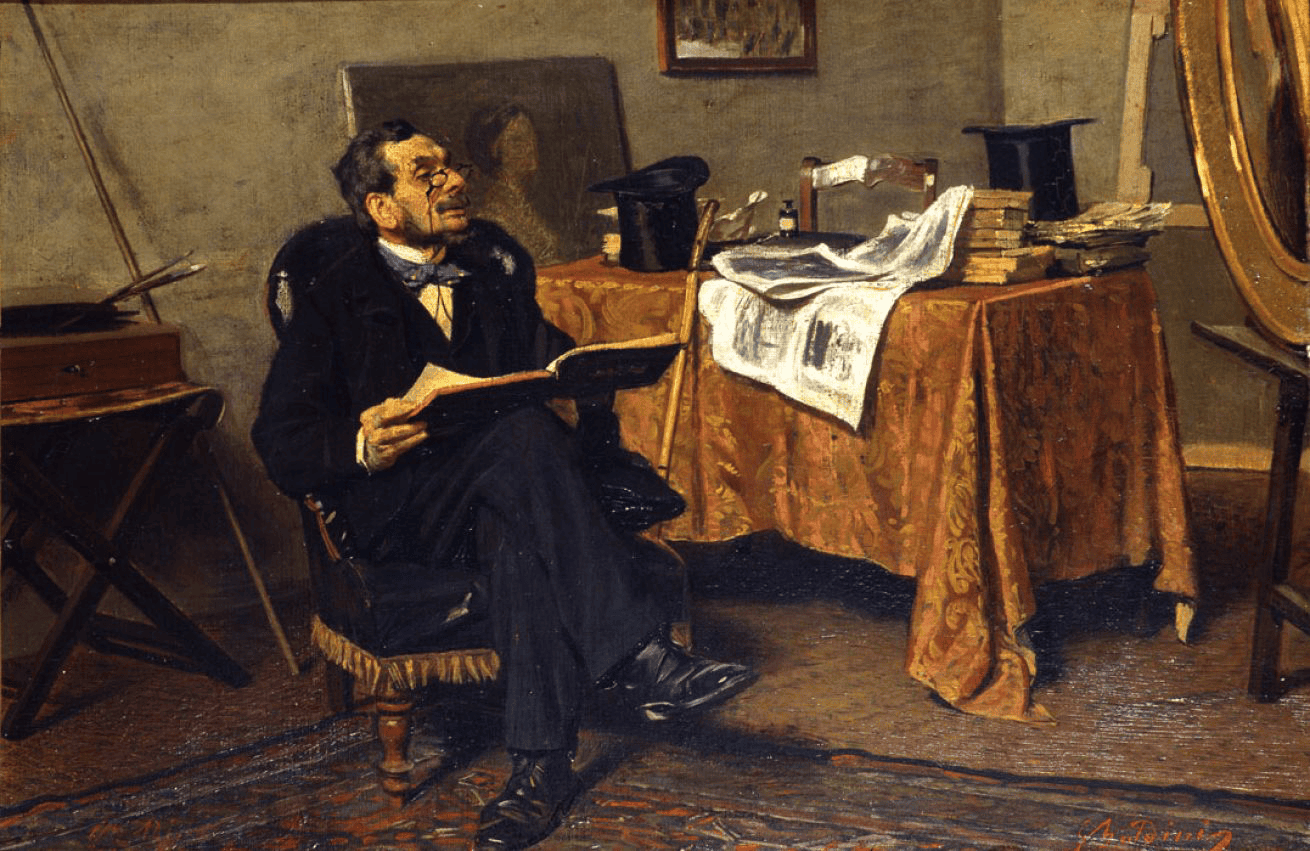
The featured image is “The Arts Lover” (c. 1866), by Giovanni Boldini, and is in the public domain, courtesy of Wikimedia Commons.