José R. Ayllón’s “The Man Who Was Chesterton” succeeds because it captures the Chesterton who debated and argued like “a bull in the china shop of his time” but “only made friends” due to “his kindness and sense of humor.” No wonder his friend Edward Macdonald said on his death, “He was the lord of the manor.”
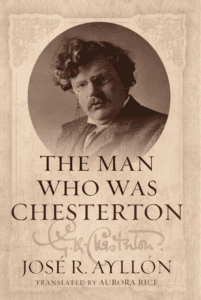
The Man Who Was Chesterton, by José R. Ayllón, translated by Aurora Rice (198 pages, Arouca Press, 2026)
 Great openings are priceless. “Call me Ishmael.” “It was the best of times, it was the worst of times.” “It is a truth universally acknowledged, that a single man in possession of a good fortune, must be in want of a wife.” Most of my readers likely knew the books immediately upon reading those lines. While José R. Ayllón’s new popular biography of Chesterton, translated by Aurora Rice, may not be quite in the ranks of Melville, Dickens, and Austen, I must say that the opening line is in that category: “This is an attractive biography because Chesterton is an attractive figure.”
Upon reading it, I had two instantaneous reactions. The first is that the statement is illogical. If the artist is bad enough, even the most attractive figures can be depicted as ugly in words, paint, photography, sculpture, or whatever medium is chosen. The second reaction is that, abstracting from the logical problem, I, the reviewer, will be the judge of whether this is an attractive, good, or even passable book!
To forestall any worry those angry, italicized words might have caused you, let me just issue a spoiler. If the opening sounds boastful, it is to be judged under the iron-clad law of rhetoric attributed to both Dizzy Dean and Muhammad Ali: “It ain’t braggin’ if you can back it up.”
The Man Who Was Chesterton is attractive because delightfully written. I don’t know the Spanish original, but Aurora Rice’s English translation renders it in an accessible, light, and occasionally poetic fashion that surely mirrors the original text (ex., “The June sun shone on the pavement and the crowded streets were gay; London had snatched a holiday”).
The biography is a brief but full 178 pages of text that includes no notes or technical apparatus and is divided into two parts. “Part One: His life, his world” has four chapters of straight, chronological biography running to 106 pages. “Part Two: His Thought” has four chapters of survey and analysis of themes and important works in 72 pages. Not academic in tone or construction, it is a smart biography that is clearly based on a great deal of reading of both Chesterton’s works and secondary literature, including modern biographies and contemporary accounts of GKC by W. R. Titterton and others.
Perhaps the most surprising source that plays a large role in this biography is the memoir of Gilbert’s sister-in-law, Ada Jones Chesterton. I’ve never read it, in part because of the well-known false account Ada gave of Gilbert and Frances’s marriage—analyzed quite well by Frances’s biographer, Nancy Brown, among others.
Ayllón never cites this part of Ada’s work, but he does treat many of the other parts of her account of matters on Fleet Street, more broadly, and The New Witness and GK’s Weekly, in particular, as reliable. Given that my suspicions were raised, I read her reported testimony carefully but found nothing obviously off. Ada’s reports of attempting somewhat deviously to negotiate higher fees for Chesterton’s writing and of ruing his less-than-stringent editing (“Gilbert writes like an angel and edits like Poor Poll”) have the ring of truth.
What makes Part One so delightful and, yes, attractive is that it really does cover both Chesterton’s life and world in a way that shows Chesterton moving in a setting and among a cast of characters. Ada comes alive in this book as do the many figures who played such a huge part of his life: Frances; parents, Edward and Marie Louise; brother, Cecil; friends Belloc, Baring, Shaw, Wells, and Fr. O’Connor; the young Nicholls sisters who befriended him; and others who walk across the stage more briefly. One topic not discussed as much elsewhere but covered here is the many contemporary debating societies’ role in Chesterton’s life and career. They provided outlets for influence and opportunities for friends.
Perhaps Ayllón might have roughed Ada up a bit for the marriage account or talked about Dorothy Collins a bit more, but the completeness accomplished in under 200 pages is remarkable. The book has the same casual and intimate tone of Maisie Ward’s and Joseph Pearce’s biographies and a surprising amount of depth.
Ayllón’s second part on Chesterton’s thought is not as quick a read or as complete as the first, but this is not surprising. Story gallops while theory trots, even when done well. The chapters are flow, however, because Ayllón interleaves bits of biography showing the importance of each subject to Gilbert’s life.
The four chapters cover Chesterton’s thoughts on women (and men), agnosticism and belief, his approach to history, and his treatment of the Middle Ages. Like the biographical bits, Chesterton’s social thought is also woven into the accounts of all the topics.
Further, as in the biographical section, Ayllón introduces briefly other thinkers connected to Chesterton—this time by way of those attracted to and influenced by him. The reader finds accounts of how Chesterton affected the lives and minds of various figures including Ronald Knox, Christopher Dawson, C. S. Lewis, and Joseph Pearce.
The Man Who Was Chesterton succeeds because it captures the Chesterton who debated and argued like “a bull in the china shop of his time” but “only made friends” due to “his kindness and sense of humor.” No wonder his friend Edward Macdonald said on his death, “He was the lord of the manor.” Ayllón’s biography depicts the man and the manor.
__________
Republished here with gracious permission of the author from Gilbert magazine.
The Imaginative Conservative applies the principle of appreciation to the discussion of culture and politics—we approach dialogue with magnanimity rather than with mere civility. Will you help us remain a refreshing oasis in the increasingly contentious arena of modern discourse? Please consider donating now.