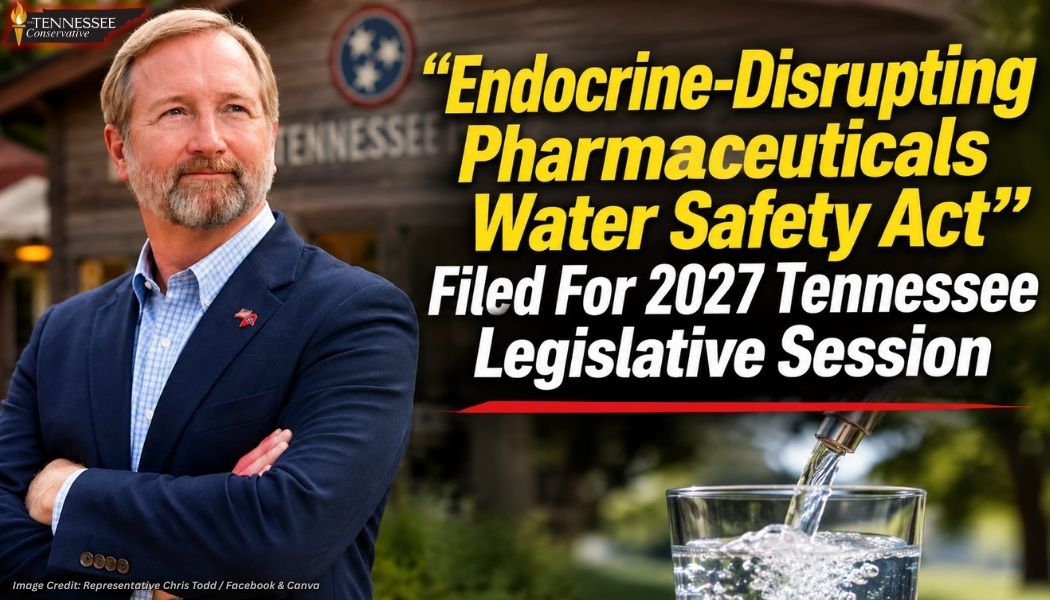
Image Credit: Representative Chris Todd / Facebook & Canva.
Article by Olivia Lupia, Tennessee Conservative News –
A Republican Representative has filed a MAHA-type bill for the 2027 legislative session which seeks to determine if certain harmful pharmaceuticals may be present in Tennessee’s water supplies and mandates further research if such substances are found.
Sponsored by Rep. Chris Todd (R-Madison County-District 73), HB0002 requires the Tennessee Department of Environment and Conservation (TDEC) to “establish a list of endocrine-disrupting pharmaceuticals of concern, require public water and wastewater treatment facilities to test for the presence of such pharmaceuticals in treated water, and require further research if such pharmaceuticals are detected.”

The bill acknowledges that endocrine-disrupting chemicals, including pharmaceuticals, have a “potential for harm,” as demonstrated in several scientific research studies, one of which notes exposure “is identified as a significant risk factor for decreased fertility in wildlife and humans.”
“These chemical compounds and their active metabolites enter wastewater systems via human excretion and flushing of unwanted pills. Some also enter wastewater systems via biomedical waste that is disposed of in such wastewater systems,” the bill elaborates. “The active metabolites of these pharmaceuticals may interfere with natural hormonal processes in wildlife and humans, rendering them contaminants of emerging concern, posing potential risks to public health and the environment.”
For clarity, the text further defines terms like “endocrine-disrupting pharmaceutical”, “biomedical waste”, and “active metabolites”, which is described as “all active compounds of a pharmaceutical drug that retain the therapeutic effects of the parent pharmaceutical drug after being metabolized in the human body.”
Should the legislation pass, TDEC has up to 180 days, or roughly six months, to compile a list of pharmaceuticals that may be entering waters and either form active metabolites, act as endocrine-disrupters, and/or generate biomedical waste.
From that list, the department will select between 3-5 pharmaceuticals that “most merit further research and investigation based on current scientific findings regarding the known or potentially ability of the pharmaceuticals to harm wildlife and humans.”

Once those selections are made, each public water system and wastewater facility must conduct quarterly testing for the presence of these substances and submit the results to TDEC within 30 days of sampling.
If the presence of the pharmaceuticals is detected, the department has 15 days immediately following receipt of the test results to initiate research on the possible effects the drugs may have on wildlife in the state, particularly aquatic species, and human health and fertility, especially children and men and women of childbearing age.
TDEC then must create annual contaminant level summaries and provide it to the public on its website and to the chief clerk of each chamber of the general assembly and the legislative librarian.
While the proposed legislation does not require the removal of such chemicals from the water systems, it could be a productive step forward in understanding exactly what is ending up in Tennessee’s drinking and treated wastewater of and the associated health concerns while paving the way for future legislation that establishes actionable steps.
Notably, Rep. Todd has previously sponsored and supported legislation to remove fluoride, another toxic chemical, from Tennessee’s public water supplies.
Last year’s iteration, which Todd voted in favor of, was carried by conservative Rep. Michele Reneau (R-Signal Mountain-District 27) and passed the House Agriculture & Natural Resources Committee before dying in the Senate.
While it is unknown at this time if he plans to revive a defluoridation bill, HB0002 seems to show Todd’s continued commitment to providing Tennesseans important information surrounding their health and advocating for their well-being through the removal of toxic substances that most encounter every day without their knowledge or consent.
Sources:


About the Author: Olivia Lupia is a political refugee from Colorado who now calls Tennessee home. A proud follower of Christ, she views all political happenings through a Biblical lens and aims to utilize her knowledge and experience to educate and equip others. Olivia is an outspoken conservative who has run for local office, managed campaigns, and been highly involved with state & local GOPs, state legislatures, and other grassroots organizations and movements. Olivia can be reached at olivia@tennesseeconservativenews.com.