C.S. Lewis believes in the laws of nature, but he argues that miracles do not violate them because miracles are done by the Creator of the natural world Himself. Miracles are, therefore, exceptions to the laws of nature.
 The Great Commission commands all Christians to share the Gospel with non-Christians. Different groups of non-Christians want to disprove logically the existence of God. But C.S. Lewis used logic to make one of the soundest arguments for the possibility of miracles. The miracles of the Old Testament, Virgin Birth, and life, death, and resurrection of Jesus Christ defy our senses and the laws of nature, but they were real. In an appeal to non-Christians and to honor the Great Commission, I offer a brief summary of Miracles by C.S. Lewis in the hope that non-Christians may recognize the logic he used to show us that indeed, the Gospel is true and miracles are possible.
Enlightenment philosophers were skeptical of religion. They proposed miracles were impossible because they violated the laws of nature. They also said there is little evidence throughout history to support them. Lewis responded two centuries later and outlined his argument for the possibility that miracles may exist. He believes in the laws of nature but argues that miracles do not violate them because miracles are done by a supernatural being outside of the natural world, the Creator of the natural world Himself. Miracles are, therefore, an exception to the laws of nature.
Before Lewis arrives at this conclusion, he begins his argument by saying, “The question whether miracles occur can never be answered simply by experience.” He rejects Enlightenment philosophical theories outright. It is impossible for experience to prove or disprove miracles because the human senses are imperfect, thus experience alone is incapable of providing a valid answer to the question.
Lewis defines a miracle as, “An interference with Nature by supernatural force.” He offers two ideas: naturalism and supernaturalism. The naturalist believes the laws of nature can explain everything that happens in the natural world. But if there is anything the laws of nature cannot explain, then naturalism is invalid. The supernaturalist, however, believes something exists beyond the natural world. The supernaturalist believes in the laws of nature, only that they and the natural world were created by the supernatural. Naturalism does not allow for the possibility of miracles because miracles run antithetical to the laws of nature. The laws of nature cannot explain miracles because they did not cause them. Supernaturalism says that miracles may happen because they are not bound by the laws of nature.
Lewis suggests the laws of nature cannot explain human reason. This makes naturalism difficult to believe in. He says, “Reason is given before Nature and on reason our concept of Nature depends.” Reason must come from something outside of the laws of nature before the natural world was created. His logic leads to the supernatural entity that is God the Creator, who exists outside the natural world and yet created it, its inhabitants, and a quality like reason.
Lewis is trying to explain the difficulty of naturalism. He goes on and says, “I believe that the primary moral principles on which all others depend are rationally perceived.” Reason, morality, virtue, and conscience are not made by the laws of nature. These qualities are “an offshoot of some absolute moral wisdom, a moral wisdom which exists absolutely on its own,” paving the way for the likelihood that the supernatural may show itself in the natural world. Something happens that the laws of nature cannot quite explain. These are miracles, a supernatural force interfering in nature.
Lewis believes the Creator may suspend the laws of nature, and that a miracle becomes an exception to the laws of nature. Lewis refers to the pregnancy of the Virgin Mary. Pregnancy, according to the laws of nature, occurs due to intercourse between a man and a woman. A virgin birth is contrary to the laws of nature, which St. Joseph knew, unless the One who made them overruled them. Joseph accepted the pregnancy of his wife as something contrary to the laws of nature, a miracle. Lewis says, “The divine art of miracle is not an art of suspending the pattern to which events conform but of feeding new events into that pattern.” After Mary learned she was pregnant, she had a normal pregnancy. Since God created the laws of nature and the world they are in, He may make exceptions to His creation.
Lewis presents enough evidence for the existence of the supernatural in the natural world. Discussing those who believe in nature alone, Lewis says, “The Naturalists have been engaged in thinking about Nature. They have not attended to the fact that they were thinking. The Supernatural is not remote and abstruse: it is a matter of daily and hourly experience, as intimate as breathing.” The use of reason and the ability to think is evident and possessed by every human, even naturalists. If it is possible for the supernatural to invade the natural world with reason, then it is possible for the supernatural to invade again using different methods at different moments in time.
Lewis does not discredit the laws of nature. They are real, and they enhance belief in the supernatural. To recognize miracles, one must know when the laws of nature have been broken. Lewis, commenting on the Virgin Birth, says, “We have already seen that if you begin by ruling out the supernatural you will perceive no miracles. We must now add that you equally perceive no miracles until you believe that nature works according to regular laws.” Belief in the natural world, and not the supernatural, fails because the natural world is incapable of producing miracles on its own. But by believing in the natural world, as well as the supernatural, one may see the extraordinary exceptions to the laws of nature. The Virgin Birth is an example of such an extraordinary exception. Lewis says, “If there ever were men who did not know the laws of nature at all, they would have no idea of a miracle and feel no particular interest in one if it were performed before them.” When humans know the laws of nature, they may identify a miracle when it happens.
Miracles is a suitable piece of philosophy and theology for non-Christians to begin trying to understand God, miracles, and the supernatural. C.S. Lewis follows a logical progression of thoughts to justify the Christian story. His own use of logic led him, an atheist, to become a Christian. If the non-Christian has questions about the logic of the Gospel, I ask that they please bring their questions to us so that we may discuss them with you and share the miracles of Jesus Christ and saints of the Christian Church.
__________
The Imaginative Conservative applies the principle of appreciation to the discussion of culture and politics—we approach dialogue with magnanimity rather than with mere civility. Will you help us remain a refreshing oasis in the increasingly contentious arena of modern discourse? Please consider donating now.
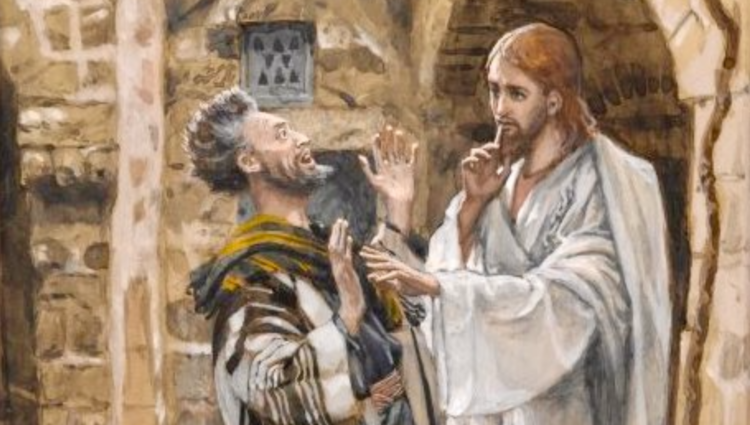
The featured image is “Jesus Heals a Mute Possessed Man” (between 1886 and 1894), by James Tissot, and is in the public domain, courtesy of Wikimedia Commons.