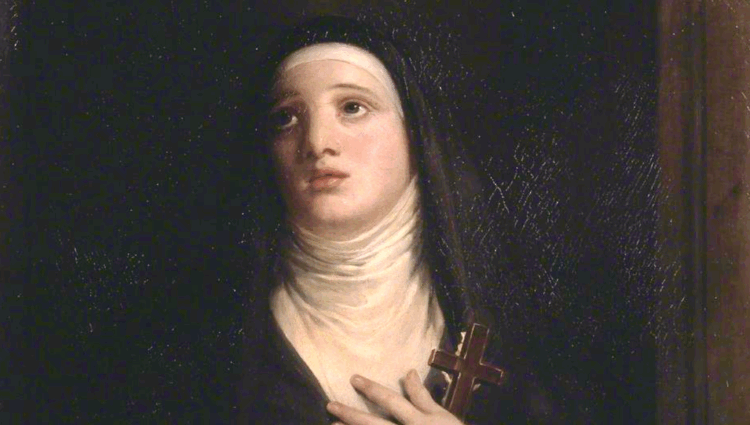
A martyr of Communist Russia, Mother Catherine of Siena, founded a convent of Third Order Dominicans before being sentenced to more than a decade of solitary confinement.
 It has been said, purportedly by G.K. Chesterton, that when people stop believing in God, they don’t believe in nothing but in anything. Even worse is that the things which people believe are not merely godless but deadly and demonic. Take, for instance, the modern anti-Christian creeds that led to the French and Russian Revolutions and to the rise of the Nazis. These monstrous ideologies gave us the guillotine, the gulag, and the gas chamber, each of which was a means to destroy those dissidents deemed to be enemies of the state. One such dissident was Anna Ivanovna Abrikosova, later known as Mother Catherine of Siena.
Mother Catherine was a Russian Catholic religious sister who founded a convent of Third Order Dominicans in her Moscow apartment and would spend more than a decade of solitary confinement as a prisoner of conscience in Joseph Stalin’s concentration camps before dying in prison.
Born in Moscow in 1882 into a noble Russian family, Anna Abrikosova studied at Girton College, Cambridge, before moving to France. She was received into the Catholic Church in the St. Vincent de Paul chapel of the Church of the Madeline in Paris in 1908.
After her return to Russia and her founding of the Byzantine Catholic sisters’ community of the Third Order of St. Dominic, she and the other members vowed in August 1917 to sacrifice themselves to the Holy Trinity for the salvation of the Russian people. In this dramatic pledge to lay down their lives for Christ for the conversion of their country, they were perhaps inspired by the heroic witness of the Discalced Carmelite Martyrs of Compiègne who were guillotined during the Reign of Terror following the French Revolution.
Only two months after the sisters had taken their vows, the Bolshevik Revolution, in October 1917, ushered in more than 70 years of atheist persecution. In spite of the imminent danger to themselves, Abrikosova and the sisters continued their religious work, opening an illegal Catholic school for those who did not want their children brainwashed by the Marxist indoctrination of the compulsory Soviet public school system. They also translated many Catholic texts into the Russian language, in defiance of state censorship, circulating their translations in secret.
Inevitably, Mother Catherine and the other sisters of her community were arrested in November 1923. She was sentenced to ten years of solitary confinement and would be imprisoned at Yaroslavl from 1924 to 1932. Shortly before sentencing, Mother Catherine told the sisters of her community that
every one of you, having given your love to God and following in His way, has in your heart more than once asked Christ to grant you the opportunity to share in His sufferings. And so it is; the moment has now arrived. Your desire to suffer for His sake is now being fulfilled.
After spending eight years in solitary confinement, Mother Catherine was diagnosed with breast cancer and was transferred to Butyrka Prison infirmary for an operation. Her left breast and some of the muscles on her back and side were removed, leaving her left arm paralyzed. In August 1932, following the operation, she petitioned to be returned to her cell in Yaroslavl but was told that she was now free and that her sentence was over. She walked directly from Butyrka Prison to the Church of St. Louis des Français, resuming her labors for Christ in the Soviet vale of tears.
“This woman is a genuine preacher of the Faith and very courageous,” wrote the underground Catholic bishop Pie Eugène Neveu, in a letter to Rome. “One feels insignificant beside someone of this moral stature. She still cannot see well, and she can only use her right hand, since the left is paralyzed.”
“As for my sister,” wrote her brother Dmitrii Abrikosov,
nothing was heard about her for nine years and even my eldest brother, who worked for the Soviets and became a prominent scientist, could do nothing for her. Then suddenly she reappeared in Moscow. Relatives who saw her wrote to my aunt in Paris that she gave the impression of a Saint.
Irrespective of the risk of arrest and reimprisonment, Mother Catherine reestablished connections with the surviving sisters of her order, intent on taking up once again the task of evangelizing the culture of death in which she found herself. She was duly arrested, along with 24 other Catholics, and was accused of forming a “terrorist organization” which was plotting to assassinate Joseph Stalin, overthrow the Communist Party of the Soviet Union, and restore the House of Romanov as a constitutional monarchy in collaboration with “international fascism” and “Papal theocracy.” It was further alleged that their “terrorist” activities were being directed by the Vatican’s Congregation for the Oriental Churches on the orders of Pope Pius XI himself.
After being declared guilty as charged, Mother Catherine was returned to the prison at Yaroslavl. She died in prison from spinal cancer in 1936. Her body was cremated unceremoniously, and the ashes were thrown into a mass grave in the Donskoy Cemetery of central Moscow.
The surviving sisters would finally be released in the mid-1950s. One of them, Nora Rubashova, would subsequently be interviewed by the great Soviet dissident and Nobel Prize winner Aleksandr Solzhenitsyn, as part of his research for The Gulag Archipelago, his bestselling exposé of the horrors of the Soviet prison system.
Let’s conclude our homage to this courageous dissident damsel who defied the red dragon of Soviet communism with a poem inspired by her martyrdom written by Fr. Sergei Solovyov (1885-1942), a Russian poet, concentration camp survivor, and Byzantine Catholic priest, who had served as the underground chaplain to Mother Catherine and her convent of Third Order Dominican Sisters prior to their arrest:
It was no accidental vision
When like a specter in the night
Of Lefortovo’s hellish prison
I watched you rise before my sight.
In prison’s dirty degradation,
Your dignity remained entire
And burned for our illumination,
Transfigured with unearthly fire.
Like to Siena’s Maid Seraphic,
You gazed with unbroken eyes
Upon our prison’s savage traffic;
As on red blooms of paradise.
A swan with poise and grace empowered,
As pure as mountain snow and frost;
Inside my soul your image flowered
And never shall I count it lost.
In habit, without ostentation,
You sensed your looming sacrifice;
Years in chains, dark isolation,
And your reward as bride of Christ.
Confined now by your enemies
With thugs and thieves; it’s for the Creed
Of Christ, crucified by Pharisees,
Who gives His Flesh as food indeed.
The hill of love and crucifixion
Was yours and, in that little spell,
There fell a drop of benediction
Inside my spirit’s dried up well!
__________
Author’s Note: Fr. Solovyov’s poem was rendered into English verse by Brendan D. King and is based on a literal translation by Joseph Lake. It first appeared in the St. Austin Review and is republished here with permission.
Republished with gracious permission from Crisis Magazine (October 2025).
This essay is part of a series, Unsung Heroes of Christendom.
The Imaginative Conservative applies the principle of appreciation to the discussion of culture and politics—we approach dialogue with magnanimity rather than with mere civility. Will you help us remain a refreshing oasis in the increasingly contentious arena of modern discourse? Please consider donating now.
The image is “The Nun” by Henry William Pickersgill (1782-1875), and is in the public domain, courtesy of Wikimedia Commons.