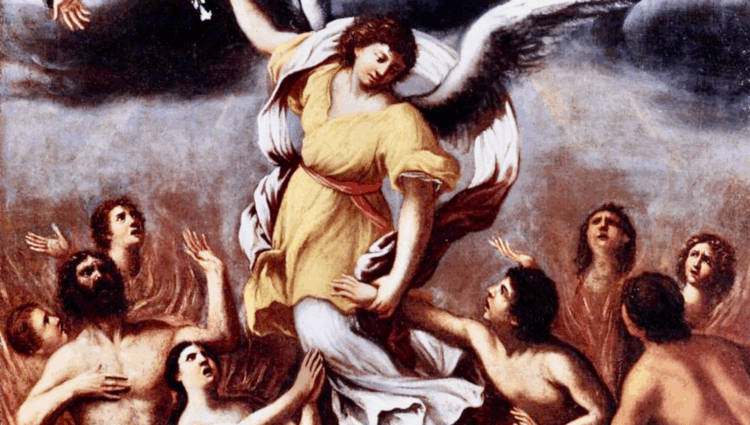
Grace alone determines whether we go to Heaven or Hell. But our good works determine whether we go through purgation or not, en route to Heaven.
 November 2 is the feast of All Souls. The point of the day is to remember those who have gone before us—but not necessarily the saints (those in Heaven). All Saints Day, of course, is November 1. But, November 2, instead, forces us to remember those in Purgatory.
The Catholic Catechism offers a brilliant defense of the tradition:
1030 All who die in God’s grace and friendship, but still imperfectly purified, are indeed assured of their eternal salvation; but after death they undergo purification, so as to achieve the holiness necessary to enter the joy of heaven.
1031 The Church gives the name Purgatory to this final purification of the elect, which is entirely different from the punishment of the damned. The Church formulated her doctrine of faith on Purgatory especially at the Councils of Florence and Trent. The tradition of the Church, by reference to certain texts of Scripture, speaks of a cleansing fire.
As for certain lesser faults, we must believe that, before the Final Judgment, there is a purifying fire. He who is truth says that whoever utters blasphemy against the Holy Spirit will be pardoned neither in this age nor in the age to come. From this sentence we understand that certain offenses can be forgiven in this age, but certain others in the age to come.
1032 This teaching is also based on the practice of prayer for the dead, already mentioned in Sacred Scripture: “Therefore [Judas Maccabeus] made atonement for the dead, that they might be delivered from their sin.” From the beginning the Church has honored the memory of the dead and offered prayers in suffrage for them, above all the Eucharistic sacrifice, so that, thus purified, they may attain the beatific vision of God. The Church also commends almsgiving, indulgences, and works of penance undertaken on behalf of the dead:
Let us help and commemorate them. If Job’s sons were purified by their father’s sacrifice, why would we doubt that our offerings for the dead bring them some consolation? Let us not hesitate to help those who have died and to offer our prayers for them.”
Praying for the dead originated with the Jews and Hebraic tradition. Specifically one finds this in 2 Maccabees 12:43-46, (New English translation): “The noble Judas called on the people to keep themselves free from sin, for they had seen with their own eyes what had happened to the fallen because of their sin. He levied a contribution from each man, and sent the total of two thousand silver drachmas to Jerusalem for a sin-offering—a fit and proper act in which the took due account of the resurrection. For if he had not been expecting the fallen to rise again, it would have been foolish and superfluous to pray for the dead. But since he had in view the wonderful reward reserved for those who die a godly death, his purpose was a holy and pious one. And this is why he offered an atoning sacrifice to free the dead from their sin.”
And, it must be remembered, those in Purgatory are our brethren and sisters, all belonging to the larger and mystical Body of Christ. They demand our prayers. Indeed, we are linked to them—far more than to those in Heaven. Along with those going through purgation, we are all pilgrims en route to Heaven. They simply happen to be on the other side of death, but still on this side of Heaven
From the standpoint of modern culture, one might look to movies such as Groundhog Day or The Sixth Sense as artistic manifestations of Purgatory as a concept.
Still, several things should be noted:
1. Purgatory is a probably a process, not a place.
It’s the process of purgation, that is, of purification. At a fundamental level, such a belief goes back, in many ways, to ancient Greek philosophy. Some Greek philosophers (Plato and Aristotle specifically) argued that for something to remain pure, only purity could enter it. Heaven is pure, and, therefore, a person entering must also be pure. Unless cleansed by martyrdom, none of us are pure.
Scripturally, we have to go through “the fire” as St. Paul tells us in his first letter to the Corinthians (1 Cor. 11-16, New English). Our works are tested. If they are like gold, we pass through unharmed. If they are like straw, they burn and we suffer.
Here is the exact quote from the New English version: There can be no other foundation beyond that which is already laid; I mean Jesus Christ himself. If anyone builds on that foundation with gold, silver, and fine stone, or with wood, hay, and straw, the work that each man does will at last be brought to light; the day of judgement will expose it. For that day dawns in fire, and the fire will test the worth of each man’s work. If a man’s building stands, he will be rewarded; if it burns, he will have to bear the loss; and yet he will escape with his life, as one might from a fire.”
Or, if you’re looking for a more Protestant friendly translation, here’s The King James Version: “For other foundation can no man lay than that is laid, which is Jesus Christ. Now if any man build upon this foundation gold, silver, precious stones, wood, hay, stubble; Every man’s work shall be made manifest: for the day shall declare it, because it shall be revealed by fire; and the fire shall try every man’s work of what sort it is. If any man’s work abide which he hath built thereupon, he shall receive a reward. If any man’s work shall be burned, he shall suffer loss: but he himself shall be saved; yet so as by fire.”
We also have this image of Jesus descending to the dead in Peter’s first letter. (1 Peter 3: 18-22): “For Christ also died for our sins once and for all. He, the just, suffered for the unjust, to bring us to God. In the body he was put to death; in the spirit he was brought to life. And in the spirit he went and made his proclamation to the imprisoned spirits. They had refused obedience long ago, while God waited patiently in the days of Noah and the building of the ark, and in the ark a few persons, eight in all, were brought to safety through the water.”
Grace, therefore, and GRACE ALONE, determines whether we go to Heaven or Hell (though as St. James tells us, “faith without works is dead”). But, our good works determine whether we go through purgation or not, en route to Heaven. Once accepted by the Blessed Trinity because of Grace, we can’t go to Hell. So, no one goes through Purgatory to Hell.
Therefore, the only possible path from Purgatory is to Heaven.
2. We must be perfect to enter Heaven
Revelations 21:26-27 is the clearest on this: “They will bring the grandeur and the wealth of the nations into it, but nothing ritually unclean will ever enter into it, nor anyone who does what is detestable or practices falsehood, but only those whose names are written in the Lamb’s book of life.”
St. Paul in his first letter to the Corinthians: 15:50-56 “Now this is what I am saying, brothers and sisters: Flesh and blood cannot inherit the kingdom of God, nor does the perishable inherit the imperishable. Listen, I will tell you a mystery: We will not all sleep, but we will all be changed –in a moment, in the blinking of an eye, at the last trumpet. For the trumpet will sound, and the dead will be raised imperishable, and we will be changed. For this perishable body must put on the imperishable, and this mortal body must put on immortality. Now when this perishable puts on the imperishable, and this mortal puts on immortality, then the saying that is written will happen,
“Death has been swallowed up in victory.”
“Where, O death, is your victory?
Where, O death, is your sting?”
The sting of death is sin, and the power of sin is the law. But thanks be to God, who gives us the victory through our Lord Jesus Christ! So then, dear brothers and sisters, be firm. Do not be moved! Always be outstanding in the work of the Lord, knowing that your labor is not in vain in the Lord.”
Therefore, someone with venial sins (1 John 5:16-20) can go through purgation and go to Heaven. Someone with mortal sins can’t–he or she has offended God too greatly. Exact quote (New English): “There is such a thing as deadly sin, and I do not suggest that he should pray about that; but although all wrongdoing is sin, not all sin is deadly sin.” Again, for those desiring something more Protestant friendly, here’s the King James Version: “There is a sin unto death: I do not say that he shall pray for it. All unrighteousness is sin: and there is a sin not unto death.”
A rough analogy would be this: a child throws a rock through a window, breaking it. The owner of the window forgives the child, but he still expects the child to offer recompense for it.
3. Suffering, therefore, is expected of us—it is the completion of our becoming one in Christ (Sanctification).
Paul—a great saint, called by God—admitted he wasn’t sanctified yet. In his letter to the Philippians (3: 12-14): “My aim is to know him, to experience the power of his resurrection, to share in his sufferings, and to be like him in his death, and so, somehow, to attain to the resurrection from the dead. Not that I have already attained this – that is, I have not already been perfected – but I strive to lay hold of that for which Christ Jesus also laid hold of me. Brothers and sisters, I do not consider myself to have attained this. Instead I am single-minded: Forgetting the things that are behind and reaching out for the things that are ahead, with this goal in mind, I strive toward the prize of the upward call of God in Christ Jesus. “
Paul (Romans 5: 2-5): Let us exult in the hope of the divine splendour that is to be ours. More than this: let us even exult in our present sufferings, because we know that suffering trains us to endure, and endurance brings proof that we have stood the test, and this proof is the ground of hope.”
Colossians 1: 24: “Now I rejoice in my sufferings for you, and I fill up in my physical body – for the sake of his body, the church – what is lacking in the sufferings of Christ.”
God perfects us through trials (Hebrews 12: 5-13): “And have you forgotten the exhortation addressed to you as sons? “My son, do not scorn the Lord’s discipline or give up when he corrects you. “For the Lord disciplines the one he loves and chastises every son he accepts.” Endure your suffering as discipline; God is treating you as sons. For what son is there that a father does not discipline? But if you do not experience discipline, something all sons have shared in, then you are illegitimate and are not sons. Besides, we have experienced discipline from our earthly fathers and we respected them; shall we not submit ourselves all the more to the Father of spirits and receive life? For they disciplined us for a little while as seemed good to them, but he does so for our benefit, that we may share his holiness. Now all discipline seems painful at the time, not joyful. But later it produces the fruit of peace and righteousness for those trained by it. Therefore, strengthen your listless hands and your weak knees, and make straight paths for your feet, so that what is lame may not be put out of joint but be healed.”
While none of this may convince those who are determined to ignore Purgatory or deny its existence, it’s pretty clear that the Catholic can defend it—right or wrong—with strong scriptural support. Further, there’s the historical side work in the Catholic’s favor; after all, not only the Jews prayed for the dead, but Christians since the earliest part of the Church have been praying for the dead. If the dead simply went to Heaven or Hell directly after death, there would be no need to pray for the dead. Yet, Christians have done so.
The Imaginative Conservative applies the principle of appreciation to the discussion of culture and politics—we approach dialogue with magnanimity rather than with mere civility. Will you help us remain a refreshing oasis in the increasingly contentious arena of modern discourse? Please consider donating now.
The featured image is “An Angel Frees the Souls of Purgatory” (circa 1610), by Ludovico Carracci, and is in the public domain, courtesy of Wikimedia Commons.