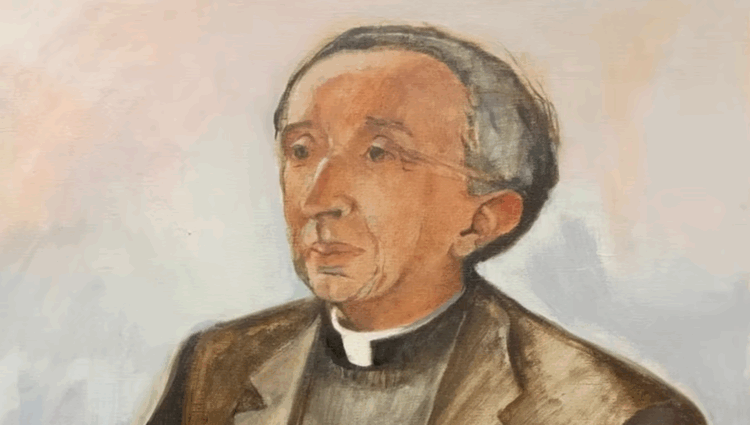
Fr. Philip Caraman not only epitomized the best of the Jesuit tradition in England, but he also chronicled the legacy of his heroic forebears: the Jesuit missionaries and martyrs of Tudor England as well as the courageous counter-Reformation apostles to the Americas, India, China, and beyond.

Philip Caraman
Rex Mottram—the Canadian dolt who marries Julia Flyte in Brideshead Revisited—was sent to “Father Mowbray at Farm Street” for instruction in the faith. “Farm Street” (aka The Church of the Immaculate Conception) in London’s high end, Mayfair, is the capital city’s Jesuit HQ, and in mid-twentieth century it was a hive of scholarly activity and the landing place of intellectuals and creative souls who were contemplating a swim across the Tiber. Evelyn Waugh, Muriel Spark, Edith Sitwell, Graham Greene, and Alex Guinness all fell under the spell of the Farm Street irregulars.
Among the clerical convert makers were: the Thomist Fr. Martin D’Arcy, SJ; philosopher Fr. Frederick Coplestone, SJ; and historian Fr. Philip Caraman, SJ.
While naming Caraman as a very English Jesuit, he was actually from an immigrant Armenian family. The middle son of nine children born to Armenian Catholic parents who fled civil war, Philip grew up in a strongly Catholic home. Two sons became priests and two daughters nuns. Educated at the Jesuit boarding school, Stonyhurst College, Caraman discerned his vocation and entered the Society of Jesus in 1929 at age 18.
His novitiate and philosophical studies unfolded against the backdrop of interwar Europe, a period of rising fascism and economic uncertainty. Ordained in 1945, after wartime service, Caraman emerged as a polymath, fluent in languages, attuned to poetry, and drawn to historical scholarship.
Caraman enjoyed a mutually respectful friendship with Evelyn Waugh, so naturally I wondered if he was the model for Father Mowbray at Farm Street. The dates don’t work. Brideshead was published in 1945—the year of Caraman’s ordination. Father Mowbray is more likely to be a composite portrait of the typical, cool, intellectual English Jesuit of the era.
In 1952, Caraman began the work that would build his literary reputation: a Catholic re-examination of the religious turmoil of the sixteenth century. He translated and edited John Gerard: The Autobiography of a Hunted Priest, a gripping firsthand account of a sixteenth-century Jesuit ministering in England during the Tudor Terror. He followed with more books on the Catholic resistance in the sixteenth and seventeenth centuries.
His 1955 William Weston: The Autobiography of an Elizabethan portrayed a Jesuit exile’s spiritual odyssey. This was followed by Henry Morse: Priest of the Plague, chronicling a seventeenth-century Jesuit who ministered to plague victims in London’s slums, only to face execution for his faith. The Other Face: Catholic Life under Elizabeth I, published in 1960, is an anthology of detailed, firsthand vignettes of recusant families—clandestine Masses in attics, priests smuggled in wine barrels, private tortures and public executions—all combining to create a heartbreaking narrative of the suffering of ordinary Catholics under the Elizabethan and Jacobean regimes.
Caraman’s major work is his 1961 Henry Garnet and the Gunpowder Plot. Combining a biography of Henry Garnet—the Jesuit superior of the day—with an examination of the political, moral, and ethical complexities facing the Jesuit leader, Caraman exonerates Garnet from plotting in the 1605 conspiracy, but acknowledges that he had knowledge of the conspiracy, though he remained silent because he had heard confessions that bound him to secrecy. The book was as much a defense of Garnet as it was the other Jesuits of the day, portraying them not as fanatics and schemers, but as true missionaries and authentic sons of St Ignatius. The Years of Siege: Catholic Life from James I to Cromwell (1966) extended his work on the recusants of England.
His concern with the wider Jesuit mission of the era produced the 1975 volume, The Lost Paradise: The Jesuit Republic in South America, about the Guarani missions in Paraguay—a story immortalized by the film The Mission, written by The Man for All Seasons playwright, Robert Bolt.
Caraman continued writing up to his death in 1998. In 1990 he published a biography of Ignatius Loyola. In 1994 he returned to England’s tortured years with The Western Rising a study of the 1549 Prayer Book Rebellion in Cornwall, and months before his death Tibet: The Jesuit Century was issued in which he wrote about missionaries like Ippolito Desideri who ventured into the Himalayas with the gospel.
Beyond books, Caraman was the influential editor of the Jesuit journal The Month from 1948-1963, and he valued his contacts with the literary lions of the time. He poked at John Betjeman’s poetic vision of Anglicanism, joked with Alec Guinness about Obi Wan Kenobi and the dubious theology of Star Wars and quibbled with Evelyn Waugh—who by the mid-sixties was famously disgruntled about the liturgical reforms of the Second Vatican Council.
Philip Caraman died on May 6, 1998, at 86, in a London nursing home. In his biography A Gentle Jesuit, Gerard Kilroy defines Caraman’s English gentlemanly manner—a style beneath which lay a rigorous historical scholar and a fierce defender of Catholic truth.
In an era when homosexual activist Fr. James Martin, SJ is the international face of the Jesuits, Caraman’s life and legacy echoes discordantly. Caraman not only epitomized the best of the Jesuit tradition in England, but he also chronicled the legacy of his heroic forebears: the Jesuit missionaries and martyrs of Tudor England as well as the courageous counter-Reformation apostles to the Americas, India, China, and beyond.
__________
The Imaginative Conservative applies the principle of appreciation to the discussion of culture and politics—we approach dialogue with magnanimity rather than with mere civility. Will you help us remain a refreshing oasis in the increasingly contentious arena of modern discourse? Please consider donating now.
The featured image is courtesy of the British Jesuit Archives.