Guiding the reader through the seven-week Easter season, Laura Bedingfeld’s “Arise” offers daily meditations from Sacred Scripture, showing how the theme of resurrection is woven through the great saga of salvation history from the beginning.
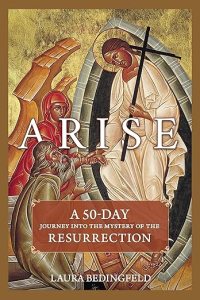 There are plenty of devotional aids produced for the penitential seasons of Advent and Lent, but not enough for the joyous season of Easter. New author Laura Bedingfeld has begun to address the imbalance. Titled simply “Arise”, Bedingfeld’s book is subtitled A 50-Day Journey into the Mystery of the Resurrection.
Guiding the reader through the seven-week Easter season, Arise offers daily meditations from Sacred Scripture, showing how the theme of resurrection is woven through the great saga of salvation history from the beginning.
Laura Bedingfeld is an American presently living in London. She has spent more than twenty years as a consecrated woman in a community of prayer and worship, and her book is the fruit of these years spent in contemplation and Biblical study. As such, each meditation is infused with Scriptural touch points and profound insights.
Step by step we are led through the entire Biblical record, tracing with the author at first the hints and guesses of resurrection embedded in the mystery of God’s First Covenant. So the first week’s reading takes us through Old Testament stories that pre-figure the Resurrection, as well as signs and symbols (like Ezekiel’s vision of the revivification of dry bones) that point to renewal and new life.
The second and third weeks are devoted to the Resurrection miracles in the Gospels as well as the parables and symbols in the Gospel stories that foreshadow the Resurrection of Christ. So Jesus’ teachings about resurrection and his references to new life are pondered—showing the theme implicit in many different ways throughout the Gospel.
Week four plunges the reader into the Resurrection of Jesus—meditating on the different Gospel accounts and the immediate post-Resurrection appearances, while the fifth week looks at the later appearances of the risen Lord and the accounts of those who became “witnesses of these things.”
Bedingfeld reserves the sixth week to examine the theology of the Resurrection explicated in the Pauline epistles, while week seven completes the Biblical tour with meditations on the first fruits of the Resurrection as revealed in Romans, Hebrews, and Revelation.
Added to all this is a complete Index of Biblical references and an impressive bibliography revealing the breadth of the author’s study and the depth of her insights.
Catholics are too often blamed for being Biblically illiterate. Bedingfeld joins with the new generation of Catholic Biblical scholars like Brant Pitre, Scott Hahn, John Bergsma, and the team at St Paul Center for Biblical Theology in helping Catholics read the Sacred Scriptures on their own outside of the liturgy. While Bedingfeld’s book will be read “outside of the liturgy,” it is a perfect book to take along to Eucharistic adoration or to be part of one’s discipline of lectio divina. Meditative reading like this may take place outside the liturgy, but it will inevitably help the Scripture being read in the liturgy to come alive in a fresh way.
Not only will the content of the book help to illuminate the reading of scripture in the liturgy, but Bedingfeld’s technique—connecting the dots, drawing out inferences, and discerning the unifying threads and themes of Scripture—will help readers use the same technique to see fresh meaning and new connections as they hear the Scriptures within the liturgical cycles of the church year.
The Church has always been cautious of the typical Protestant Evangelical home-Bible-study approach, in which a group of earnest believers decide to “study” the Bible by reading it together then asking, “And what did that verse mean to you Mildred?” While this approach may lead to an intimate and personal interpretation, without further study and outside references to church teaching and competent scholarship. one is left with nothing but a subjective, and often sentimental, reading.
Bedingfeld’s list of works cited allays that danger. Connecting to the documents of the church, papal teachings, the Apostolic Fathers, Augustine, Aquinas, and the saints, Bedingfeld’s book is rooted and grounded in Catholic theology, history, and spirituality. Arise is detailed, scholarly, and exhaustive, but always accessible, inspiring, and illuminating.
A reviewer should highlight the good and point out what may be lacking in a book. It is a small point, but it may be that a meditation on the mystery of the Resurrection every day in the Easter season may be a bit too much of a good thing for most people. Each meditation is so rich in content and food for thought that an alternative, more spacious reading schedule may have been useful. As such, rather than the book being spaced out over the fifty days of the Easter season, an alternative timetable might spread the meditations out from the whole period from Easter to Advent Sunday.
Which brings me to praise for this thematic approach to Bible study. Bedingfeld picks on the theme of resurrection and traces it in detail through the Scriptures. It is an excellent tactic because, while focussing on the resurrection one also absorbs an overview of the whole of salvation history as revealed in Sacred Scripture.
The folks at Sophia Institute Press are to be commended for bringing us a new author of Laura Bedingfeld’s learning and gift for communication. There is room, in my opinion, for other books that take a similar approach. Perhaps Bedingfeld’s next book should be a treatment of The Holy Spirit through Scripture or a book tracing the hints and pointers to the Blessed Virgin, the Eucharist, or the Holy Trinity.
Fr Longenecker’s latest book Bloodshed and Blessing: Stories of Sacrifice from Ancient Altars to the Holy Mass will be published later this year.
__________
The Imaginative Conservative applies the principle of appreciation to the discussion of culture and politics—we approach dialogue with magnanimity rather than with mere civility. Will you help us remain a refreshing oasis in the increasingly contentious arena of modern discourse? Please consider donating now.
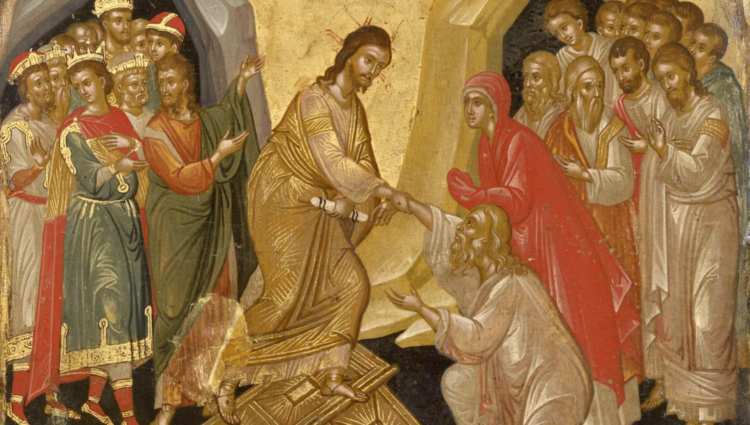
The featured image is “Resurrection of Christ,” by Markos Bathas (1498-1578), and is in the public domain, courtesy of Wikimedia Commons.