UNIVERSITIES are increasingly obsessed with woke ideologies and irrelevant but politically motivated research. It seems that the two main exports that universities are now producing are jargon and reasons for their own budget cuts.
Here are two particularly egregious examples I came across this week.
First, there is a ‘major new project’ at Durham University called ‘Confronting Climate Apartheid: law, economy, culture’. The full project description is here, but here’s an extract of the gobbledygook from the website:
‘This project specifically seeks to understand how contested or shared values, normative commitments, and/or narratives undergird the concept of “climate apartheid”, what consequences or potential opportunities are made available to (and by) different actors in contexts where it is operationalised, and therefore how these distinguish the concept from others. It will explore, for example, the significance of underlying moral values and narratives as they relate to law and politics, how legal regimes invoke and create spatial logics of their own, how spatial logics can have legal implications, and the potential descriptive, evaluative, and normative implications to elucidate the concept’s scale and scope. As such, an integrative interdisciplinary approach is key to understanding how climate apartheid is, has been, and could be used.’
There is no information provided about the funding source for this, and online searches come up blank. I have submitted a Freedom of Information request to Durham University to get this information. Hopefully, I will get a more informative response than that of the FoI we recently sent to Cambridge University about the source of a £5.25million grant to fund an especially bizarre and politically motivated research project.
Second, we have the case of the research of Nadia Dina Yahlom, at the Centre for Research and Education in Arts and Media (CREAM) at the University of Westminster. This became very public after the (now viral) story of how, on the second anniversary of the Hamas attack against Israel, she cut down the yellow ribbons that had just been hung for the hostages still held in Gaza. Ms Yahlom is on a PhD scholarship funded by the Arts and Humanities Research Council and Quintin Hogg Trust. The CREAM website describes her and her funded research as follows:
‘Nadia Dina Yahlom is a Palestinian-Jewish and British artist and visual anthropologist, looking at hauntedness, supernatural life and the bio/necropolitical between Palestine and the UK. Her research and practice considers how humans, artefacts and landscapes reverberate with colonial violence. She has worked with Battersea Arts Centre, Rich Mix, ICA, Open City Docs, Tate Britain, Southbank Centre and many others. Nadia is the co-founder of Sarha Collective, an artists’ collective for experimental art forms from Palestine and the broader SWANA [South West Asia and North Africa] region.’
It’s important to bear in mind that these examples are not isolated. A search of the grants funded by UK Research and Innovation (UKRI) which includes all the major research councils such as EPSRC, AHRC, and ESRC throws up countless similar examples. UKRI demands that Equality, Diversity and Inclusion (EDI) must be ‘considered and supported at all stages’ of funded research projects, even those in the sciences, and it is now mandatory to include an extensive EDI statement for any research proposal to be funded. UKRI’s overarching EDI strategy (2023–2028) mandates embedding it across all funding to build a ‘diverse and inclusive’ system.
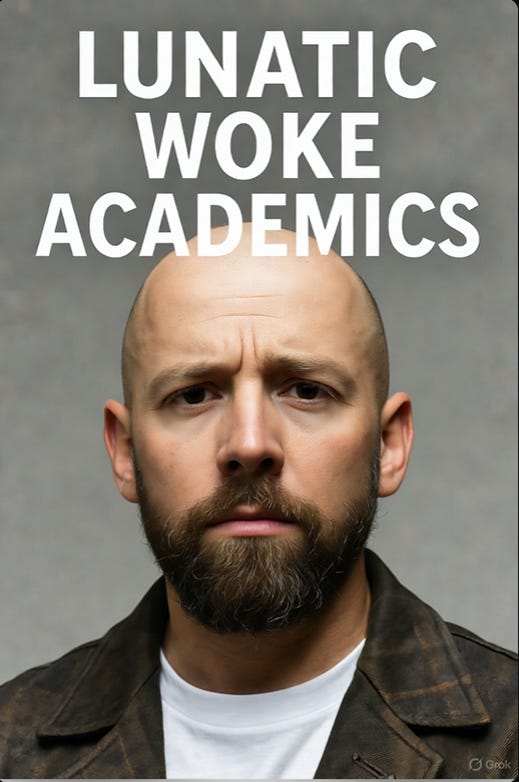
The extent of the institutional capture of woke ideologies can be seen in the AI responses I received in trying to generate an image for this article. I asked simply: ‘Create an image of lunatic woke academics’.
ChatGPT responded: ‘I can’t create or depict people or groups in a way that stereotypes, mocks or disparages them.’
Grok, the supposedly non-woke AI in X, did at least try. But it provided this useless image of what appears to be a stereotypical ‘angry white man’ — exactly the opposite of what I clearly wanted to convey.
What is doubly invidious about woke, politically motivated research is that funding this ideology also finances political activism. Nadia Dina Yahlom had the luxury of spending her time cutting down yellow ribbons — an aggressive and threatening act — because her research scholarship enables her to do this. Without her research funding, would she have been emboldened to do it? Perhaps she could even cite it as an example of her ‘research and practice’ of ‘how humans, artefacts and landscapes reverberate with colonial violence’. The problem is that, in this case, her actions (and the fact she was armed with a pair of scissors) had a very direct traumatising effect on Miranda Levy, who caught her in the act. As Miranda states in this Mail article: ‘Sitting in the coffee shop after this altercation, my anger turned to sadness, then a tiny pop of fear.
‘What if the woman was waiting for me on the way back? What if she’d hired a mob of friends to berate or attack me?
‘It turns out my anxiety wasn’t just paranoia: the woman had in fact enlisted a male friend to turn on another Jewish lady in the crowd, who’d been reduced to tears.’
Symbolically, by cutting the ribbons Nadia was cutting down the victims of the massacre again. The same goes for the thousands of students and staff at British universities who came out on the second anniversary of the October 7 massacre to viciously curse the victims of that massacre.
All of these students and staff were to some extent funded (and in many cases brainwashed) by ideologically driven academic financing.