The king’s task is to weave the two kinds together, bringing out the good qualities in their opposite temperaments, so that virtues of both courage and moderation may be found together in each individual soul and in the city.
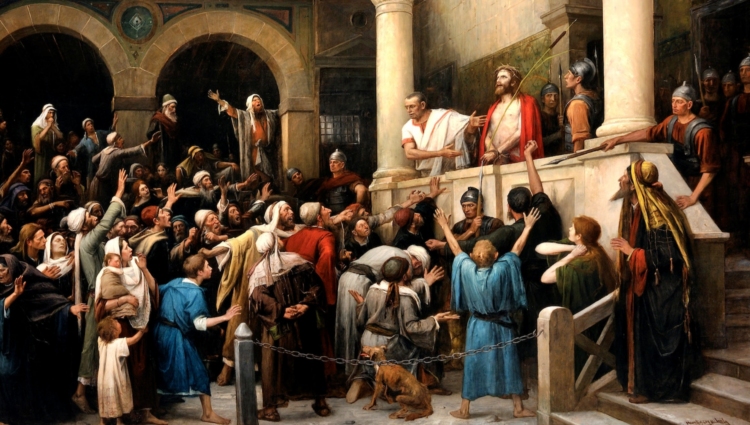
 Interrogated by the governor for political treason, the lowly Nazarene simply responds, “My kingship is not of this world” (John 18:36). Christ’s claim is puzzling, for it seems paradoxical that a political reality should belong to another world. To understand better this otherworldly kingship, we can turn to Plato, one of the greatest philosophical minds and an expert in realities beyond the physical. In his Statesman dialogue, Plato describes the perfect statesman as a king who possesses full knowledge of how to weave society together. Plato’s ideal, which he could grasp only through philosophy, finds its historical fulfillment in the person of Christ.
To explain why we even need a statesman, Plato presents a myth of the cosmic reversal. In ancient times, he says, human beings lived in a paradise, in which the earth naturally grew all their food, and they needed no clothing or shelter for protection from dangers (Statesman 272a). God himself ruled directly over humanity as its shepherd, “just as man . . . now tends the lower species of animals” (271e). But when God withdrew, a great calamity occurred, and the very heavens began rotating in the opposite direction (272d–273a). Men were left to fend for themselves in a suddenly hostile and deadly world (274b–c). And so they chose kings to rule, as necessary yet inferior replacements for the care of their divine Shepherd (275b–c).
Plato gets some elements of his story wrong, but the central message here—an idyllic garden of plenty, lost in a cosmic reversal—immediately evokes the opening chapters of Genesis. What Plato omits, however, is how we lost paradise: we rejected our Shepherd and foolishly sought to rule ourselves as gods (Gen 3:5). But God promised a Messiah, to reestablish creation in right relation to himself. Our Messiah comes to us as God, “the Good Shepherd,” yet he also comes as a man who “lays down his life for the sheep” (John 10:11). Through his humanity elevated by his divinity, Christ is able to rule perfectly as our temporal king.
A king must possess statesmanship, which Plato describes as a kind of wisdom or expertise, “a science of judgement and command” exercised for the good of his subjects (292b). Sometimes these commands take the form of laws, “but the best thing is not that the laws be in power, but that the man who is wise and of kingly nature be ruler” (294a). Since this wisdom is so rare, most political constitutions instead rely upon law as the highest authority, rather than any individual man (297d–e). But this is an imperfect arrangement, for human society is so complex that the simple judgments of the law “could never, by determining exactly what is noblest and most just for one and all, enjoin upon them that which is best” (294a–b). Plato does not mean that the law itself is bad, but simply that it is an incomplete standard, unable to account for all situations. The perfect society would permit the wise king to override even his own laws when it would benefit his subjects.
In his interpretation of the Mosaic Law, Christ shows himself to possess this kingly wisdom. As “the lord even of the Sabbath,” he can recognize when the precepts of the Law fail to serve the people of God (Mark 2:28). He fulfills the Law in his own person (Matt 5:17), transcending its imperfections by means of a better covenant (Heb 8:6-7). But even this “new commandment” is not primarily a law that prescribes certain rigidly defined actions, but more importantly a standard of imitating himself: “even as I have loved you . . . love one another” (John 13:34). For this reason, St. Paul corrects those who blindly rely on the Law instead of faith in Christ: “No human being will be justified in his sight by works of the law…. But now the righteousness of God has been manifested apart from law… through faith in Jesus Christ for all who believe.” (Rom 3:20-22).
Ultimately, statesmanship consists in a management of all the activities and elements of a city, “weaving them all most perfectly together” (305e). Just as the weaver organizes different kinds of strands into a unified whole, so too does the king unify his subjects. Plato illustrates this with the particular example of different temperaments. Some people are naturally more peaceable and prefer a quiet life, while others are more vigorous and prefer an active life, so that each kind of person tends to gravitate toward those who are like themselves (307e-308b). The king’s task is to weave the two kinds together, bringing out the good qualities in their opposite temperaments, so that virtues of both courage and moderation may be found together in each individual soul and in the city (310e–311c).
Likewise, Christ founded his kingdom on earth, the Church, as a unity among differing peoples. She is meant to be a complete society that brings many together, whether they be Jew or Gentile, slave or free, woman or man (Gal 3:28). As St. Paul says, “For he is our peace, who has made us both one… by abolishing in his flesh the law of commandments and ordinances, that he might create in himself one new man in place of the two” (Eph 2:14–15). In fact, the wisdom of Christ is so expansive that he is able to incorporate all of mankind into this one kingdom, no matter how different they may be from one another.
In contrast to Pilate, who pleads ignorance of truth, Christ’s whole purpose on earth is “to bear witness to the truth” (John 18:37). But trusting in this claim to possess complete and expert knowledge of human affairs, which includes the activities of our personal life, is not an easy task. Christ’s opponents could not accept his lordship over the Law, so they chose to execute him. Plato predicts this when he describes “the most extreme penalties” imposed on the expert statesman by the law-obsessed society (299c). Yet while Plato believed these penalties to be the final ruin of true statesmanship, they were not so for Christ. Precisely in his passion and death, Christ fully unveils his divine kingdom. Although the Law states, “Cursed be he who hangs on a tree” (Gal 3:13, cf. Deut 21:22–23), Christ ordains his crucifixion to bring about the greatest possible good: the reunion of every man with one another and with their Divine Shepherd.
✠
Republished with gracious permission from Dominicana (March 2026).
The Imaginative Conservative applies the principle of appreciation to the discussion of culture and politics—we approach dialogue with magnanimity rather than with mere civility. Will you help us remain a refreshing oasis in the increasingly contentious arena of modern discourse? Please consider donating now.
Image: Mihály Munkácsy, Ecce Homo!