Image Credit: TN General Assembly & TN.gov
Note from The Tennessee Conservative: Editorial statements in this column are the sole opinion of the author; they do not necessarily reflect the opinions of the staff of this publication.
Submitted by Connie Reguli, J.D. –
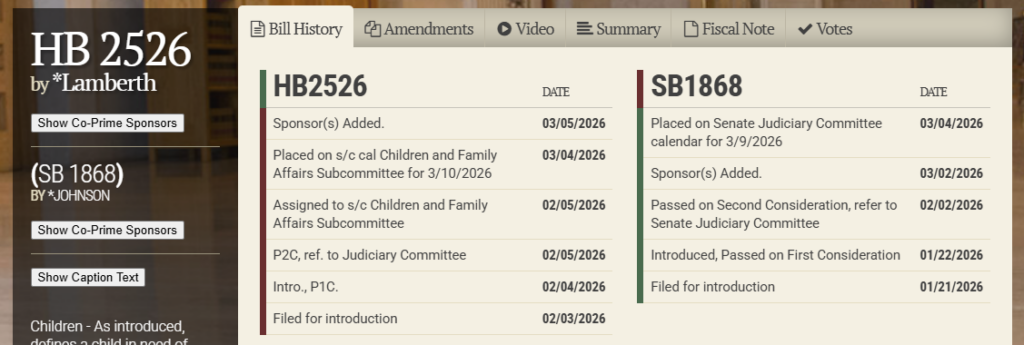
This week in Senate Judiciary and House Children and Families, HB2526/SB1868, an administration bill, will put more children in kiddie-prison.
HB2526 (Lamberth– R 44)/ SB1868 (Johnson – R 27) now carries an amendment that has changed but not cured the persistent notion that children are not entitled to basic due process. This administration bill has a clear intent: to incarcerate more children in hardwire secure facilities without protecting their due process rights. The fiscal note of $10 million a year confirms it. Fiscal calculates that 94 children will be incarcerated for assaulting a staffer x $613.46 daily rate x 181 days. Every year, this will be a recurring expense. Here’s how:
HB2526/SB1868 as filed, sought to create a new category of child in the jurisdiction of the juvenile court system. The bill defined a “child in need of heightened supervision” as one who has committed serious crime, but also added children who were “incompetent to be adjudicated delinquent but exhibited behavior consistent with a violent offense”, and added a child who is “alleged to have committed an assault against a staff member at the child’s residential placement.” Albeit, sounding like “safe environment” legislation, the bill required a period of incarceration of six months without due process.
While long standing juvenile law has separated dispositions for children who were found delinquent from those found to be unruly, this new definition blurred the lines and created “something in between”, as explained by sponsor Rep. Lamberth. This new category would permit the housing of a child in a hardware secure facility without the adjudication of guilt by proof “beyond a reasonable doubt.”
A host of grassroots advocates for children and families took to the halls of the General Assembly and the office of Rep. Lamberth and hoisted their objections.
Now there is an amendment.

The amendment makes a substantial change to T.C.A. 37-1-131 and 37-1-137. These laws are a complex weave of criteria, requirements, treatment, due process, and commitment to the department for children who are adjudicated delinquent. To be clear, a delinquent child is one who has committed a criminal offense and has had certain due process protections … the right to counsel, the right to confront the accuser, the right to require proof against him beyond a reasonable doubt. What happens after the child is found guilty of an offense drops into a maze of conditions of probation, treatment plans, alternative placement considerations. Once the child is “in the system”, his destiny is controlled by the court and the Department of Children’s Services.
So – is the amendment acceptable? No.
The amendment modifies T.C.A. 37-1-131(a)(2)(A)(v)(c)(2) and (a)(4)(B)(iii)(b). That recipe of statutory subdivisions should, alone, make every legislator pause, in that, if they do not understand the complete text of 37-1-131, they should vote no to this change, just because they don’t understand the law, and to allow the sponsors to introduce this legislation with a narrative of how this will help DCS manage children in custody and keep them out of DCS offices is intellectually inadequate.
T.C.A. 37-1-131 first requires a child to be adjudicated delinquent. Okay, we will assume with a starting point that the child has had a due process hearing on the criminal offense. After adjudication, the child is placed on probation: (a)(2)(A). The probation cannot exceed six months unless the court finds its in the best interest of the child to extend it. A violation of probation can be heard by the court and if, by a preponderance of the evidence, there is a violation of the probation requirements, the court now has the power to order a child placed into the custody of the department if (a) the child is also dependent and neglected; (b) the child is adjudicated for a subsequent delinquent offense; or (c) the child is imminent risk of danger and treatment is only available if the child is in the custody of the department: (a)(2)(A)(v)(c). A child placed in custody SHALL REMAIN IN CUSTODY SO LONG AS NECESSARY TO COMPLETE TREATMENT, and no longer than six months, however the court may order another six months, if (a) the treatment for the child is only available if the child is in custody, and (b) the treatment for the child is evidence-based by a qualified provider.
Now, with this new legislation, the addition at (a)(2)(A)(v)(c)(2) adds language that if the child commits an assault against a staff member at the child’s residential placement, the court can order that the child remain incarcerated for six additional months.
While, the words on their face appear to mark a path to protect a child from unnecessary incarceration and protect their liberty interests at the commencement of delinquency proceedings, the question must be asked; “how can this go wrong for a child?”
First, once a child is adjudicated as delinquent, which could be as innocuous as petty theft, a harassing phone call, or chalking the school sidewalk, the child becomes cast into servitude of the court. Yes, correcting a child’s conduct is critical and can be rehabilitative, but the conditions of probation are not necessarily specifically tied to the offense. A child can be placed under a series of requirements during probation, such as suspension of all use of cell phones, and computers, cannot be without direct supervision by a parent, or strict requirements against being absent or tardy from school. The slightest infraction of these restrictions need only be proven by a “preponderance of the evidence” and the court is NOT required to assign the child a defense attorney.
With a minor crime and a minor probation infraction (with no attorney), the child can now be placed in the custody of DCS and incarcerated in a hardwire secure facility. The emotional trauma associated with being incarcerated as a child is well documented.
Second, an incarcerated child is at the complete mercy of the facility hires. Staff there historically lack training and demonstrably lack accountability for their aggressive conduct against children. A pending class action lawsuit against DCS describes the offenses suffered by children at the hands of guards and supervisors at a lock-up facility. These allegations include guards taunting children to assault each other with a reward of Ramen noodles for the most egregious conduct exhibited by the children.
This legislation, particularly, confronts the child’s aggression at the facility, but not the aggression suffered by children.
Now, incompetent and corrupt staffers at the facility will have another layer of threat against a child. While grooming a child or taunting a child to exhibit aggression against another child, the guard will be able to tell the child, that if they do not do as they say, they will report that the child assaulted them and they will spend another six months behind the razor wire and locked in a cell.
In the December 2025 DCS audit, one of the most shocking reveals was that DCS did not properly investigate and resolve SIU (Special Investigation Unit) allegations of abuse. SIU are investigations conducted against professionals, staffers, and contractors working with children. The missing piece for sufficient review of the actual risk to children in lock-up is knowledge about the consequences to kiddie-prison guards described in this lawsuit.
The new law says this, “the child does not have to be adjudicated of a separate delinquent offense of assault for the court to order that the child remain in custody for up to an additional six (6) months.”
“The child does not have to be adjudicated…..” meaning, there are NO due process protections when the allegation of assault has occurred.
This alone should bring a full-stop to this bill. No adult would be found in violation of criminal probation without a hearing and the right to counsel.
As early as 2013, research showed that up to 90% of justice-involved youth report exposure to some type of traumatic event. On average, 70% of youth meet criteria for a mental health disorder with approximately 30% of youth meeting criteria for post-traumatic stress disorder (PTSD). Justice-involved youth are also at risk for substance use and academic problems, and child welfare involvement.
The Tennessee juvenile justice system does not seek to explore the root causes and systemic failures of DCS, but to heighten the rate of incarceration and blame the children while they deal with the difficult challenge of growing up.
This bill is meant to protect adults, not children.

Call your legislator to say “NO” to HB2526/SB1868.
Rep. Lamberth 615-741-1980
Sen. Johnson 615-741-2495
VOTE NO HB2526/SB1868
House Committee Members
Rep. Keisling 615-741-6852
Rep. Bulso 615-741-6808
Rep. Harris 615-741-2239
Rep. Doggett 615-741-7476
Rep. Towns 615-741-2189
Rep. Alexander 615-741-2251
Senate Committee Members
Sen. Gardenhire 615-741-6682
Sen. Roberts 615-741-4499
Sen. Rose 615-741-1967
Sen. Harshbarger 615-741-5761
Sen. Kyle 615-741-4167
Sen. Lamar 615-741-2509
Sen. Stevens 615-741-4576
Sen. Taylor 615-741-3036
Sen. White 615-741-6853
Find the list of House Members here.
Find the list of Senate Members here.
If you don’t know your representatives, put your address in here.
House Children and Family Affairs Subcommittee – HB2526 to be heard March 10
HB2526 would incarcerate more children in hardwire secure facilities without protecting their due process rights.
Rep.mary.littleton@capitol.tn.gov; rep.rebecca.alexander@capitol.tn.gov; rep.gino.bulso@capitol.tn.gov; rep.clay.doggett@capitol.tn.gov; rep.torrey.harris@capitol.tn.gov; rep.kelly.keisling@capitol.tn.gov; rep.joe.towns@capitol.tn.gov
Senate Judiciary Committee – SB1868 to be heard March 10
SB1868 would incarcerate more children in hardwire secure facilities without protecting their due process rights.
Sen.todd.gardenhire@capitol.tn.gov; Sen.kerry.roberts@capitol.tn.gov; Sen.paul.rose@capitol.tn.gov; Sen.bobby.harshbarger@capitol.tn.gov; Sen.sara.kyle@capitol.tn.gov; Sen.london.lamar@capitol.tn.gov; Sen.john.stevens@capitol.tn.gov; Sen.brent.taylor@capitol.tn.gov; Sen.dawn.white@capitol.tn.gov


Connie Reguli J.D. has 28 years experience in family and juvenile law and is a political activist for child welfare reform. She organized the Family Forward Project through social media and has 28,000 families nationwide working towards reform.
She can be contacted at connie.familyforward@gmail.com or through Facebook messenger.
YouTube: https://www.youtube.com/@connieregulifamilyforward
Facebook: https://www.facebook.com/connie.reguli
Instagram: https://www.instagram.com/conniereguli/