The essence of the attitude of the believer lies in the obduracy with which he approaches the real, and in the firmness of his determination to keep up the struggle. If faith is still developing, there comes a time when the believer considers his faith as the most securely anchored reality of all, sure to triumph.

Are any typical crises of faith?
There certainly are, and of the most varied kind. Some, for example, come from a change in environment or from disturbing human events, such as a break in ties dear to one; from good fortune or ill fortune; from physical or spiritual disturbances, etc. We must now focus our attention on crises provoked by definite situations which change the course of a human life.
It has been correctly said that in childhood we are protected as by an enveloping shell. The care of parents and teachers, and in general the spontaneous attitude of every adult tends toward surrounding the child by a protective atmosphere, in order that he may be able to grow up without danger, surrounded wholly by benevolent influences. But the care of adults, by itself, would not be sufficient to create and maintain this atmosphere; there is also needed the active cooperation of the child. It is the child himself who creates this protection, according to the laws of his own development. The way in which he perceives reality—beyond a certain limited point he does not see things at all, or sees them only vaguely—the habit of relating objects and events to his own existence, of attaching a meaning to them or transforming them, all this creates a protective environment about him. Everything tends to be confused. The internal and external, reality and legend, the world and faith all are mixed up together. Everything appears to the child with a familiar and friendly face, everything is ready to help him.
To be sure, it is not always thus. Many children experience dislocations and tensions from an early age. Many never know the harmonious existence of childhood in which they are so carefully screened. They may experience trouble of all kinds: suffering, a sense of oppression, or unconscious desires. Nevertheless, the basic form of childhood existence implies a limited and protective environment, wherein realities are harmoniously mixed up together, in which life in this world and in the next, reality and dreams, soul, body, and things are confused.
This state of mind determines the faith of the child. Regardless of the differences one may observe in this or that child, their faith has an assurance born of confidence. To be sure, problems are always bound to arise, but they remain veiled or in suspense.
Then come the years of adolescence. At first faintly, then with ever greater force and determination, the grand impulse of life awakens in the young man, drives him toward those of the opposite sex, causes him to seek the world in all its fullness; he also seeks his own proper task and the development of his personality.
This drive may be described in various ways. From our point of view the important thing is that it exposes him to the infinite, compels him to rise up and broaden his outlook, to seize the world in its fullness in order to coordinate himself with it. At the same time the adolescent wishes to find himself, find his balance, by opposing whatever limits or restricts him. His will collides with the form of childhood existence. Especially its limited outlook, its friendly protection, the warmth which surrounds it, now become unbearable to him. He feels that its old concepts, its attitudes, its symbols are too narrow for him; they burst their seams; they must be surmounted or thrown away.
So it is with the life of faith. Religious forms, rules, motives, everything which has hitherto been considered valid is now felt to be immature, childish, stupid, and embarrassing: his whole religious attitude enters a period of crisis which may express itself in widely different ways: in intellectual criticism; in moral rejection; in a feeling of opposition to the previous generation; in a revolt against authority; in impatient opposition to the previous mode of existence, etc. But the essential thing in each such case is the transformation of the interior life which seeks room and expression for a new reality in process of being born…
Then faith develops magnificently; we may consider this its ideal or enthusiastic form. In it the desire for the infinite, the thirst for freedom, and the will to create are merged with the Christian will. Such faith is bold, broad, and sure of itself; it reveals a boldness of spirit, a bravura which enables it to accomplish great feats and achieve a noble strength and intolerance. A life which has never known a period like this must lack something very important.
This attitude grows apace; it lasts for a more or less long period according to circumstances and its inner strength, until it too in turn enters a period of crisis.
This type of faith—like all youthful reactions—has a feeling for the wide world; it has the power to give itself completely to the infinite; is fired by thoughts and imagination, and full of generosity. It does not yet see reality as it is, nor human conditions nor existence in all its harshness. It has transformed all these things by the power of its mind and heart, both of which are inclined to idealize; it has “stylized” them—or simply ignored them. In the same way the passionate will thinks that by the exercise of freedom it can discover its true identity, but does not yet grasp it in its true reality; it creates an identity according to its own dreams into which it fits the transfigured reality. An existence of this kind is torn, so to speak, between the drive of the spirit and heart on the one hand, and the ideal world on the other. But the concrete reality in between has not yet emerged. Now as life progresses, the drive loses its force; the bow of life becomes distended, the power to idealize diminishes. At the same time reality becomes more sharply defined: things appear as they are, men, institutions, situations, and the reality of one’s own identity itself. Frustrations and disappointments increase. The compromises which one is obliged to make in place of the confident and bold certitude of this kind of idealism become more and more numerous. A new crisis develops; but confidence gradually becomes weaker and weaker. It becomes more and more impossible not to see the negative side of things, it is more and more difficult to confuse the intensity of desire with the achievement of success. One sees more and more clearly how obscure and stationary existence is, and in the light of this how ineffective great ideals and movements are destined to remain. The meaning of “reality” is revealed for what it is, and how, grounded in itself, it is opposed to all affection and does not yield to the latter.
The danger which then threatens is that of disillusionment: the danger of succumbing to the thought that reality is stronger than the ideal; that actual conditions are harder than thought; that selfishness, narrowness, small-mindedness, baseness and vulgarity are more alive than generosity of heart. The person who pursues a noble aim experiences the shame of being thought a visionary. One who is about to become an adult blushes at whatever remains from his years of adolescence; she who is about to become a woman blushes at what remains of her outlook as a young girl. The danger of skepticism threatens, strengthened by the desire to appear truly grown-up, that is blasé.
It is scarcely necessary to show that faith is the first to suffer in such a crisis. The faith of the idealist dissolves. It appears as overly ambitious, foreign to the world, sentimental and exaggerated.
Then a change may come about in many different ways. The young man becomes more sober in his thoughts and feelings; he becomes more critical regarding his relationships with other persons; more persevering at his profession, more settled in his social habits, etc. Faith may also be re-won in the most varied ways. If it is achieved through a proper deepening of the personality, once one arrives at a certain maturity, reality is accepted for what it is, without capitulating before it, strong in one’s faith. Such faith makes sure of its independence with regard to the world. It becomes more deeply rooted in its own ground and may oppose to existence an attitude which does not expect agreement, but extricates itself from all opposition or disappointment deriving from reality, and emphasizes itself, as against such reality, by an “And nevertheless”! Such a person may even find a deep, grim satisfaction in acknowledging that the world does not agree with him, that struggle is everywhere inevitable, and that the life of faith is itself a combat.
We may express this again in the following way: faith grows in character. To have character means that conviction maintains itself in the face of reality. Trust, discipline, perseverance all enter into faith; a tenacious struggle with reality, the maintenance of a position even when a successful outcome can hardly be predicted in the near or distant future.
Such is the faith of one who has matured, of the man or woman who lives by steadfastness without any illusions.
Perhaps the development goes even further. The essence of the attitude of the believer of whom we are speaking lies in the obduracy with which he approaches the real, and in the firmness of his determination to keep up the struggle. If faith is still developing, there comes a time when the believer considers his faith as the most securely anchored reality of all, sure to triumph. He can then defend himself against the reality of the “world” and triumph over it, as St. John says: “This is the victory which overcomes the world, our faith.”
__________
This essay is taken from The Life of Faith. Republished with gracious permission from Cluny Media.
Imaginative Conservative readers may use the code IMCON15 to receive 15% off any order of not-already discounted books from Cluny Media.

The Imaginative Conservative applies the principle of appreciation to the discussion of culture and politics—we approach dialogue with magnanimity rather than with mere civility. Will you help us remain a refreshing oasis in the increasingly contentious arena of modern discourse? Please consider donating now.
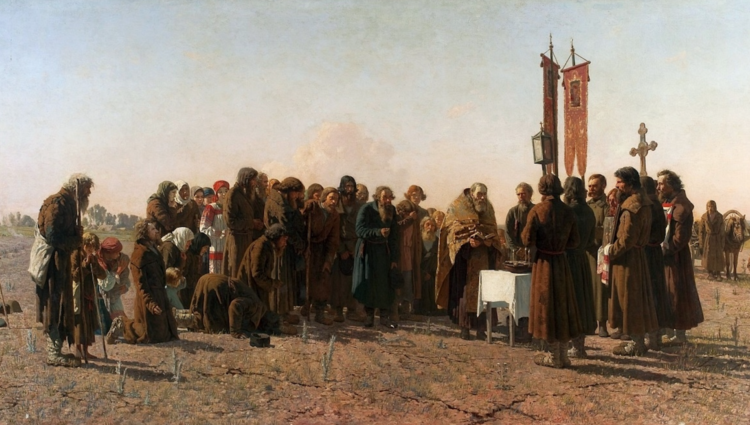
The featured image is “A Prayer in Time of Drought” (between 1878 and 1881), by Grigoriy Myasoyedov, and is in the public domain, courtesy of Wikimedia Commons.