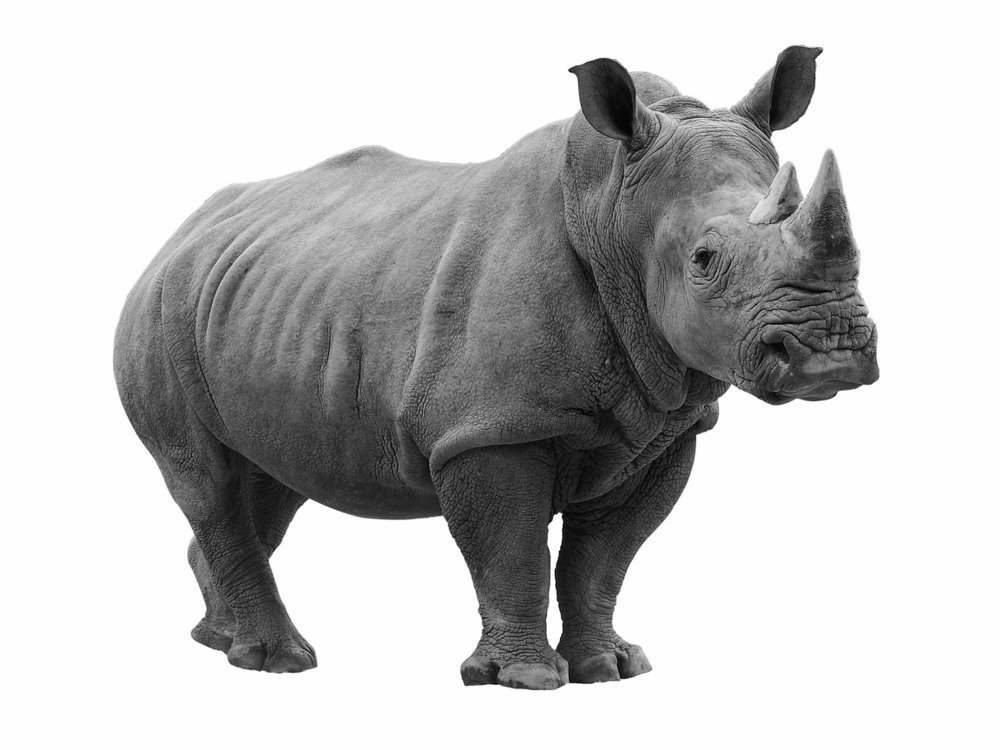
RHINOCEROS is is a play by Eugène Ionesco written in 1959. Over the course of three acts, the inhabitants of a small town turn into rhinoceroses. The only character who doesn’t undergo metamorphosis is Bérenger, an aimless everyman, regularly belittled by his peers for his drinking, unkempt appearance and his stubborn fixation on the mysterious phenomenon. The play is an allegory of conformity and mob mentality.
All the characters except Bérenger speak in clichés. Upon first encountering a rhinoceros, they exclaim ‘Well, of all things’, a phrase repeated 26 times throughout the play. Ionesco said that the repetition of hollow platitudes illustrates the impossibility of thinking critically. Likewise, once someone utters the commonplace ‘It’s never too late!’, others repeat it mechanically, 22 times in all. This is the way the author chose to expose herd reflexes.
Today, diversity functions in much the same way: as a password required for admission into a closed circuit of ritualised jargon.
What does diversity mean in the big media ecosystem? Nothing but a word hollowed out by overuse and intellectual laziness, drained of substance and inflated from a presumable moral high ground. Its epicentre is ‘woke’, a vapid nebula. An Urban Dictionary entry defines woke as ‘the act of being very pretentious about how much you care about a social issue’. Crude as it may be, the definition captures something real. Diversity often serves a similar performative function.
Mainstream news shows present themselves as guardians and enforcers of this torpid ideal. Presenters invoke the word with solemn expressions, pompous gestures and ceremonial gravity. Yet, the result is rarely genuine pluralism. Major media corporations increasingly resemble a pool of state-controlled networks run by a military junta rather than privately owned independent firms operating in a, presumably, democratic society. Dissenting voices are removed with remarkable efficiency, and long-standing contributors can vanish without explanation, as though erased by Stalin’s photographer.
This has little to do with belief and much to do with incentives. In a system driven by clicks and shouts, friction is rewarded and nuance penalised. Simplified moral language travels better than careful analysis. Slogans outperform arguments. Whether those who deploy this language believe in it sincerely is largely irrelevant. The structure itself guarantees repetition.
Diversity is a word brutally abused and used as a dagger by TV ratings alchemists who, in many cases, don’t believe in what they preach. In private, among friends, over wine and cynicism, they openly admit it is just babble for the rabble. It is a fact: labelling is much easier than thinking and cheesy slogans sell better than proper journalism to the unlearned masses.
The same logic increasingly governs cultural production. Films are criticised not for what they say, but for failing to comply with an implicit checklist of approved attributes. Are writers next? Are they going to be told that their latest novel is not diverse enough? This variant is possible but highly unlikely. Writers are free from scrutiny. Nobody reads books these days.
What exactly do diversity and freedom mean as they are presented on the social media accounts managed by this new breed of petty despots who wear uniforms and march like wind-up soldiers? What is this meaningless mania? What does this longing mean? This longing for an autocratic society where everybody uses the same hollow vocabulary, takes the same knee, and performs many other close-order drills, behaving like automatons connected to the same neglected brain. What is the point of this deployment of cheap hyperbolism worthy of the tackiest soap opera?
A free society is, by nature, untidy. Those who demand that it be perfectly ordered often reveal a deeper discomfort with freedom itself. History offers ample evidence of where monochrome social experiments tend to end.
In turn, those who want to avoid getting pummelled and having their lives ruined by digital stampedes, need to learn how to choose the correct pronouns, blame everyone else for their problems and show the world how clever they are by selecting the right profile pictures and writing brave hashtags. They must adopt the correct terminology, display the correct symbols and repeat the correct slogans. The performance is not subtle, but it is effective. Compliance is easier than resistance.
Ironically, the same phenomenon sustains an entire class of professional commentators whose output depends on perpetual outrage. Their condemnations are predictable, their language interchangeable, their indignation manufactured to order. This, too, is a product — consumed eagerly by audiences trained to mistake repetition for conviction.
It is often claimed that social media has transformed the public from passive spectators into active participants. This is largely a fiction. Typing, reposting and signalling agreement do not constitute agency. Mechanical activity is not the same as thought, and noise is not engagement.
Ionesco claimed that demi-intellectuals – not true intellectuals like Einstein or Bergson – have a mass mentality and that they – writers, journalists, professors and the like – were to blame for the rise of Nazism. It was their fault, said Ionesco.
And he was right. Rhinoceros is as much a drama as it is a warning. Conformity begins not with violence, but with words repeated too often and examined too little.
Meanwhile, rulers adapt readily. The fear of losing status and privilege has always proved stronger than any abstract commitment to principle.