“The link between father and son is not only of the perishable flesh: it must have something of aeternitas about it,” J.R.R. Tolkien wrote to his son. “There is a place called ‘heaven’ where the good here unfinished is completed; and where the stories unwritten, and the hopes unfulfilled, are continued. We may laugh together yet….”
 One of my favourite ways of relaxing in the evenings is eavesdropping on friends, especially those friends who have been so dear to me over the years. Most of these friends are long since dead which means, in some sense, that I’m eavesdropping on ghosts.
Perhaps, at this point, I should pause to offer an explanation of my strange pastime.
Amongst the many volumes in the Pearce family library are collections of letters or diaries by writers whom I admire. These include the letters of T.S. Eliot and the diaries and letters of Evelyn Waugh, and also the three volumes of C.S. Lewis’ letters, each of which is a weighty tome of over a thousand pages, and each of which was edited by my late, great friend Walter Hooper. Another prized volume is The Letters of J.R.R. Tolkien, recently published in a most welcome “revised and expanded edition”. It was to this edition that I resorted a couple of evenings ago to eavesdrop for a while on the private correspondence of the literary giant who gave us the world and wonder of Middle-earth.
The charm of reading other people’s letters is the intimacy it gives us with those who wrote them. It’s as though we become a fly on the wall of their homes, listening in on their private conversations, entering into the privacy of their private lives, meeting their friends, getting to know them more deeply, albeit vicariously. Were they still alive, our unheeded presence would be an outrageous trespass, an imposition, possibly a crime and most certainly a sin. Since, however, they are safely dead, we can safely read. Their ghosts cannot harm us and, more to the point, we can’t harm them. As such, it’s a harmless exercise in getting to know good people better and benefitting from the experience.
It was with this spirit of harmless intimacy that I opened the pages of Tolkien’s letters, turning the pages at random and reading whatever opened itself to my gaze.
On September 17, 1937, four days before the publication of The Hobbit, Tolkien wrote to his publisher thanking him for the cheque, presumably the advance due upon the book’s publication. “The cheque was both surprising, and comes at a very convenient moment indeed. I only hope the Hobbit will earn it, and quickly put me out of your debt, though not out of gratefulness.” Two weeks later, on October 2, he wrote to his youngest son Christopher, who had recently become a boarder at the Oratory School in Woodcote, Oxfordshire, which had been founded by St. John Henry Newman in 1859. Amongst the news that the father imparted to his son was his recent meeting with C.S. Lewis (“Mr Lewis”), who had told him that Lewis’s brother had read The Hobbit “and wanted more…”. Appropriately enough, the letter concludes with Tolkien enquiring after his son’s spiritual health: “In the meanwhile good night, and God bless you. I pray for you. Remember mummy and me at Mass. Have you been to Communion?”
Fast forwarding nine months to July 25, 1938, we find a curious letter to a German publisher in which Tolkien is quite clearly irritated by the publisher’s enquiry about whether he was an “Aryan”:
I regret that I am not clear as to what you intend by arisch. I am not of Aryan extraction: that is Indo-iranian; as far as I am aware none of my ancestors spoke Flindustani, Persian, Gypsy, or any related dialects. But if I am to understand that you are enquiring whether I am of Jewish origin, I can only reply that I regret to say that I have no ancestors of that gifted people.
Although his great-great-grandfather had come to England from Germany in the eighteenth century, Tolkien insisted that the “main part” of his descent was “purely English”. He explained that he had been accustomed nonetheless to regard his German surname with pride, and had continued to do so even while serving in the British Army during World War One. “I cannot, however, forbear to comment that if impertinent and irrelevant inquiries of this sort are to become the rule in matters of literature, then the time is not far distant when a German name will no longer be a source of pride.”
Fast forwarding a further three years to June 9, 1941, we find Britain now at war with Nazi Germany and Tolkien writing to his son Michael, who was training as an Officer Cadet at Sandhurst, the Royal Military College. Expressing his frustration that he was not able to do “something active” for the war effort, he gained an element of comfort in being “the father of a good young soldier”:
The link between father and son is not only of the perishable flesh: it must have something of aeternitas about it. There is a place called ‘heaven’ where the good here unfinished is completed; and where the stories unwritten, and the hopes unfulfilled, are continued. We may laugh together yet….
This vision of heaven as the place where the unfinished good is completed, where hopes are fulfilled, where unwritten and unfinished stories are continued, and where all human goodness is perfected, was the inspiration for Tolkien’s short story, “Leaf By Niggle”, which he had written a year or two earlier, in 1938 and 1939, but which would not be published until 1945, four years later.
The rest of Tolkien’s letter to his “good young soldier” of a son is replete with a great mind’s musings on good and wicked things: the slothfulness of the English, and the poisoning of the obedience and patriotism of the Germans “who are – under the curse of God – now led by a man inspired by a mad, whirlwind, devil: a typhoon, a passion: that makes the poor old Kaiser look like an old woman knitting”. This one letter, of which I’ve only quoted a small part, would furnish more than enough for a whole new essay in its own right. For now, however, it is time to desist until the next time I feel the urge to eavesdrop on Tolkien.
__________
The Imaginative Conservative applies the principle of appreciation to the discussion of culture and politics—we approach dialogue with magnanimity rather than with mere civility. Will you help us remain a refreshing oasis in the increasingly contentious arena of modern discourse? Please consider donating now.
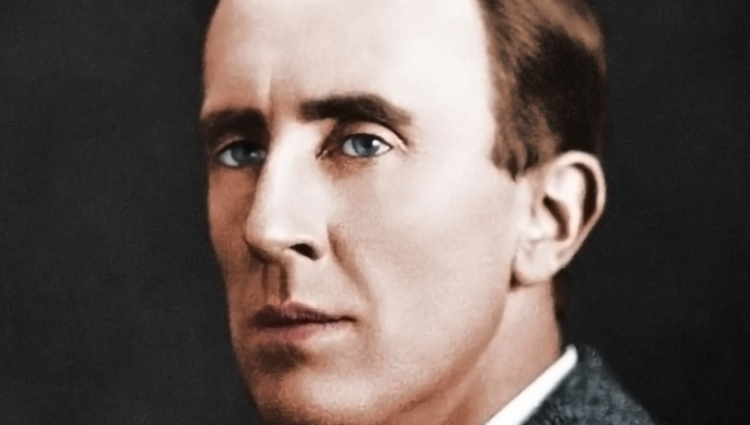
The featured image, uploaded by TuckerFTW, is “Tolkien in 1940’s colored by TuckerFTW 2021.” This file is licensed under the Creative Commons Attribution-Share Alike 4.0 International license, courtesy of Wikimedia Commons.