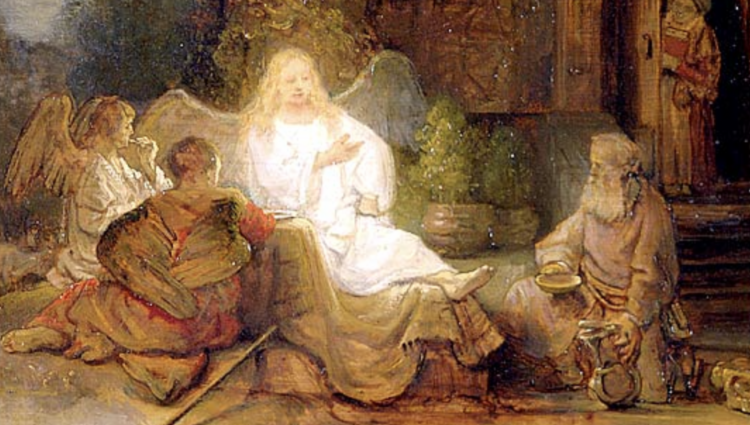
“Do not neglect to show hospitality to strangers, for thereby some have entertained angels unawares.” —Hebrews 13:2
 I am probably more likely to entertain strangers when on the road than I am at work or at home. While traveling on a plane, a train, or a bus, one of my favorite positions is the seat behind a baby over six months. At that age, the child can explore his setting and discover rather quickly that he can see someone through the crack between his mother’s seat and the person next to him. He is also usually capable of grasping the mysterious game of peek-a-boo. I can fill up plenty of my ride peeking around and over the seats at a child who giggles. The Cherubim may not be roly-poly infants, as some painters have depicted them, but such infants are definitely angels.
Even better than a baby, if such a thing is possible, is to be seated next to someone with whom one can have a conversation. I am always happy to read a book or, if there’s enough room, plonk down my laptop and work on writing something. But, the delight of a real live human being with whom one can talk is a pleasure too seldom encountered in the Age of Entertainment Technology. St. Augustine described the human plight under Original Sin as incurvatus in se—to be curved in upon oneself. Our mobile devices may not be evil themselves, but they strangely cause us to sit and even walk through traffic with our heads bent down upon the glowing device held close to our hearts.
I say “our” here because, as my kids will remind me, I’m just as bad as anybody else in this regard. As one Anonymous Younger Deavel says, “If you from ten years ago could see you, he’d be horrified.”
For some reason, airplanes bring back to life that younger, judgmental, pre-smartphone me. The cause may well be my own stinginess: I refuse to pay for internet on a plane. Thus, I feel liberated to sit with my books or, if possible, get in a good gossip with an Image of God placed next to me by the interplay of Lady Fortune and Providence.
So it was on my last trip to speak for a conference. My flight to Kansas City was early enough that I fell asleep before take-off, head wedged between the seat and the wall of the plane, drooling onto my own shoulder. But the return was an 11:00 AM flight. I was going to be awake.
Seated by the window again (I must not have chosen my seats), I got to my row first, sat down, pulled out my book, and sent a few messages before getting my respite from wireless service and servitude. A young man—teenage, college-age? I can’t even tell anymore—sat down beside me, turned on a video on his phone, pulled giant earphones over his head, and curled into the space next to me. This would be a reading flight, I thought.
And then, I realized from my peripheral vision, the aisle seat occupant had arrived. As I turned to the side, I looked in wonder to see my friend LuElla, an English professor at a school in San Antonio. “LUELLA!” I exclaimed, with only a small fear that it might be a doppelganger.
It was no doppelganger. It was the friend herself. She had been at a different conference in Kansas. So, we began to chat over the arched back of the young curled-up dude. We exchanged details on our conferences and personal details. An English professor, she just was promoted to full professor—yet she deigned to associate with a mere associate professor such as myself. From there, the conversation went everywhere: as many laudatory jokes as we could remember about the greatness of the recently deceased Chuck Norris, our writing projects, teaching in an age of AI and decreasing literacy, Catholic higher education, forms of worship among Evangelicals and Catholics, children’s literature, and lots of other things. The conversation became easier midway through the flight when the young dude went to the restroom and then agreed to switch seats with me.
Good internet citizen that she is, LuElla shared a picture of us in the plane on social media and commented that such a good surprise conversation with a friend on a plane “is a sign that God is watching over it all.” So He is.
That flight, the best one I’ve had in a while brought back memories of other trips where I had the curious sensation of God orchestrating my meeting of others who seemed to me to be angels. Two stand out.
The first was Holy Week in April 1995, when my term at the Centre for Medieval and Renaissance Studies in Oxford, England, had ended. I was on a bus from London to Dover for a ferry over to the continent and a little tour on a Eurail pass. I sat down on the aisle seat next to a man who looked Middle Eastern. As we got going, he pulled out a small book in a foreign language and began to read and, it seemed to me, pray.
At a suitable pause in his reading, I asked him if he was reading a Bible. An Egyptian by birth, he said he was praying in the Coptic language. At the time, I had begun to be very interested in Catholicism and Orthodoxy. Though Copts are Oriental Orthodox and share full communion with neither Catholics nor Orthodox, they are similar enough in their approach to Tradition and Scripture, images, and a truly embodied faith working through love—so much so that he was able to answer a great many questions I as a Protestant brought to the ancient communions in general. Whether he felt the same, I cannot guess, but when we parted ways, I felt that I had been ministered to on my trip.
The other trip that came to my mind was from a few years later on a train. Now a Catholic in graduate school at Fordham University, I sometimes flew and sometimes took Amtrak from my childhood home in Indiana. The train that went from Chicago to New York City stopped in Nappanee, Indiana, at 11:07 PM. I never paid for a sleeping berth. Instead, I would plop down on a seat and snooze till the morning hours when we were usually winding through Pennsylvania somewhere on our way to our noon destination of Penn Station.
On one of those trips, I ended up sitting by a Jewish woman whose name was Soloveitchik. She was related by marriage to the great 20th-century Orthodox theologian Rabbi Joseph Soloveitchik. Though I was not considering conversion to Judaism, I was fascinated by Jewish approaches to the Old Testament and to service of the one God. In fact, I had been reading the Jewish Harvard scholar Jon Levenson’s The Resurrection of the Beloved Son and was struck by how much there is to learn about the New Testament by studying those types of Christ in the Old. Christians find the fullness of the Law, the Prophets, and Wisdom in Jesus Christ, but faithful Jews who study those texts and seek God can teach us a great deal about the types that he fulfills.
As with the Coptic Christian, my memory of the details of this conversation has faded. I hope that this is because whatever truth was in them was fully incorporated into my own intellectual and spiritual outlook. What I still have fresh in my memory is that sense that God was looking out for me.
The writer Frederick Buechner wrote a novelistic treatment of the Book of Tobit titled On the Road With the Archangel. Apart from my friend LuElla, the full professor, I don’t know the ranks of the angels I have entertained while on the road. What I know is that they have both entertained and illumined me.
__________
The Imaginative Conservative applies the principle of appreciation to the discussion of culture and politics—we approach dialogue with magnanimity rather than with mere civility. Will you help us remain a refreshing oasis in the increasingly contentious arena of modern discourse? Please consider donating now.
The featured image is “Rembrandt: Abraham and the Three Angels” (1646), and is in the public domain, courtesy of Wikimedia Commons.