As one of the greatest bridges from the ancient world to the medieval, St. Augustine of Hippo’s “Confessions” illuminates the path forward through the gloom of the modern world. And C.C. Pecknold’s new book, “Fire on the Altar” is a wonderful guide to this masterpiece.
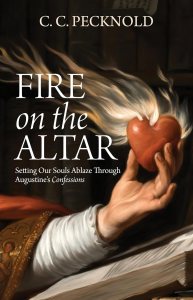
Fire on the Altar: Setting Our Souls Ablaze through St. Augustine’s Confessions, by C.C. Pecknold (160 pages Emmaus Road, 2025)
 The confessions about which I need to confess is St Augustine’s masterpiece. To put it bluntly, I confess that I have not read Confessions. I have dipped into it, scanned and skimmed for research purposes, but I have not sat down and made my way all the way through it. Perhaps, had I had the advantage of attending a school with a great books curriculum I would not now, at this stage in my life, have to make such an embarrassing admission.
I realize with this admission that I am missing something. A piece is missing in my mind and heart. Nevertheless, I believe to have tapped over the years into the heart and mind of this great soul—this seminal philosopher, pastor, theologian, lover, and saint. How could anyone who has had even a mediocre education in the Western tradition be immune to his influence? As one of the greatest bridges from the ancient world to the medieval, St Augustine of Hippo’s Confessions illuminates the darkness of the ancient world and lights the path forward through the gloom of the modern world.
Aware of my lack, I was delighted to receive C.C. Pecknold’s Fire on the Altar. His subtitle is “Setting Our Souls Ablaze through Augustine’s Confessions.” Pecknold is Associate Professor of theology at the Catholic University of America, where he teaches and writes on Augustine—especially on Augustine’s theological and political thought. A lifelong student and teacher of Augustine, he has provided a concise and punchy commentary on the Confessions. While reading Fire on the Altar, I first thought it was a kind of Cliff Notes shortcut for people like myself—too lazy or otherwise occupied—to read the primary text. This first impression was mis-judged. Pecknold’s book is a precis of Augustine’s most famous work, but it is much more than that: It is a learned and inspiring commentary.
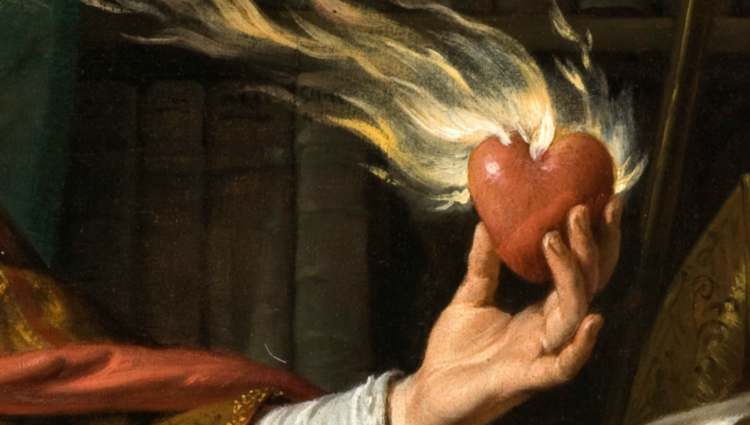
This is because Professor Pecknold views Confessions through the lens of sacrifice. As a result, Augustine the priest and pastor shine through, and we are able to glimpse the true heart of the work—a heart full of fire and passion for the love of Christ.
As the author explains in his introduction, the book is the result of several series of lectures he has given for his students and his fellow parishioners. Cultivating the themes of sacrifice, liturgy, and worship, in seven chapters he guides us through Confessions, helping us see the germination and culmination of Augustine’s arguments. Here we touch on the famous surge of the restless heart searching for God, the distortions of love through concupiscence and sin, the need for passion to be balanced by reason, and the need for the human will to be completed by sacrifice and submission to the Divine Will.
In our modern world, where the Christian religion has been reduced to moralistic, therapeutic deism, the concept of sacrifice has been downgraded to a kind of respectable do-goodism. Even for church goers, to “make a sacrifice” means no more than perhaps volunteering at the soup kitchen, signing up to sell girl scout cookies, or (at most) putting a little bit extra in the collection plate. Professor Pecknold brings out Augustine’s emphasis on sacrifice as being the total giving of oneself to God—in response to Christ’s own self-giving on the cross and in union with the eternal re-presentation of that sacrifice on the altar at Mass. Pecknold challenges the lukewarm do-goodism typical of suburban Christianity, not with invective, blame, or self-righteous preaching, but by inspiring us with Augustine’s own heart ablaze with the love of Christ. For this to take place, Pecknold explains that what is required is “a certain kind of patience… as the book demands both an intellectual seriousness as well as spiritual reflection.” To assist in this process, each chapter concludes with a Preparatio—a summary to spark deeper meditation and prepare the reader to proceed into the next chapter and the next stage of Augustine’s argument.
Pecknold’s learned introduction provides an excellent overview of the philosophical and theological context for Augustine’s work. Especially helpful is his explanation of the importance and ubiquity of sacrifice in the ancient world. Augustine’s readers would therefore have gleaned the theme of sacrifice from his text easily, whereas we are blinded by the materialistic secularism that saturates our world. We are therefore indebted to Professor Pecknold’s elucidation to help us see how sacrifice (and therefore the religious instinct) was at the heart of the hearth, the home, and therefore the whole society.
As Pecknold’s book was the result of lectures to students and fellow parishioners, I would recommend it as the perfect text for high-school and college student groups and parish book and fellowship groups. Since our new pope is an Augustinian, Fire on the Altar will have a second purpose of taking readers into the mind and heart of Pope Leo.
I came away from Fire on the Altar wishing for more. As a small book and a commentary on a greater book, it did its job. I shall turn anew to find my own copy of Augustine’s great work and do a proper and joyful penance: to read it through this time… with Pecknold as my guide.
__________
Fr Longenecker’s latest book, Bloodshed and Blessing-Modern Man and the Meaning of Sacrifice will be published by Sophia Institute Press later this year.
The Imaginative Conservative applies the principle of appreciation to the discussion of culture and politics—we approach dialogue with magnanimity rather than with mere civility. Will you help us remain a refreshing oasis in the increasingly contentious arena of modern discourse? Please consider donating now.