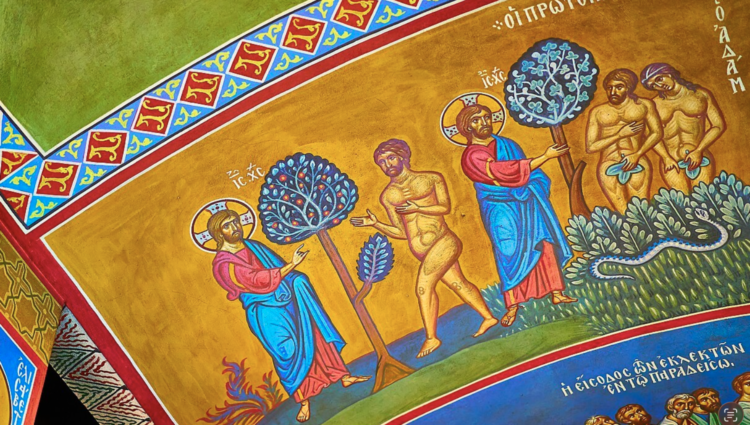
 It started in a garden—man’s first sin, our fall. It began beneath a tree with fruit that was good and pleasing to the eyes (Gen 3:6). Although we tend to place the blame on the apple based on a Latin pun, some traditions point to the fig tree, whose leaves Adam and Eve used to cover themselves.
At the beginning of Holy Week, we see Jesus, the New Adam, as he prepares for his Passion, also beneath a fig tree. Yet it was not the fruit that cursed the man—there was none (Matt 21:19)—but the God-man who cursed the tree. How should we understand this?
As we approach the culmination of the liturgical year, this Fig Monday (as Monday of Holy Week is traditionally known), don’t miss the trees for the forest. Instead, take a lesson on how to prepare from the trees of Holy Week: the palm, the olive, and, of course, the cursed fig tree.
On Palm Sunday, when Jesus and the disciples drew near to Jerusalem, they were met by a joyous retinue. “The very large crowd spread their cloaks on the road, while others cut branches from the trees and strewed them on the road” (Matt 21:8). The poor preacher, who had formerly eschewed regality, now enters in majesty through streets strewn with palm branches. Rather than pitying the fruitless fig, we should take our example from the palms.
Throughout Lent, we pray, fast, and give alms for this same purpose: penances are taken on insofar as we lay aside our attachment to fleeting things, humble ourselves before the Lord, and rejoice in his offer of salvation. Trodden down in the dirt, the palms are united to the people’s own act of humility. Lifted high, they join the throng’s song of salvation: “Hosanna!”
As the lofty palms offer their own boughs to be strewn on the dirt road on Palm Sunday, we should offer our own humble praise to the Lord, our saving King.
Days later, in the Garden of Gethsemane, just before a new crowd will chant for his death, Christ went to pray in the company of the olive trees.
Aware of his coming Passion, Jesus waits in Gethsemane, which means “olive press.” Here, like Christ, the olives offer the fruit of their sacrifice “by which gods and men are honored” (Judg 9:9). Here, the olive gives its oil to be used to light lamps and to anoint kings and priests.
As the olive keeps vigil with Christ in the garden, “watch and pray” (Matt 26:41). “Offer your bodies as a living sacrifice, holy and pleasing to God, your spiritual worship” (Rom 12:1).
Then there’s the fig tree.
When Jesus was “going back to the city in the morning, he was hungry. Seeing a fig tree by the road, he went over to it, but found nothing on it except leaves” (Matt 21:18-19). And after he cursed the tree, “immediately the fig tree withered.”
But why did he curse the tree? It had nothing to offer.
Perhaps it was not prepared. According to Mark, “it was not the time for figs” (Mark 11:13). Yet wouldn’t the fig’s Creator know its proper season (see Mark 13:28)? Reproaching Jeremiah, who felt unprepared to be a prophet, the Lord said, “Do not say, ‘I am too young’” (Jer 1:7). Early or late, God calls us to be “prepared in season and out of season” (2 Tim 4:2).
Or maybe, like Adam, it was ashamed and hid itself because it bore the “fruit that was the occasion of sin” (Saint Isidore of Pelusium). Remembering our past sins and brokenness, we too can hide from God’s loving call. We can feel unworthy or incapable of pleasing God.
Yet there is a fourth tree: the tree of the Cross. Christ bore the weight of its dead wood and made it the tree of life. Nothing is impossible for God (Luke 1:37).
In these final days of Lent, “have faith in God” (Mark 11:22), and be a good tree.
✠
Republished with gracious permission from Dominicana (March 2026).
The Imaginative Conservative applies the principle of appreciation to the discussion of culture and politics—we approach dialogue with magnanimity rather than with mere civility. Will you help us remain a refreshing oasis in the increasingly contentious arena of modern discourse? Please consider donating now.
Image: Mural from the Church of St. Thomas in Goudi, Athens. Photo by George E. Koronaios.