I THOUGHT I might get away from Gorton and Denton today but what brings me back in a rush are two articles covering a very similar theme, one in the Daily Telegraph and the other, Matthew Syed’s column in the Sunday Times.
The Telegraph piece sets the tone, headed: ‘Deprivation and segregation: Gorton and Denton is a dismal preview of the future of broken Britain’, with the sub-head reading: ‘A bitter, sectarian by-election in this fractured Manchester seat exposes the fault lines reshaping British politics’.
The only thing to which I would take exception in this line is the idea that the conditions observed are a ‘preview’, where the writers – Annabel Denham, the paper’s senior political commentator, and Ollie Corfe, a senior data journalist – make observations of the fractured constituency of two parts.
‘These two communities may exist cheek by jowl’, they write, ‘but they cannot be considered what politicians like to call a “multiculturalism success story”. Marked by discrete cultural, linguistic and political preferences, the two areas share an MP but are different worlds.’
While such a phenomenon night be new to blinkered London journalists – from a city in which ‘diversity’ very often does mean many different races co-existing in the same space – this is the reality in many northern towns and cities, as well as the Midlands and elsewhere.
We get this in my adopted home town, Bradford, where there is mostly rigid demarcation between white and Muslim ‘communities’, where ‘multiculturalism’ is a sick joke and the Muslim ghettos are as near a monoculture as it is possible to have.
Where there is mixing of the races, it is on the fringes of the ghettos, where the exploding Muslim populations spread, ink-blot fashion, into their surrounds. Then, for a short period, the races co-exist, but only for as long as it takes for white flight to clear the area of its indigenous peoples and the colonisers to take over.
In my area, this is what has been happening with gloomy predictability. Historic names and fine towns: Halifax, Batley, Heckmondwike and Dewsbury, have all been settled by people who have changed them beyond all recognition.
I have been reading a book by local journalist, editor and newspaper owner Danny Lockwood who in 2015 wrote of his experiences under the title The Islamic Republic of Dewsbury ‘Requiem’, which tells you what you need to know of the fate of the town.
He writes of Britain’s example of community colonisation on a local basis, as he witnessed in Dewsbury and marks it down as ‘one of foisting privilege on an alien ideology in order to buy an acceptance and respect that shows no sign of being reciprocated’.
The separation between communities in Dewsbury is complete, with the Muslims in the centre, spreading outwards, while the whites (in what was once an exclusively white community) are confined to the fringes. The deadly effect is that the greater the separation, the more the British state tries to buy ‘love’ from its Muslim citizens. It is all carrot and no stick.
What is being seen in the Gorton and Denton constituency was near-complete in the West Yorkshire town over a decade ago.
Lockwood writes that the proselytising 21st century Islam which dominates Dewsbury’s Muslim community is based on an unyielding and unforgiving ideology. It demands equality and more, while yielding nothing to its host.
That, he says, is increasingly the experience across Western Europe, and never more so than in the face of the migrating millions from the Middle East. Furthermore, as the dull, humourless creed spreads, no government seems to have found an answer to it and if they have, they’re clearly not comfortable with it.
The essence of even a minimal level of integration requires of the immigrant community a willingness at least to respect the laws and values of its host.
This new wave of Muslim immigration has taken root in much the same way as previous settlers such as the Irish but, unlike them, have never been asked nor expected remotely to respect British ways.
Lockwood speculates whether left-wing social scientists – who have done much to bring about this situation – are deliberate in their project or not. He suspects they are, given their well-established anti-British agenda. But whatever the motivation, it appears that the migrant culture trumps the hosts’ values at every turn.
And here Lockwood speaks of the reality of this so-called multicultural Britain: ‘So much of British lifestyle is either quietly despised by Muslims of the conservative old school, or loudly by the militant young . . . Whether repugnance comes as a result of mosque teachings, misguided wars in Iraq, or simply the distasteful sight of semi-naked white girls heaving their guts up after a night on the lash, it is there and it is fact’.
Characterising everything Islamic as utterly anti-Western is no doubt unhelpful and possibly unfair, but so is elevating Islam to a superior pedestal and trying to buy its friendship at the cost of alienating the people who feel they are paying its board and lodging. That is the realpolitik in Dewsbury.
Bearing in mind that Lockwood was writing over a decade ago, his commentary is remarkably up-to-date: ‘At every level of contact, from government to police, from education system to hospital ward, the state-sponsored sense of privilege and entitlement for one community over all others has become an absolute fact of public perception.’
Even if it is on occasion either exaggerated or rooted in urban myth, he says, ‘the fact is that a two-tier system exists and little or nothing is done to give the barest impression otherwise’.
This is what causes most of the deep-rooted resentment in Dewsbury, he states: a mixture of unquestioning appeasement and favouritism and a constantly reinforced message that where community problems exist, they’re ‘our’ fault. That is why relations between the two communities have never been further apart, with an inexorably widening gap.
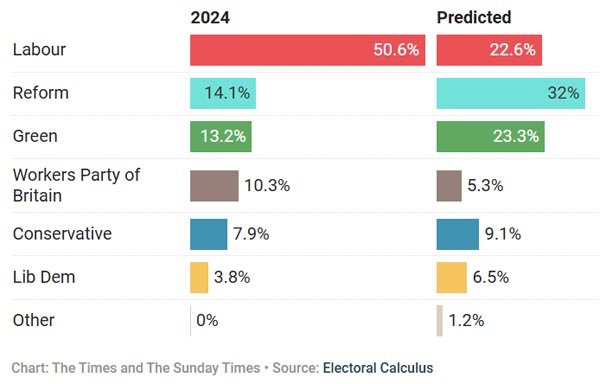
It is that inexorably widening gap that the Telegraph writers are seeing, even if they don’t express their findings with the same degree of clarity. In a constituency formed by boundary changes in 2024, they see the white, working-class vote drifting to the right.
Muslim voters lean heavily left, explaining why the Workers’ Party’s Shahbaz Sarwar was elected councillor in Longsight in 2024 on a ‘bring our community’s voice to council decisions’ platform.
This, they say, ‘feels like a portent’: Britain is heading into a period of politics that could become more bitter, vicious and polarised than anything we witnessed during the Brexit years.
Syed, under the headline ‘In Gorton and Denton, voters all feel they have been left behind’, writes of a constituency as ‘a game of two halves’. Over in Longsight, to the north-west of the constituency, he tells of glimpsing ‘the other defining story of modern Britain’: the consequences of mass immigration. The first four women he approached at the market didn’t speak a word of English; he got no further than a look of fear in their eyes, the only part of their faces he could discern behind their burqas, before they were shepherded off by bearded men.
‘This isn’t multiculturalism; it is balkanisation,’ Syed writes. ‘Like dozens of enclaves in northern towns and, indeed, parts of London, this area is dominated by Muslims; in this case, mainly of Pakistani ethnicity (actually, Kashmiri).’
According to the 2021 census, more than six in ten residents are Muslim, the highest proportion in Manchester area. As a brown person, Syed is able to ask: ‘How can it be good for immigrants, let alone the rest of the community, when there is a sharp divide between communities as if severed with a scalpel?
‘How can it be conducive to their flourishing, to our flourishing, to the ethos of solidarity which is, after all, the rationale of that abstraction we call the nation state?’
The point is, of course, that it isn’t. But this is Britain in the 21st century. Syed at least recognises the danger of balkanisation as ‘cancerous to a nation since it leads to a balkanised culture and, in time, a balkanised politics’.
In Longsight, he says, you see hundreds of Palestinian flags but little that celebrates Britain. It is why, whatever happens on Thursday, the politicians who allowed this to happen (while serially lying about it) should hang their heads in shame.
This article appeared in Turbulent Times on February 22, 2026, and is republished by kind permission.