Please never forget, we Catholics have a great legacy. We’ve been promoting liberal education since the days of St. Paul. Some of our greatest saints were liberally educated, and some of our greatest causes have been promoting all that is good and true and beautiful.
The author recently delivered the address below to the Roman Catholic Diocese of Lansing. —Editor
 “In the spirit of Bishop Boyea’s call for renewal in his schools, the Diocese of Lansing is updating its content standards from “Social Studies” to “History”. This change is being made in our continued efforts to clarify and improve the truth behind the content presented in our classrooms and communities. The change puts continued emphasis on the pursuit of objective intransient fact and truth through the use of quality materials and the study of primary sources, which are essential to the discipline of History. It places the central focus on the Incarnation, the life, death, and resurrection of Our Lord Jesus Christ—the very center of History, or HIS story. A greater emphasis will be placed on God calling not just individuals, but all of humanity to Salvation.”
Let us begin, first, with St. John’s prologue to his Gospel:
1 In the beginning was the Word, and the Word was with God, and the Word was God. 2 He was with God in the beginning. 3 Through him all things were made; without him nothing was made that has been made.4 In him was life, and that life was the light of all mankind. 5 The light shines in the darkness, and the darkness has not overcome[a] it.
6 There was a man sent from God whose name was John. 7 He came as a witness to testify concerning that light, so that through him all might believe. 8 He himself was not the light; he came only as a witness to the light.
9 The true light that gives light to everyone was coming into the world.10 He was in the world, and though the world was made through him, the world did not recognize him. 11 He came to that which was his own, but his own did not receive him. 12 Yet to all who did receive him, to those who believed in his name, he gave the right to become children of God—13 children born not of natural descent, nor of human decision or a husband’s will, but born of God.
14 The Word became flesh and made his dwelling among us. We have seen his glory, the glory of the one and only Son, who came from the Father, full of grace and truth.
Now, let us turn to St. Paul in his letter to the Colossians:
15 The Son is the image of the invisible God, the firstborn over all creation. 16 For in him all things were created: things in heaven and on earth, visible and invisible, whether thrones or powers or rulers or authorities; all things have been created through him and for him. 17 He is before all things, and in him all things hold together. 18 And he is the head of the body, the church; he is the beginning and the firstborn from among the dead, so that in everything he might have the supremacy. 19 For God was pleased to have all his fullness dwell in him, 20 and through him to reconcile to himself all things, whether things on earth or things in heaven, by making peace through his blood, shed on the cross.
And, finally (at least to begin), two quotes from St. Paul’s letter to the Galatians:
4 But when the set time had fully come, God sent his Son, born of a woman, born under the law, 5 to redeem those under the law, that we might receive adoption to sonship.[a] 6 Because you are his sons, God sent the Spirit of his Son into our hearts, the Spirit who calls out, “Abba,[b]Father.” 7 So you are no longer a slave, but God’s child; and since you are his child, God has made you also an heir.
And,
26 So in Christ Jesus you are all children of God through faith, 27 for all of you who were baptized into Christ have clothed yourselves with Christ.28 There is neither Jew nor Gentile, neither slave nor free, nor is there male and female, for you are all one in Christ Jesus. 29 If you belong to Christ, then you are Abraham’s seed, and heirs according to the promise.
For what it’s worth, I believe these are the four most important passages to understand the role of the Logos, the role of Jesus Christ, as the center of all creation and all time and all history, thus living up to Bishop Boyea’s charge. Notice what we have as we consider the Incarnation, the death, and the Resurrection. Coming outside of time, the second person of the Most Blessed Trinity became not only flesh (thus, taking on our image—compare this to Genesis where man is made in God’s image) but entered into the very fabric of time. Realize how amazing this is. Could a painter enter his painting? Could an author enter his book? Yet, being outside of time (and, indeed, the creator of time itself), Christ became fully man while remaining fully God. He became one of us, thus sanctifying our very image. Further, think about John 1:9: the Logos (Christ) is that which lightens up every man. Please note, this does not state that Christ enlightened every man who is to come, but every man who has ever existed, past, present, and future. As such, I am convinced that men such as Socrates, Cicero, and Virgil were enlightened by the Logos, even though they came chronologically before Christ. But, I’ll get to this later.
Let’s continue our analysis of those four passages. Not only is Christ that which enlightens every person, but He is also, per St. Paul, revealed as the King of the Universe, not when He is resurrected on Easter morning, but, critically, when He dies on the Cross. Remember St. Paul: “For God was pleased to have all his fullness dwell in him, 20 and through him to reconcile to himself all things, whether things on earth or things in heaven, by making peace through his blood, shed on the cross.” Again, it’s Friday at 3, not Sunday at dawn—that reveals Christ’s kingship. In other words, suffering, even unto death, is our highest calling and that which remakes the world.
Further, as St. Paul notes in his letter to the Galatians, the Incarnation happened at the exact moment in history that was predetermined and exactly when it was needed—when the Jewish religion, Roman governance, and Greek culture—came together in the Holy Land. Let us remember that all of the New Testament was written in Greek, that Jesus almost certainly preached in Greek, and that St. Paul was almost certainly liberally educated. It’s also worth remembering that the Latin word for God is “Deus,” a corruption of the Greek word for God, “Zeus,” and that in English, it’s “Tues” (as in Tuesday). Quite literally, our Christian employment of the word “God” comes from the name Zeus. Things are far more connected than we often recognize.
Finally, remember St. Paul’s notes that we are “neither Greek nor Jew, neither male nor female,” but all one in Christ Jesus. Never, in the history of the world, has such a statement of human dignity—universal and applicable to all men and women—existed in the world. Christianity was radical and revolutionary, enhancing human dignity throughout the world. Even today, a Somali Muslim woman living in St. Paul, Minnesota, is a beneficiary of Christianity’s radical call for dignity and equality.
Logos
When St. John says, “In the beginning was the Word,” the Greek word he used was “Logos.” That word has a fascinating history. As far we know, it dates back to roughly 510BC. In a little town—stuck between Greece and modern-day Turkey—called Miletus, philosophy began. Men such as Heraclitus and Thales and others debated the very origin of man. That is, they asked, “what is the Urstoff”—the primary matter of man. Critically, they were looking for that which makes all men, not just Greek men or white men? When radical Leftists proclaim that Western civilization is rooted in oppression, sexism, racism, and colonialism, I just shake my head. As far as I can tell, Western civilization is rooted in a universal search for the dignity of the human person.
I would take this a step further. We can examine all the ancient texts we want—Aeschylus, Ovid, Homer, Virgil, Tacitus—and we can find absolutely NO—I mean ZERO—evidence that anyone ever dismissed another person because of their skin color. The religious, cultural, and civilizational fights were intense, to be sure, but they never denigrated another person because of skin color or what we would label racism. Racism, then, is not rooted in Western civilization, but is a modern heresy. This, however, is another topic for another time.
Back to Miletus. The earliest Greek philosophers decided that the human person must be made up of one of the four elements—earth, wind, water, and fire. It was Heraclitus who took the side of fire, and to define it, he coined the term “Logos.” Here, we must be careful. In English, a word can mean this or that. In ancient Greek, though, a word meant everything associated with it, this AND that. For Heraclitus, Logos meant fire, thought, speech, and, most importantly, imagination and reason. Logos was truly that which enlightened every man, just as St. John wrote six hundred years later.
From Heraclitus, the Stoics, around 300BC, adopted the term “Logos” for their god. Granted, their god was more of a pantheistic god, but still a god that oversaw the natural law and enforced it.
Amazingly, the brilliant Roman pagan poet, Virgil, adopted the concept of the Logos as well. In his Eclogue No. 4, he prophesized, a full 50 years before the birth of Christ:
Sicilian Muses, sing a nobler music,
For orchard trees and humble tamarisks
Do not please everyone; so may your song
Be of a forest worthy of a consul.
The last great age the Sybil told has come;
The new order of centuries is born;
The Virgin now returns, and the reign of Saturn;
The new generation now comes down from heaven.
Lucina, look with favor on this child,
—Lucina, goddess, pure—this child by whom
The Age of Iron gives way to the Golden Age.
Now is the time of your Apollo’s reign;
And, Pollio, in your consulship, begins
The grand procession of the mighty months,
Commencement of the glory, freedom from
Earth’s bondage to its own perpetual fear.
Our crimes are going to be erased at last.
This child will share in the life of the gods arid he
Will see and be seen in the company of heroes,
And he will be the ruler of a world
Made peaceful by the merits of his father.
This pagan prophecy is so utterly astounding that we can explain it in no other way than that Virgil was enlightened by the Logos. It’s no wonder that Dante chose Virgil to be his guide in the Divine Comedy and that many early Christians saw Virgil as a proto-Christian.
I would argue—rather forcefully—that Virgil is not the only ancient enlightened by the Logos.
Three days before he was to die, Socrates dreamt, while in prison, that a woman in white appeared to him. In his dream, she assured him that in three days, he would be in the land of Pythia (heaven) with his ancestors. A woman in white? Three days? In the land of Pythia. Not surprisingly, early Christians also saw in Socrates a foreshadowing of Christ.
Let’s take just one of Socrates’ important teachings, the foundation not only of his ethics, but the foundation of all Western ethics, and the very beginning of Just War theory. Here was see Socrates, just days before Athens forces him to take the Hemlock, his execution, in conversation with his best friend, Crito.
Soc. Are we to say that we are never intentionally to do wrong, or that in one way we ought and in another way we ought not to do wrong, or is doing wrong always evil and dishonorable, as I was just now saying, and as has been already acknowledged by us? Are all our former admissions which were made within a few days to be thrown away? And have we, at our age, been earnestly discoursing with one another all our life long only to discover that we are no better than children? Or are we to rest assured, in spite of the opinion of the many, and in spite of consequences whether better or worse, of the truth of what was then said, that injustice is always an evil and dishonor to him who acts unjustly? Shall we affirm that?
Cr. Yes.
Soc. Then we must do no wrong?
Cr. Certainly not.
Soc. Nor when injured injure in return, as the many imagine; for we must injure no one at all?
Cr. Clearly not.
Soc. Again, Crito, may we do evil?
Cr. Surely not, Socrates.
Soc. And what of doing evil in return for evil, which is the morality of the many-is that just or not?
Cr. Not just.
Soc. For doing evil to another is the same as injuring him?
Cr. Very true.
Soc. Then we ought not to retaliate or render evil for evil to anyone, whatever evil we may have suffered from him.
Just as we saw with Virgil, a pagan, anticipating the Incarnation, so we have Socrates, a full four hundred years before the birth of Christ, anticipating Christ and his admonition to turn the other cheek. A very hard and difficult lesson, to be sure, but one that we must take very seriously and one which all great thinkers, at least from Socrates until Machiavelli, took very seriously. It is, as I just mentioned, the foundation of all Western ethics and of just war theory.
Let’s consider some modern examples of the application of Socrates’ theory. After the Japanese attack on Pearl Harbor, we had every right—and duty—to counter attack the Japanese navy and armed forces. Did we, though, have the right to drop an atomic bomb on Nagasaki, a civilian city and the center of not just Japanese Catholicism but of Asian Christianity in August 1945? Yes, there was a military presence there, but because the military had to occupy the city, it being the only pro-Western city in the country? During our war against the Nazis, we had every right—and duty—to liberate the Holocaust camps. Did we have the right to firebomb Dresden, an arts and retirement community, made up of almost nothing but civilians? More recently, perhaps we had the right to attack Iran’s nuclear facilities, but did we have the right to tomahawk a girls’ school? These are timeless questions, but they all date back to Socrates.
Again, how do we explain not only the genius but the martyrdom of Socrates except as a fore-shadowing of Christ, enlightened by the Logos Himself?
Or, for a brief moment, let’s consider Cicero, murdered by Marc Antony. In one of his most profound dialogues, On the Laws, imitating Plato, we see the following:
Since you grant me the existence of God, and the superintendence of Providence, I maintain that he has been especially beneficent to man. This human animal—prescient, sagacious, complex, acute, full of memory, reason and counsel, which we call man,—is generated by the supreme God in a more transcendent condition than most of his fellow–creatures. For he is the only creature among the earthly races of animated beings endued with superior reason and thought, in which the rest are deficient. And what is there, I do not say in man alone, but in all heaven and earth, more divine than reason, which, when it becomes ripe and perfect, is justly termed wisdom?
There exists, therefore, since nothing is better than reason, and since this is the common property of God and man, a certain aboriginal rational intercourse between divine and human natures. This reason, which is common to both, therefore, can be none other than right reason; and since this right reason is what we call Law, God and men are said by Law to be consociated. Between whom, since there is a communion of law, there must be also a communication of Justice.
Law and Justice being thus the common rule of immortals and mortals, it follows that they are both the fellow–citizens of one city and commonwealth. And if they are obedient to the same rule, the same authority and denomination, they may with still closer propriety be termed fellow–citizens, since one celestial regency, one divine mind, one omnipotent Deity then regulates all their thoughts and actions.
This universe, therefore, forms one immeasurable Commonwealth and city, common alike to gods and mortals. [The Cosmopolis]
Again, how can we not see the enlightenment of the Logos here? What connects us one to another? Reason! And, in what way, through the cosmopolis, the city of God and all men and women of good will! Here, of course, he sounds very much like St. Augustine and the City of God (in opposition to the City of Man).
Again, let me note, when someone claims that Western civilization is rooted in oppression, inequality, sexism, racism, and colonialism, I simply shake my head. To me, as shown by every person we’ve talked about, Western civilization is rooted in a profound search for human dignity. Did it always achieve that? No, of course not. Western men and women are fallen, but no more fallen than any other men and women. Yet, whatever faults of the West, the West has—especially in its ancient and Medieval manifestations—always aspired to the good, the true, and the beautiful.
After looking at these three great pagans of the ancient world—Socrates, Virgil, and Cicero—let’s also consider one of the most important terms synonymous with the Greek Logos, “reason.” In our modern world, we often confuse reason and rationality. In the ancient world, however, there was no such confusion. When discussing reason, for example, Plato described it as a form of “divine madness,” that is a mind looking from outside of oneself. Christ, then, as the Logos, is the Divine Reason.
In the ancient world, the faculties—that is, our ways of knowing something—reflected the human being himself. Our head was associated with rationality and, politically, as the executive or the monarchy. This was the most logical part of our selves. Our stomach and the pro-creative regions were our lowest parts, associated with the passions and, politically, as democracy. This was the most animalistic part of us. That which tied all together, though, was our chest—our heart or our soul—through which we were reasonable and, politically, associated with aristocracy.
The great Christian apologist C.S. Lewis, echoing the ancients, put it this way in his magisterial Abolition of Man:
We were told it all long ago by Plato. As the king governs by his executive, so Reason in man must rule the mere appetites by means of the ‘spirited element’. The head rules the belly through the chest—the seat, as Alanus tells us, of Magnanimity, of emotions organized by trained habit into stable sentiments. The Chest-Magnanimity-Sentiment—these are the indispensable liaison officers between cerebral man and visceral man. It may even be said that it is by this middle element that man is man: for by his intellect he is mere spirit and by his appetite mere animal.
What, then, does reason mean in the ancient (and, by extension early Christian) world? Reason is that which makes us most human, but, ironically, is the least human thing about us. It is the light of the divine reflected in our soul. It comes from God and projects itself into us. It is, truly, “the light that lighteth up every man.” Again, John 1:9. But, let us also consider the Blessed Virgin Mary. When meeting with Elizabeth, she said, perfectly and beautifully, “My soul doth magnify the Lord.” Notice, this was a complete submission, a moment of complete Logos and Reason—she reflects the greatness of the Lord.
Imagination
As the Diocese of Lansing Catholic Schools rededicate themselves to the good, the true, and the beautiful, to the liberal arts, I’d like to suggest that we all proudly call this “Christian Humanism.” Since 1933, the absolutely beautiful term “humanism” has been corrupted—especially in conservative and Protestant circles—to mean a privileging of man over God. In its long, long history, though, it means anything but this. Indeed, at its most basic level, it’s simply a proclamation that we believe in the humanities, the liberal arts. And, we modify it with Christian. Thus, it is neither about man, nor is it about any kind of Puritanism. Rather, it is a Christian celebration of the humanities and the humanist celebration of Christianity. Man, rather than being the highest creature, is, instead, above the animals and below the angels. But, unlike the animals or the angels, he is uniquely body and spirit. We share this with the Incarnate Christ, though, of course, we do not share His divinity, except in the sacraments, especially in the Eucharist.
Christian humanism has a profoundly noble history. It began with St. Paul when he visited Mar’s Hill in Athens (Acts 17). While there, he debated with the Stoics and Epicureans. It was the perfect collision of the classical and the Christian worlds. St. Paul, brilliantly, did not dismiss the Athenians, but praised them for two things. First, he noted that in their humility, they erected a statue to the unknown god. He now brought them knowledge of the true God. Second, he said, “As your own poets have said, ‘In Him, we move and live and have our being.’” This came from a 300-plus year-old Stoic hymn that stated, “In Zeus, we move and live and have our being.” Far from dismissing this pagan song, St. Paul baptized it. We now use that Stoic hymn, modified slightly, in our Eucharistic celebration.
That tradition—the baptizing of pagan things—stands at the heart of Catholicism. Our holy days often rest on pagan holy days, our churches often stand on the sites of pagan temples, and our saints often mimic pagan gods. This is nothing to be ashamed of, but rather to be proud of. Let’s take a blatant example. We’re meeting with one another on a Monday—the day we worship the Moon. Yet, I’m guessing that no one woke up this morning and made offerings to the Moon. On Tuesday, we worship the God of lightning, on Wednesday, Odin, king of the Norse gods, on Thursday, Thor, god of justice, and on Friday, Freya, the goddess of fertility. Clearly, we have baptized these days and even the most fundamentalist among us would not hesitate to employ the pagan names of these days.
We find the Christian humanist tradition not only St. Paul and St. John (John having baptized the Heraclitan Logos), but in St. Perpetua a liberally educated martyr in North Africa, in St. Augustine, in King Alfred the Great, in Dante, in Petrarch, in Sir Thomas More, and, especially, in Saint John Paul the Great. But, we find it in a myriad of others, some Catholic and some not: Paul Elmer More, T.S. Eliot, Willa Cather, Christopher Dawson, Romano Guardini, Jacques Maritain, Dorothy Day, Walter Miller, Russell Kirk, and, more recently in novelist Michael O’Brien, critic and historian Joseph Pearce, poet James Matthew Wilson, and political philosopher Patrick Deneen.
So, if you’re still with me after our drive-by history of Western civilization, especially in its pagan phase and Johannine and Pauline aspects, I’d like to turn, finally, to an understanding of imagination in our world. I would argue that it is the highest faculty—the best way of knowing—we have. Remember, we always associate the imagination with reason, with our chests, the soul or the heart. And, if we practice the liberal arts, we embrace the imagination and creativity. As J.R.R. Tolkien called it, we imitate God not as Creators (He is the only Creator, after all), but, rather, as sub-creators. We make in His image. It is, as Tolkien understood it, one of the highest functions of man.
The heart of man is not compound of lies,
but draws some wisdom from the only Wise,
and still recalls him. Though now long estranged,
man is now wholly lost nor wholly changed.
Dis-graced he may be, yet is not dethroned,
and keeps the rags of lordship one he owned,
his world-dominion by creative act:
not his to worship the great Artefact,
man, sub-creator, the refracted light
through whom is splintered from a single White
to many hues, and endlessly combined
in living shapes that move from mind to mind.
Though all the crannies of the world we filled
with elves and goblins, though we dared to build
gods and their houses out of dark and light,
and sow the seed of dragons, ‘twas our right
(used or misused). The right has not decayed.
We make still by the law in which we’re made.
Going back several centuries, we find something similar with the profound Anglo-Irish statesman, Edmund Burke. In his Reflections on the Revolution in France, he argued that we are the beneficiaries of the “unbought grace of life.” Further, he spoke of the Wardrobe of the Moral Imagination:
But now all is to be changed. All the pleasing illusions, which made power gentle, and obedience liberal, which harmonized the different shades of life, and which, by a bland assimilation, incorporated into politics the sentiments which beautify and soften private society, are to be dissolved by this new conquering empire of light and reason. All the decent drapery of life is to be rudely torn off. All the superadded ideas, furnished from the wardrobe of a moral imagination, which the heart owns, and the understanding ratifies, as necessary to cover the defects of our naked shivering nature, and to raise it to dignity in our own estimation, are to be exploded as a ridiculous, absurd, and antiquated fashion.
On this scheme of things, a king is but a man; a queen is but a woman; a woman is but an animal; and an animal not of the highest order. All homage paid to the sex in general as such, and without distinct views, is to be regarded as romance and folly. Regicide, and parricide, and sacrilege, are but fictions of superstition, corrupting jurisprudence by destroying its simplicity. The murder of a king, or a queen, or a bishop, or a father, are only common homicide; and if the people are by any chance, or in any way gainers by it, a sort of homicide much the most pardonable, and into which we ought not to make too severe a scrutiny.
On the scheme of this barbarous philosophy, which is the offspring of cold hearts and muddy understandings, and which is as void of solid wisdom, as it is destitute of all taste and elegance.
As Burke so beautifully puts it, when we look at another, we do not look at their skin color or their fallenness caused by Adam and Eve. Rather, we see them, ideally, as Christ would see them, we see the divine, the light of the Logos, within them. Later, C.S. Lewis would borrow not only Burke’s image of a wardrobe, but also the “Weight of Glory,” the ability to see the divine within everyone. It’s not always easy, especially when looking at our enemies, but we are called to do it, nonetheless. Even the most decrepit and depraved person still lives and moves and breathes thanks to the grace of God.
I also love and admire the way historical and founder of post-war conservatism, Russell Kirk, understood the imagination:
“Images are representations of mysteries, necessarily; for your words are tools that break in the hand, and it has not pleased God that man should be saved by logic, abstract reasoning, alone.”
“The image, I repeat, can raise us on high, as did Dante’s high dream; also it can draw us down to the abyss. It is a matter of the truth or the falsity of images. If we study good images and religion, and literature, and music, in the visual arts—why, the spirit is uplifted, and in some sense liberated from the tramples of the flesh. But if we submit ourselves (which is easy to do nowadays) to evil images—why, we become what we admire. Within limits, the will is free. It is imagery, rather than some narrowly deductive and inductive process, which gives us great poetry and scientific insights.”
“And it is true great philosophy, before Plato and since him, that the enduring philosopher sees things in images initially.”
Let me finish with a concrete example. We could easily imagine and mythologize (please remember, a myth, properly defined, is not a lie—we reveal too much about ourselves by claiming it’s a lie—but, properly, a true story that involves the supernatural and the unexplained) a Catholic saint. After all, when one thinks of St. Sebastian or St. Francis or St. Claire or St. Maximillian Kolbe, how could we dismiss the supernatural, the mythic elegance of each.
So, let’s take a harder example, something seemingly secular. Let’s take the American founding, especially as we celebrate the 250th anniversary of the Declaration of Independence. It was, after all, for lack of a better term, mythic. A small colonial people rising up against the greatest power the world had yet seen and creating not our own empire, but a republic. We were Romans reborn—even going so far as to recreate a Senate and a capitol building built to mimic Roman republican architecture. We even took names like Publius and Brutus. Or, let’s think about how mythic (and universal) a statement such as “We hold these truths to be self evident, that all men are created equal. . . that they are endowed by their Creator with certain unalienable rights, that among these are the right to life, liberty, and the pursuit of happiness.” What audacity we Americans have, proclaiming the dignity of every human person who has ever or ever will exist. Or, let’s take George Washington. If ever a figure deserved to be mythologized, he did. He was the American Achilles, a man who was in the thick of battle and literally had his clothes torn apart by enemy bullets. Yet, not one bullet ever grazed his skin. He was the American Cincinnatus, offered the dictatorship, but, in the name of goodness and the republic, refused on the Ides of March, 1783. He was the American Aeneas, a Trojan reborn and planting civilization, not on the Tiber, but on the Potomac.
Phew.
We’ve really covered a lot over the last 45 minutes. You should be incredibly proud of what you’re doing, rededicating the diocese and educating the young in the liberal arts. This is a great and meaningful moment, worthy itself of myth! I am so deeply honored that you allowed me to be a part of it.
Please never forget, we Catholics have a great legacy. We’ve been promoting liberal education since the days of St. Paul. Some of our greatest saints were liberally educated, and some of our greatest causes have been promoting all that is good and true and beautiful.
Let me end with that great Catholic convert, G.K. Chesterton. “But in reality the rivers of mythology and philosophy run parallel and do not mingle till they meet in the sea of Christendom. Simple secularists still talk as if the Church had introduced a sort of schism between reason and religion. The truth is that the Church was actually the first thing that ever tried to combine reason and religion. There had never before been any such union of the priests and the philosophers. Mythology, then, sought God through the imagination; or sought truth by means of beauty.”
__________
The Imaginative Conservative applies the principle of appreciation to the discussion of culture and politics—we approach dialogue with magnanimity rather than with mere civility. Will you help us remain a refreshing oasis in the increasingly contentious arena of modern discourse? Please consider donating now.
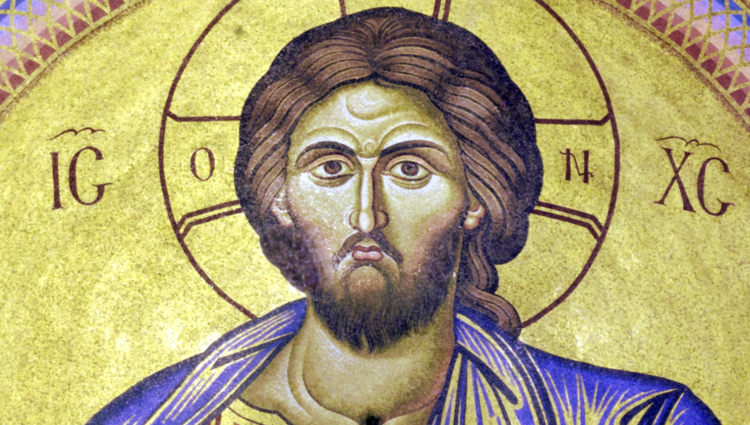
The featured image, uploaded by Andrew Shiva, is Christ Pantocrator, Church of the Holy Sepulchre. This file is licensed under the Creative Commons Attribution-Share Alike 4.0 International license, is courtesy of Wikimedia Commons.