While we are in this sojourning to our true homeland, we are not fixed immovably in the love of God. Only in heaven, with the blessed, will we see God and his goodness in all of its contours; and once seen, we will desire nothing else.
 Human love can be fickle; it can sway here and there, depending on what catches our attention. One day, you may prefer vanilla ice cream; the next day you may prefer chocolate moose tracks (which is clearly superior, in my opinion). But the real problem arises when we realize that we ought to love Jesus with all our heart but cannot. Can the heart remain immovably fixed on one single object of love, on one single person?
Consider Peter and Judas. Peter was one of the chosen apostles in Jesus’ inner circle, along with James and John. He was present at the raising of Jairus’ daughter, at the transfiguration, and at the Garden of Gethsemane the night Jesus was betrayed. He was given the keys of the Kingdom of Heaven and the authority to be the foundation of his Church. Yet Peter betrayed Jesus three times out of fear.
Judas was one of the few chosen to follow Jesus in his travels, to be a witness to the miracles and sayings. To Judas was entrusted the money bag (cf. John 12:5-6; 13:29)—he would provide for the needs of Jesus and the Apostles and be in charge of the contributions. Not only was Judas chosen to be one of the Twelve, but he was entrusted with a great responsibility. Yet Judas betrayed the Lord and sold him for the price of a slave. Even though Judas and Peter had followed Christ for the past three years and had seen wonderful deeds and heard marvelous things, they still could not remain fixed in his steadfast love.
In fact, none of the disciples could remain fixed in the Lord. They all left their Lord and Master when the guards arrived. Their love for Christ was authentic and genuine, but not fixed, not yet. They lack something. They need the strength of the Holy Spirit to keep them fixed, immovably, in Christ, as branches in the vine.
They should have known better than to rely only on themselves. But can we make sense out of it? Not really. The mystery of rejecting God baffles every Christian. We, too, can be like St. Peter, boldly claiming that we would never deny Jesus, or like Judas, who simply succumbs to his desires, doubting the Lord’s mercy.
But there is still another path. Every morning, St. Philip Neri would pray: “Watch me, O Lord, this day; for, abandoned to myself, I shall surely betray thee.” Saint Philip Neri did not presume on his own strength; he knew fully well that all was a gift from God, and that he ought never despair of God’s mercy and patience. Rather, he kept a sober knowledge of himself: a sinner capable of betraying the Lord, but one who the blood of Christ has redeemed and no longer needs to live in fear.
Christ knows our weaknesses and our frailty. Yet he still loves us and asks us to remain in him: “Without me you can do nothing” (John 15:5). The problem is that we tend to see only what is most immediate to us. We focus only on our weaknesses and faults instead of directing our gaze to him who can lift us up from our sins and give us new life. He does not wish for us to remain lost, but to return to his flock. Christ Jesus did not wish that Judas be lost. He loved Judas so much that he warned him, so that he might turn back. Just as the father of the prodigal son waited for him to return, ready to embrace him, so also Christ waited for him to return. But, unlike Peter, Judas remained far from the Lord. Judas did not see the infinite goodness of the Lord and remain fixed in him.
For us today, this means that we must follow the example of St. Philip Neri and ask Christ every day to preserve us in his love, by his strength. For while we are in this sojourning to our true homeland, we are not fixed immovably in the love of God. Only in heaven, with the blessed, will we see God and his goodness in all of its contours; and once seen, we will desire nothing else. Non nisi te, Domine—nothing but you, Lord.
✠
Republished with gracious permission from Dominicana (March 2026).
The Imaginative Conservative applies the principle of appreciation to the discussion of culture and politics—we approach dialogue with magnanimity rather than with mere civility. Will you help us remain a refreshing oasis in the increasingly contentious arena of modern discourse? Please consider donating now.
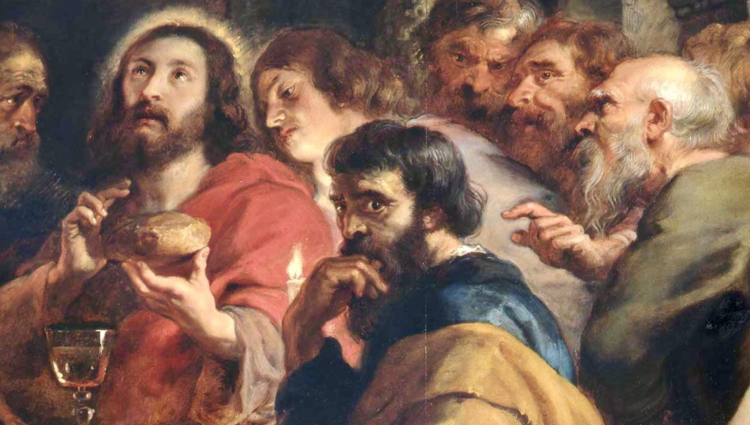
Image: Peter Paul Rubens, The Institution of the Eucharist during the Last Supper