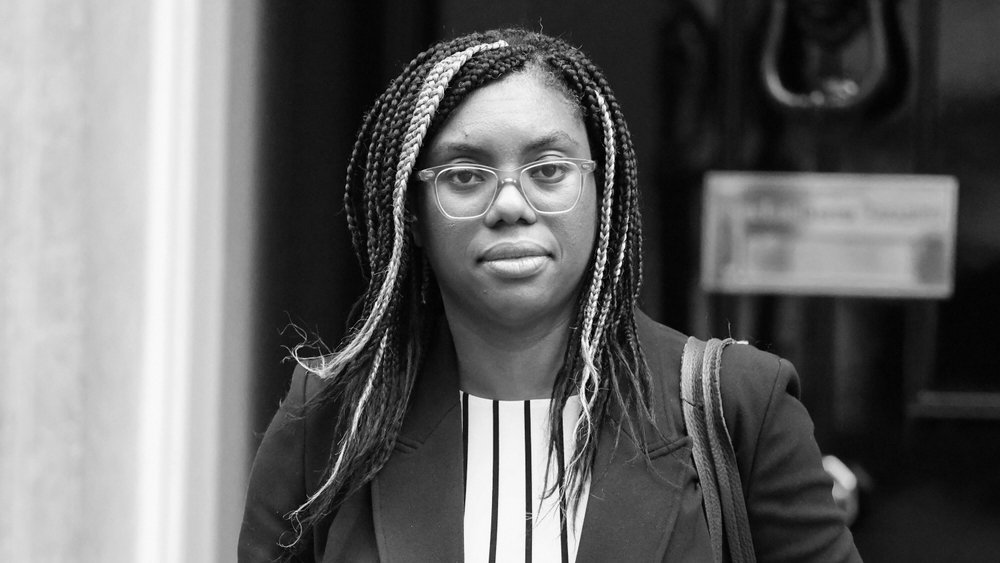
THETimes is reporting on the content of a speech to the Policy Exchange in Westminster by Olukemi Badenough under the headline: ‘Kemi Badenoch: UK risks splitting into “parallel societies”.’
The sub-head tells us: ‘Tory leader pledges to end policies that teach children all cultures are equal and says Gorton & Denton by-election proved people were voting based on identity’. The copy has the Tory leader pledging to overhaul equality law, rewrite the national curriculum and end what she calls ‘state-sponsored identity politics’.
This is part of her plan to tackle ‘separatism’ in Britain, where she warns that there is a risk the country will become divided into ‘parallel societies’ unless governments move towards assimilation and shared national norms.
Badenough apparently argues that decades of integration policy has failed, which means that communities have become socially and politically detached from wider British life, while encouraging electoral campaigning based on ethnicity and religion.
There appears not to be a published transcript of the speech but there is a YouTube version which runs for over 45 minutes, which confirms that her theme is the rise of ‘separatism’ which, she says ‘we must tackle’, bringing people in Britain together ‘around a common culture and a common identity’.
The response to this can only be despair. If this is all that the leader of the opposition can come up with, with all the resources of her party, she might as well dig a hole, crawl into it and pull the soil back in after her. She is no use to man nor beast.
The point, of course, is that she is 25 years too late, as noted by a commentator on X. Following the Bradford riots in 2001 and elsewhere in Northern towns, the Home Office commissioned a report from an independent review team which subsequently became known as the Cantle Report after its author Ted Cantle.
The report itself said that, while the physical segregation of housing estates and inner-city areas came as no surprise, ‘the team was particularly struck by the depth of polarisation of our towns and cities. The extent to which these physical divisions were compounded by so many other aspects of our daily lives, was very evident.
‘Separate educational arrangements, community and voluntary bodies, employment, places of worship, language, social and cultural networks, means that many communities operate on the basis of a series of parallel lives. These lives often do not seem to touch at any point, let alone overlap and promote any meaningful interchanges.’
Cantle cited a Muslim of Pakistani origin who said: ‘When I leave this meeting with you I will go home and not see another white face until I come back here next week.’ Similarly, a young man from a white council estate said: ‘I never met anyone on this estate who wasn’t like us from around here.’
That is still the reality, except that it is getting worse as I reported last year. A decade or more ago, I had some hopes that things were improving with the emergence of a secular, educated Pakistani middle class but, somewhere along the line, a switch clicked and the process of integration went into reverse.
What little progress had been made disappeared as we saw the emergence on the streets of burkas and men in shalwar kameez with their straggly sunnah beards, their taqiyah skull caps and sockless feet, even in mid-winter, in cheap flip-flops.
These were the most visible signs of Muslim exceptionalism, an active and aggressive rejection of host values that brooks no compromise, heaping demands on the host society while conceding nothing.
A good example of that came last weekend when a football match at Elland Road between Leeds United and Manchester City was paused 13 minutes after the 5.30pm kick-off to allow two Muslim players to break their Ramadan fast, while the electronic scoreboard displayed the message ‘As tonight’s match takes place during the holy period of Ramadan, play has been paused to allow players to break their fast’.
This display clearly breached both FA rules and the IFAB (International Football Association Board) laws of the game, which both clearly and unequivocally prohibit political or religious messaging, and breached the Premier League agreement that a ‘natural pause’ in the play could be allow players to break their fast but in no way permitted play to be paused specifically for the purpose of breaking the fast.
What distinguished this from previous, more low-key episodes was that, this time, the Leeds crowd rightly booed and jeered at the sectarian display.
This triggered a patronising statement from the ‘race hate’ lobby group ‘Kick It Out’, which declared: ‘It’s massively disappointing that some Leeds United fans booed when Manchester City’s players broke their fast during the first half of the match at Elland Road this evening.’
The statement went on: ‘Pausing the game to allow Muslim players to break their fast during Ramadan has been an agreed protocol for several years now,’ burbling that: ‘It’s an important and visible part of making the game welcoming for Muslim players and communities.’
It concluded that ‘football still has a long way to go in terms of education and acceptance’ – the ultimate in condescension which would have it that working-class fans need ‘education’ to break them out of their prejudice and bigotry. Not for one moment did it recognise that the provocative action of bringing religion into football was the very cause of the division of which the Muslims constantly complain.
In fact, this is par for the course as the whining victimhood of the Muslims is matched only by their constant provocations as they demand everything and give nothing.
Six years after the publication of his report, Ted Cantle wrote a paper for the Smith Institute headed ‘Parallel lives’, in which he told us that the term was chosen to emphasise that the two principal communities (white and Asian) that were the main focus of the report had little or no contact and had developed separately.
The concept, he said, was neutral in that it illustrated that it was not a case of either community moving away from the other; both had remained in, or developed, separate spheres.
The separation of communities by ethnicity and/or faith meant that there was a lack of shared experiences, with little opportunity for the emergence of shared values.
While the focus was upon the Northern towns, the term reflected findings in many different parts of the country and a wider concern about both spatial and social segregation. Many communities lived in ignorance and fear of each other, each feeling that others were receiving preferential treatment.
Little or nothing, Cantle said, had been done to break down the barriers between the communities, to promote interaction and mutual trust and understanding – prejudices were allowed to fester with little leadership at either local or national level to promote a positive view of diversity.
One might dispute with Cantle that there is anything positive about the ‘diversity’ foisted on a homogeneous British society, but his overall diagnosis is correct. More to the point, the ‘integration’ ship has sailed. We are way, way beyond any point where the structural separatism in Britain can be reversed.
If Badenoch looked around the nation she aspires to lead, she would know that. Instead, she sits cocooned in her cosy Westminster bubble, dribbling about integration and coming up with grandiose plans for a ‘cultural and integration commission’ which bear no relation to reality.
The trouble is that she and her party don’t even live in parallel societies. They live in a parallel universe.
This article appeared in Turbulent Times on March 3, 2026, and is republished by kind permission.