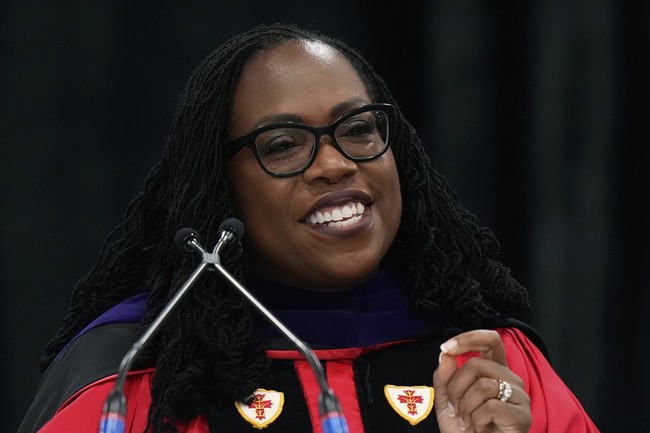
It is tempting to think that Ketanji Brown-Jackson is an idiot.
I sincerely doubt that this is the case.
A lot of people have been noticing that even her liberal colleagues are exasperated with Jackson, who speaks by far the most in oral arguments, and often seems to make absurd and self-contradictory arguments.
The latest example of this is Kagan firing a broadside at Jackson on her dissent in Chiles vs. Salazar, in which the court ruled that Colorado could not ban what it called “conversion therapy,” which was the bizarre term used to describe giving counseling to children who are confused about their gender.
Merely telling a child they are beautiful and fine the way they are, rather than being born in the wrong body, was made illegal. The court ruled 8-1 that Colorado had no business making counseling illegal.
Wow.
Justice Kagan’s concurring opinion attacks the dissent of her fellow liberal Justice Jackson. pic.twitter.com/FhSy6Pk2lz
— Greg Price (@greg_price11) March 31, 2026
Jackson’s dissent was a wonder to behold, not least because it contradicted her dissent from last year on a case having to do with transgender surgery for minors. In that case, she claimed the state had no business interfering with medical judgment; in this case, she asserts that the state has an absolute right to interfere with medical and counseling judgment.
Kagen basically laughed in her face, with good reason.
To illustrate the total absurdity of Justice Jackson, she ruled last year that states *do not* have the right to ban child sex changes, but ruled today that states *do* have the right to ban counselors from telling boys they are not girls. https://t.co/j1YBJG4ydL
— Brandon Gill (@realBrandonGill) March 31, 2026
Given how stupid this LOOKS, how could I argue that it is not stupid in fact?
Insert Critical Theory, or Critical Legal Theory in this case, which is a subset of CT, just like Queer Theory and CRT. All of them assert that words and, in particular, the law, are all about power structures. The current legal system is designed to preserve the power of the ruling elite, or white supremacy, or colonialism, or some form of oppression or another.
Words do not describe reality, and laws are not to create a working social order that is maximally fair. They are tools of oppression, and hence, everything that buttresses the current unjust power arrangement needs to be redefined.
That’s how you get absurdities like this:
A Canadian math education association put “2 + 2 = 4” on a white supremacy slide.
In 2022, the Ontario Mathematics Coordinators Association ran a professional development webinar for math teachers across Ontario school boards.
The slide was titled “White Supremacy in Math… pic.twitter.com/R4HmoOwmVE
— Jake (@JakeCan72) March 30, 2026
A Canadian math education association put “2 + 2 = 4” on a white supremacy slide.
In 2022, the Ontario Mathematics Coordinators Association ran a professional development webinar for math teachers across Ontario school boards.
The slide was titled “White Supremacy in Math Education.” Under “covert white supremacy” it listed: standardized testing, “I don’t see colour in my math class,” and “Of course math is neutral because 2 + 2 = 4.”
Not a fringe blog. Not a parody account. A professional association shaping how math teachers are trained.
When the slide went viral in 2023, the OMCA released an official statement confirming that 2 + 2 = 4 is mathematically true — but argued the equation can be “weaponized to uphold bigotry and white supremacy ideology” when used to claim math is politically neutral.
Their defense of the slide was the slide.
Someone once wrote about a party that demanded citizens believe two and two made five.
In 2022, a professional math association wrote a slide that said believing math is neutral is white supremacy.
One was fiction. The other was professional development.
When we point to basic facts and say “See?!,” the answer that Critical Theorists give is that the “facts” are an assertion of power, not an observation of reality.
I don’t want to get too deep in the philosophical weeds, but let me pull out a quote from a feminist critical theorist who believes that truth-seeking or critical thinking is all about maintaining power, not seeking to find truth, because “truth” depends upon where you are in the social order:
Philosophers of education have long made the distinction between critical thinking and critical pedagogy. Both literatures appeal to the value of being “critical” in the sense that instructors should cultivate in students a more cautious approach to accepting common beliefs at face value. Both traditions share the concern that learners generally lack the ability to spot inaccurate, misleading, incomplete, or blatantly false claims. They also share a sense that learning a particular set of critical skills has a corrective, humanizing, and liberatory effect. The traditions, however, part ways over their definition of “critical.” Nicholas C. Burbules and Rupert Berk’s comparison of the traditions provides a useful background for my discussion in the next section.
The critical-thinking tradition is concerned primarily with epistemic adequacy. To be critical is to show good judgment in recognizing when arguments are faulty, assertions lack evidence, truth claims appeal to unreliable sources, or concepts are sloppily crafted and applied. For critical thinkers, the problem is that people fail to “examine the assumptions, commitments, and logic of daily life… the basic problem is irrational, illogical, and unexamined living” (Burbules and Berk 1999, 46). In this tradition sloppy claims can be identified and fixed by learning to apply the tools of formal and informal logic correctly.
In other words, critical thinking is about developing the skills necessary to discover what is true and what is false. “Epistemic adequacy” just means using the tools necessary to discover what is true and what is not, what evidence is good, and what isn’t.
Critical pedagogy begins from a different set of assumptions rooted in the neoMarxian literature on critical theory commonly associated with the Frankfurt School.
Critical theory is all about implementing Marxism, and hence, what is true or false doesn’t matter, but rather what is useful for that goal and what is not. Power is the goal, not truth.
Here, the critical learner is someone who is empowered and motivated to seek justice and emancipation. Critical pedagogy regards the claims that students make in response to social-justice issues not as propositions to be assessed for their truth value, but as expressions of power that function to re-inscribe and perpetuate social inequalities. Its mission is to teach students ways of identifying and mapping how power shapes our understandings of the world. This is the first step toward resisting and transforming social injustices. By interrogating the politics of knowledge-production, this tradition also calls into question the uses of the accepted critical-thinking toolkit to determine epistemic adequacy.
You see? Everything, including what you and I consider ground truth, is really about power. This is why it is important to own the definitions of every word. This is why no Critical Theorist will ever go beyond “A woman is whoever thinks they are a woman.” Admitting that there is a different definition brings down the entire Queer Theory world.
There are a million examples, but getting back to KBJ not being an idiot, or at least the fact that she says patently absurd things, does not provide evidence that she is.
Critical Legal Theory is essentially the toolkit used by Marxists to shape the law to say whatever they want. You and I keep looking for words and references to say something about what is real, but reality is what critical theorists say it is, and they say it is whatever they need it to say.
We are looking for “epistemic adequacy,” or correlation with reality. Or in her case, correlation with the Constitution and established law. She sees that as an oppressive assertion of power by the dominant hierarchy to impose injustice. So she simply defines those away.
“Can you provide a definition of the word ‘woman’?”
Ketanji Brown Jackson: “No, I can’t… not a biologist”pic.twitter.com/d91QvyHWsv
— Defiant L’s (@DefiantLs) December 10, 2025
The reason why KBJ couldn’t provide a definition of a woman is not that she has none; it is because the definition literally does not exist until she conjures it in whatever context she needs to. As with her assertion about state power and treating trans kids, it all depends on the context. What she believes about state power depends entirely on whether it gets her the outcome she wants.
This is why arguing with people informed by Critical Theory is impossible. They are in a different world, referring to different things. You think you are both speaking the same language, but that is an illusion. An illusion they find useful if they can convince you through sophistry, but an illusion nonetheless.
Now, it is still possible that KBJ is simply a DEI hire without much of a brain in her head, but the fact that she makes no sense to us is not evidence of that. When I was in graduate school ran into perfectly nice and relatively smart people who would argue that physics isn’t real; it is a social construct. Gravity exists solely because we believe it does.
Academia is now filled with people who think this way, which explains why academics seem so loony. They are, in many ways, insane in the way we think of sanity, because they begin with a view of the world where “real” does not exist. It is socially constructed. Believing in “ground truth”—things that exist outside our minds—is a trap.
KBJ reasons back from her goals, because that is exactly how Critical Theory teachers her how to reason.
Editor’s note: If we thought our job in pushing back against the Academia/media/Democrat censorship complex was over with the election, think again. This is going to be a long fight. If you want to join the conversation in the comments — and support independent platforms — why not join our VIP Membership program? Choose VIP to support Hot Air and access our premium content, VIP Gold to extend your access to all Townhall Media platforms and participate in this show, or VIP Platinum to get access to even more content and discounts on merchandise. Use the promo code FIGHT to join or to upgrade your existing membership level today, and get 60% off!