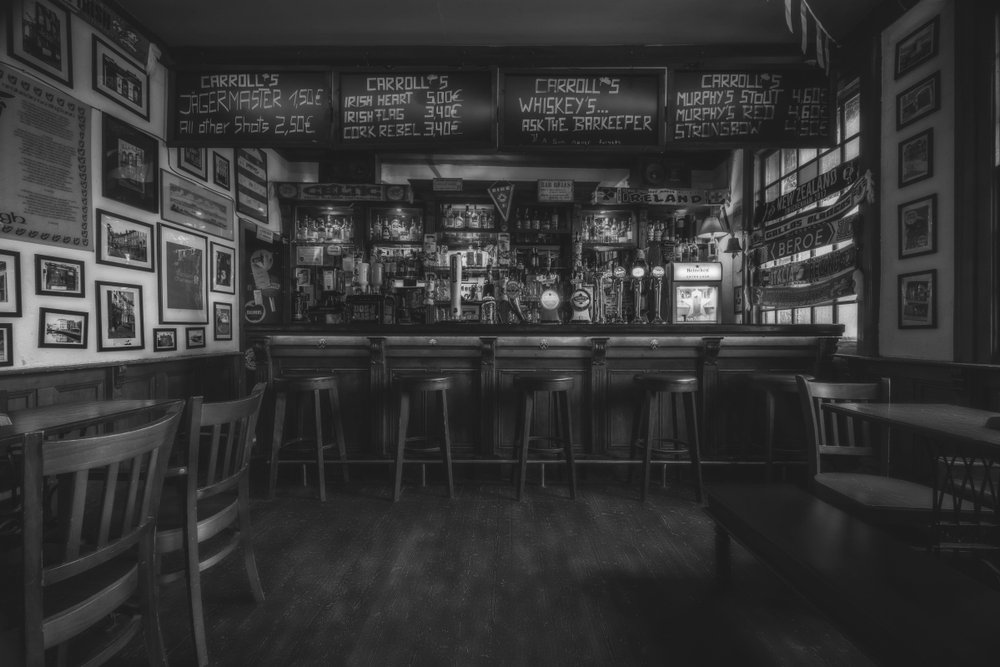
THE fate of the German Kneipe – traditional pub – is in jeopardy because of the Islamification of a sizeable number of the country’s towns and smaller cities.
Recent trends are a warning to the UK, both in terms of immigration and the historical culture, in which pubs play a significant and increasingly, it seems, under-appreciated part.
‘The biggest business rates rise in a generation’ under Rachel Reeves caused justifiable fears that British pubs were in danger of closing en masse.
In response to the outcry, the Chancellor has offered pubs a £300million bail-out package.
But as Melanie McDonagh has argued in the Daily Telegraph, such changes will not ‘offset the raft of bad stuff that the Government has inflicted on [pubs] – from the National Insurance rise to increased energy bills and higher minimum-wage payments, and rounding off with stricter rules for what you can drink if you drive’.
Can you imagine Britain without pubs?
In 1912, the French-English writer and MP Hilaire Belloc tried to do so, and he wrote: ‘Change your hearts or you will lose your inns and you will deserve to have lost them. But when you have lost your inns drown your empty selves, for you will have lost the last of England.’
If you want to see what life is like without pubs, visit Germany.
Recently I went to the city of Hanau, famous for the Brothers Grimm whom the world has to thank for Little Red Riding Hood, Rapunzel, Hänsel and Gretel, Cinderella, Snow White and Sleeping Beauty.
In the city’s central square stands an impressive bronze statue of the 17th century folklorists. Dominating the streets from the square are endless kebab shops, fast-food takeaways, restaurants and grocery stores, most of them ‘halal’.
As a veteran of Iraq and Afghanistan, I couldn’t help but be struck by this – especially by the Afghan Starway restaurant and the Kabul Central supermarket, and the As-Salaam-Alaikum greetings everywhere.
In Worms – one of northern Europe’s oldest cities, famous for its 1521 edict that declared Martin Luther a heretic – the situation is even more stark, especially if you apply the ‘bar test’.
If you think the UK’s pub scene is struggling, go to Worms. I canvassed the city centre, criss-crossing streets and alleys looking for a German bar. I found shisha bars, betting shops, bland cocktail lounges reminiscent of a bad night in Dubai, endless Turkish-style barbers. But no straightforward Kneipe.
Finally, I found one tucked away near the railway station, close to a doorway where a dazed-looking blonde woman in a sleeping bag was smoking a cigarette. The bar itself seemed indicative of the general problem. The bartender told me there was no beer on tap and just one brand of bottled beer, from a brewery about to go bust.
‘The city is dying,’ he added, explaining that the shisha bars I’d passed were once regular pubs in a bustling nightlife during the 1990s. Now, he said, Turkish and Muslim culture was becoming dominant. This was no ‘right-winger’ speaking, mind you – he said he couldn’t bear the Alternative für Deutschland (AfD) party (presently polling at 25 per cent) and would probably leave the country if it came to power. At the same time, he couldn’t deny what was happening in front of his eyes.
In The Strange Death of Europe: Immigration, Identity, Islam, Douglas Murray notes that after Angela Merkel allowed a huge influx of Syrian refugees into Germany in 2015, ‘continuing mass immigration, high birth rates among immigrants and low birth rates among native Europeans all ensured that the changes under way would only accelerate in the years ahead’. The German Chancellor, he said, ‘helped to alter a continent and change an entire society, with consequences that would play out for generations to come’.
Sweden is another example cited by Murray, a country once viewed as a ‘liberal, benevolent humanitarian superpower’ which has been reshaped by immigration.
‘In Malmö – Sweden’s third-largest city – non-ethnic Swedes already constitute almost half of the population,’ Murray writes, adding that according to some estimates, ‘within a generation other cities will follow and ethnic Swedes will be in a minority in all the major cities: partly as a result of immigration, partly as a result of higher birth rates among migrants, and partly as a result of ethnic Swedes abandoning areas where immigrants dominate.’
What can be done as European cities once emblematic of ‘German-ness’ or ‘Swedish-ness’, morph before one’s eyes?
During a train journey through Germany, I chatted about this with a young man sitting across the aisle with his Ukrainian girlfriend.
I suggested to him that while he was right in principle not to discriminate against those wearing hijabs and niqab face-coverings, there was a flip-side to such magnanimous toleration, and that he might feel differently if a time came when 60 per cent or more women in Germany dress in that way, and a similar proportion of men in Germany look and dress in a markedly different way from him.
We all want to be nice and kind, but if a society persists in yielding to all that the open-border and multicultural ideologies demand, is it too far-fetched to imagine that the German Kneipe will effectively disappear altogether because the country has become an entirely new place with a new people?
Perhaps Douglas Murray is right when he doubts the presumption that ‘in time everybody who arrives will become like Europeans’, given the self-doubt and self-distrust within native populations, and suggesting that instead it is ‘plausible that many of those who come will enjoy the lifestyle, will take part in the aspirations and the fruits of the economic uplift so long as it continues, and yet despise or disdain the culture into which they have come’.
In Worms – having managed to find one other decent pub – I ended up in a surreal argument with a man who insisted that Germany was in a worse state than the UK, while I countered that the UK had it just as bad.
‘Nein, nein,’ he insisted. ‘At least you went for Brexit – at least you have the balls to do something, unlike here in Germany!’
In the end, partly out of politeness, I ceded and let him have it that Germany was worse off than the UK. But I am not convinced.
The UK was recently described as an ‘un-developing’ country in an article by Charles Moore for the Spectator. It’s hard to argue with that when you see the state of the country: its infrastructure, its institutions, the tepid economy and lack of dynamism, even its moral landscape, with assisted suicide and abortion up to birth apparently priorities for our politicians.
Like the Germans, Brits need to face up to the hard truths pressing ever more on the national jugular. The plight of the German Kneipe offers a stark warning about the risks of mass migration even before this Government’s economic policies are added to the mix.
It’s something to think about the next time you enjoy an over-taxed pint – if the pub is still there.