During this season of Lent it is helpful to reflect on how mimetic desire—defined as “imitation envy”—connects with and influences the classic seven deadly sins.
 The French thinker Rene Girard had a seminal insight which has shed light on just about every aspect of human endeavor from theology and anthropology to economics, politics, psychology, and business development. It’s called mimetic desire—which might be translated as “imitation envy.”
Basically, mimetic desire is the fact that we learn by watching and imitating others, and as such, we desire to be like the other. While there is nothing wrong with this natural learning instinct, given human nature, before long the imitation and desire leads to rivalry and competition.
Thus Johnny watches Jimmy playing with toy trucks and Johnny is soon pretending to play with toy trucks too. But the problem is he doesn’t have any toy trucks, or he doesn’t have nice shiny new ones like Jimmy, so he not only imitates Jimmy, he covets Jimmy’s toy trucks. This, of course, may lead him to steal Jimmy’s toy trucks when Jimmy’s out of the room, or if he can’t wait and is not sly and is actually bigger than Jimmy, he goes over, knocks Jimmy on the head, and takes his trucks.
This scenario is perfectly portrayed in the prologue of the The Return of the King—Peter Jackson’s third installment of the Lord of the Rings trilogy in which we see Smeagol steal the ring from his cousin Deagol, after he murders him.
During this season of Lent it is helpful to reflect on how mimetic desire connects with and influences the classic seven deadly sins.
To begin, Lust is the distortion of our natural (and therefore good) sexual desire. It is good for a man to desire a woman and vice versa. It moves from good to better and best when that desire is directed toward a lifelong marriage and the procreation of children. This natural desire is twisted into lust however, by mimetic desire.
How so? We should ask what we desire when lust is going on. Perhaps we simply desire the physical pleasure–the spasm of genital contentment, but lust is more complicated than the mere desire for orgasm. It involves another person and therefore a mimetic relationship. Thus, a woman may lust after a man not because of pure animal desire, but because she wants to be married like all her friends are or because she wants the perfect suburban family like the media has told her she should have. A man may desire the beautiful young woman not for herself or even for sexual pleasure, but because he will impress all the other guys with her on his arm. The adulterer not only wants sexual delight with the married woman, he wants to take her from her husband who he wishes to imitate– So natural sexual desire is twisted into lust by mimetic desire.
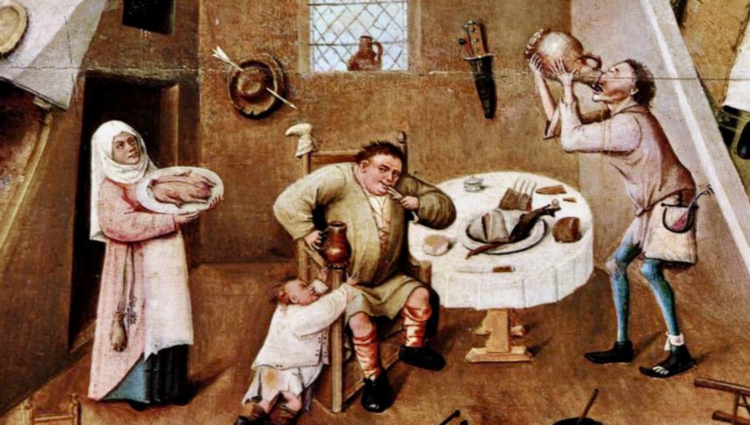
Food and drink are also natural desires and are good, but mimetic desire twists that desire into the deadly sin of gluttony. How so? Why does a person eat and drink too much or too little? Maybe simply for the animalistic pleasure of the taste of the food. If so, that’s really pretty basic and forgivable. But, as with lust, there is often more going on. Why is the glutton over-indulging? Is the glutton dining at a super-expensive restaurant to impress the people he is imitating and who he desires to be like? Is he drinking too much to be “one of the guys,” and so being driven by mimetic desire? Is that woman starving herself to fit the ideal she has been given by the people she is trying to impress? Maybe it’s more basic. The person eats and drinks too much (or takes drugs) in order to achieve a level of comfort and ease which he associates with those he wants to be like, or to achieve a level of “happiness” that society has told him he must pursue. Alternatively, the glutton is seeking a quick, sweet comfort to compensate for his failure to achieve satisfactory imitative success.
We also have a natural desire for money and material possessions. Greed is that desire twisted by mimetic desire. We want the fancy car and the beach house not for the simple pleasure of a well-engineered motor vehicle or a relaxing retreat at the shore. Instead we want it to keep up with the Joneses, to impress others by imitating the trappings of “success”. Greed is the most obvious deadly sin conditioned by mimetic desire.
Wrath is driven by mimetic desire because Johnny gets angry when Jimmy has nice shiny trucks he won’t share. That anger and rivalry leads to revenge. Wrath is Cain killing his brother Abel in the first action of fraternal violence sparked by mimetic desire.
Envy is not just mimetic desire. It is the final step of the progress of mimetic desire: the desire not only to have what the other has, but to be the other—to replace them. I don’t simply want my neighbor’s fine house, cool car, and glamorous wife. Mimetic desire, fully blown, is that I want to be my neighbor, and of course the only way to take his place completely is to rub him out.
Sloth is more tricky to view through this lens… until we understand what sloth really is. Of course, like the other sins, it has a basic, animalistic dimension. We are slothful because we like laying around and dislike work. However, the natural and good desire for relaxation and leisure is twisted into sloth because we see the leisured classes–the people who are so well off that they don’t need to work and we slip into sloth trying to imitate them. There is more to sloth than simple sluggardliness. At the heart of the sin of sloth is despair—the person who cannot be bothered: indifference, not caring, giving up. This is a kind of negative backlash to the failure of mimetic desire. The failed imitator says, “You can keep it! I’m quitting. I don’t care what you think!” Thus the loser wins the game.
Pride is the mimetic desire in which we wish to be like the ultimate rival—God. Even in Eden the wily one said to Eve, “He told you not to eat of the tree of the knowledge of good and evil because he knows then you will be like Him.” Pride is the ultimate and foundational outworking of mimetic desire: the desire to be like God, and ultimately to replace God.
While mimetic desire as a human motivation is not evil in itself, when it plays out in relationships it becomes a force for deception, distortion, and destruction of properly ordered loves. Lent is a time for that self reflection that brings us to the cure, which is the cross.
__________
Fr Longenecker’s latest book Bloodshed and Blessing will be published later this year.
The Imaginative Conservative applies the principle of appreciation to the discussion of culture and politics—we approach dialogue with magnanimity rather than with mere civility. Will you help us remain a refreshing oasis in the increasingly contentious arena of modern discourse? Please consider donating now.
The featured image is “The Seven Deadly Sins and the Four Last Things” (detail, between 1505 and 1510), by Hieronymus Bosch, and is in the public domain, courtesy of Wikimedia Commons.