My own continued admiration of Gerald Finzi’s majestic and moving anthem, “Lo, The Full Final Sacrifice,” lies not only in the masterful blend of music and words, but also in the confluence of so many personal memories that touch and move me.
 Sometimes a piece of music or art brings different aspects of one’s life together in a sudden synthesis of life events, important memories, and emotion to imprint forever in one’s mind and evoke waves of nostalgia on hearing or seeing again.
I first came across Gerald Finzi’s majestic and moving anthem, Lo, The Full Final Sacrifice, when I served as chaplain to Kings’ College, Cambridge. The choir, conducted then by Stephen Cleobury, performed it perfectly, and Finzi’s setting of words by the seventeenth century poet Richard Crashaw—which were themselves re-settings of the Eucharistic hymns of Aquinas—burned a cross in my heart.
If you are not familiar with this haunting masterpiece of modern English choral music, it is available at YouTube and at Spotify and makes a mystical and somber reflection for Holy Week. Written in 1947, it is, admittedly sonorous in some of its beautiful dissonance and may require some close listening. To aid the understanding and appreciation, following the lyrics (found here) is essential.
Finzi gathered the lyrics from the poetry of a Cambridge man Richard Crashaw. Born in London around 1613 to a prominent anti-Catholic Puritan preacher, Richard was educated at Charterhouse School and Pembroke College, Cambridge. Elected a Fellow of Peterhouse in 1635 during the reign of Charles I, he embraced the High Church Laudian movement, serving as a curate at “Little St Mary’s,” the church across the road from Peterhouse—which is still an Anglo-Catholic stronghold. While he was there, he rocked the boat by adorning Little St. Mary’s with images and candles that scandalized the Puritans.
The Civil War erupted, and in 1643 Parliamentary forces ejected Crashaw from Cambridge. He took refuge first at Little Gidding—the religious community just North of Cambridge founded by George Herbert’s friend Nicholas Ferrar (later made famous by T.S. Eliot’s poem The Four Quartets.) Crashaw then fled to France and Italy, converting to Roman Catholicism around 1646 amid exile and poverty. Friends secured him a minor canonry at the Santa Casa shrine in Loreto, where he died of fever on 21 August 1649, aged just thirty-six.
Crashaw did not invent the lyrics that Finzi set to music. He augmented and edited devotional poems by Thomas Aquinas: Lauda Sion Salvatorem and Adoro Te Devote. Both celebrate the death on Calvary, and its memorial as the “full, final sacrifice”. Crashaw’s versions, published in Steps to the Temple and Carmen Deo Nostro, are not literal translations but paraphrases infused with metaphysical wit and baroque imagery. Finzi, excerpted, reordered, and fused stanzas from Crashaw’s poems to create a single poem for his musical setting. The result is a dramatic progression from Old Testament shadows to the cross and finally the unveiled Face of God.
The lyrics open with solemn grandeur:
Lo, the full, final Sacrifice
On which all figures fix’t their eyes.
The ransomed Isaac, and his ram;
The Manna, and the Paschal Lamb.
The Old Testament typology opens: Isaac’s near-sacrifice and the ram, manna in the wilderness, and the Passover lamb all “fix their eyes” on Calvary and the altar. These foreshadowings are fulfilled in the Eucharist—the “full, final” offering that renders all prior rites obsolete yet eternally present. Then an address to the Savior:
Jesu Master, just and true!
Our Food, and faithful Shepherd too!
O let that love which thus makes thee
Mix with our low Mortality,
Lift our lean Souls, and set us up
Convictors of thine own full cup,
Coheirs of Saints.
Crashaw’s own suffering opens into Christ’s passion, mixing divine love with human frailty, elevating souls to co-inheritance at the heavenly banquet.
The text then turns to the Eucharist as living memorial:
O dear Memorial of that Death
Which lives still, and allows us breath!
Rich, Royal food! Bountiful Bread!
Whose use denies us to the dead!
Personal petition follows:
Live ever Bread of loves, and be
My life, my soul, my surer self to me.
Then a call to praise:
Rise, Royal Sion! rise and sing
Thy soul’s kind shepherd, thy heart’s King…
Lo the Bread of Life, this day’s
Triumphant Text provokes thy praise.
Which points to the Last Supper:
The living and life-giving bread
To the great twelve distributed
When Life, himself, at point to die
Of love, was his own Legacy.
The emotional climax arrives with the “O Soft self-wounding pelican,” an image from the medieval bestiaries—the mother pelican was thought to feed her young with her own blood and was thus an image of Christ.
At this point a tenor voice plaintively breaks through,
O soft self-wounding Pelican!
Whose breast weeps Balm for wounded man…
That blood, whose least drops sovereign be
To wash my worlds of sins from me.
Then the voices rise in a personal and eschatological yearning:
Come love! Come Lord! and that long day
For which I languish, come away…
And for thy veil give me thy Face.
Amen.
The final lines echo Adoro Te’s longing to see beyond the sacramental veil into the unveiled glory of God. Finzi’s sublime “Amen” provides a celestial musical seal.
My own continued admiration of this piece lies not only in the masterful blend of music and words, but also in the confluence of so many personal memories that touch and move me: Crashaw’s Protestant, then Anglican, then Catholic journey, his Cambridge background (I used to worship and say Mass at Little St Mary’s), my own conversion, ordination, and life at the altar, my time as a chaplain at Kings’—and more: Little Gidding, George Herbert, T.S. Eliot, Aquinas and Crashaw—are all melded into a piece of music that will be ever-evocative, moving, and part of every Holy Week and Good Friday.`
__________
The Imaginative Conservative applies the principle of appreciation to the discussion of culture and politics—we approach dialogue with magnanimity rather than with mere civility. Will you help us remain a refreshing oasis in the increasingly contentious arena of modern discourse? Please consider donating now.
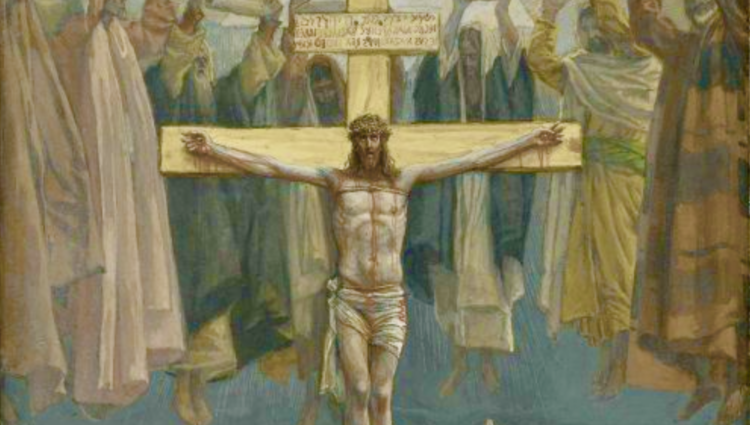
The featured image is “It Is Finished” (between 1886 and 1894), by James Tissot, and is in the public domain, courtesy of Wikimedia Commons.